
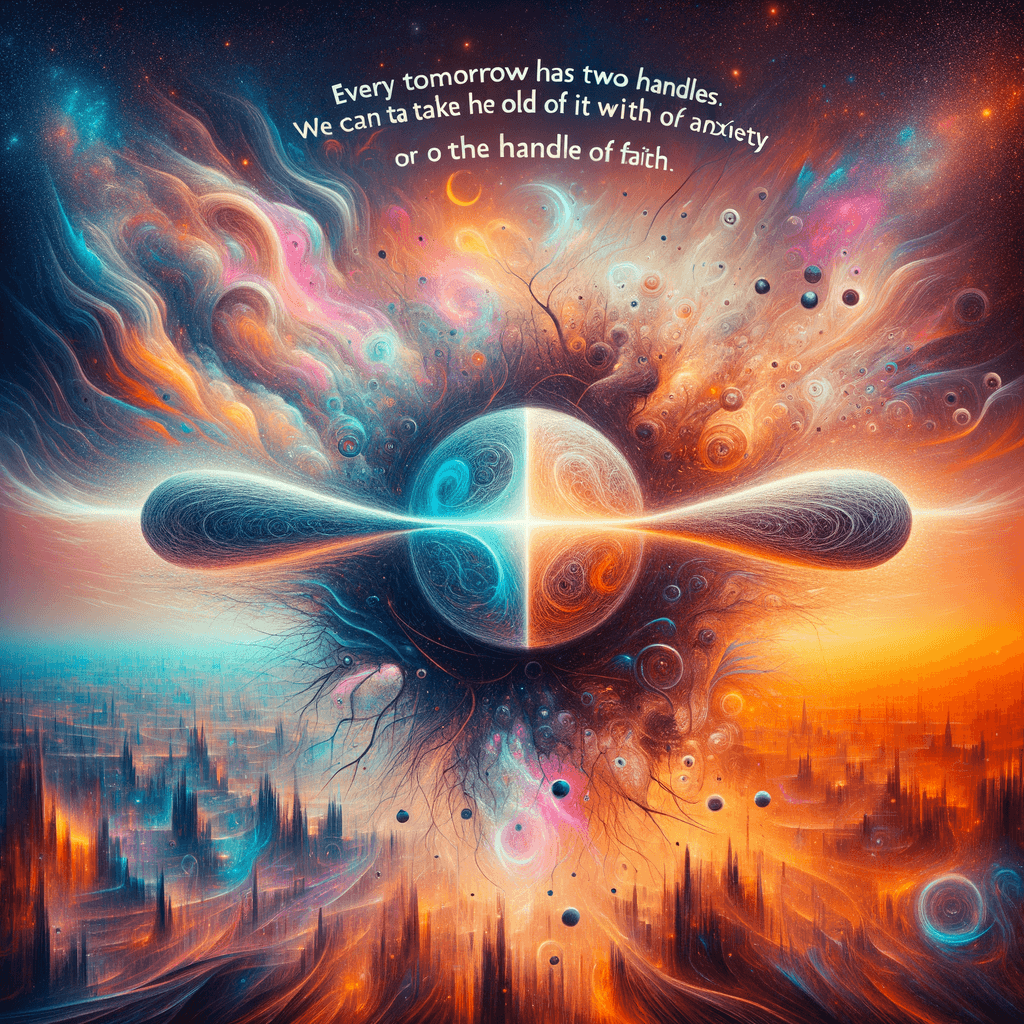
Every tomorrow has two handles. We can take hold of it with the handle of anxiety or the handle of faith. — Henry Ward Beecher, United States.
—What lingers after this line?
Choices in Life
This quote highlights the idea that each day brings choices. We can approach the future with either anxiety or faith, suggesting that our mindset determines our experience of tomorrow.
Handle of Anxiety
Choosing the handle of anxiety implies a focus on fear and uncertainty. It reflects how worries about the future can affect our present state of mind and actions.
Handle of Faith
The handle of faith represents hope and trust in the future. It emphasizes the importance of believing in positive outcomes and the belief that good things are possible.
Empowerment Through Perspective
Beecher's quote encourages empowerment through perspective. By consciously choosing faith over anxiety, individuals can shape their lives in a more positive direction.
Historical Context
Henry Ward Beecher was a prominent 19th-century American preacher, social reformer, and speaker known for his views on religion, morality, and human rights. His insights continue to resonate in discussions about faith and mental well-being.
One-minute reflection
Where does this idea show up in your life right now?
Related Quotes
6 selectedAnxiety is just the imagination working overtime, and most of that overtime is completely unpaid. — Alain de Botton
Alain de Botton
At first glance, Alain de Botton’s remark frames anxiety with disarming humor: the mind behaves like an overworked employee, generating scenarios, rehearsing disasters, and collecting no reward for the effort. By calling...
Read full interpretation →Don't believe every worried thought you have. Worried thoughts are notoriously inaccurate. — Renee Jain
Renee Jain
At its core, Renee Jain’s quote confronts a habit many people barely notice: treating every anxious thought as if it were reliable evidence. Worry often arrives with urgency, and because it feels protective, it can masqu...
Read full interpretation →Your anxiety is not a failure; it is a signal. Stop trying to silence it and start listening to what it is trying to teach you about your boundaries. — Bessel van der Kolk
Bessel van der Kolk
At first glance, anxiety often feels like evidence that something is wrong within us. Yet Bessel van der Kolk reverses that assumption, suggesting that anxiety is not simply a defect to erase but a message to interpret.
Read full interpretation →Anxiety is not you. It's something moving through you. It can leave out of the same door it came in. — James Clear
James Clear
At its core, James Clear’s line draws a crucial boundary between the self and a temporary emotional state. By saying anxiety is “not you,” he interrupts the common habit of turning a passing feeling into a fixed identity...
Read full interpretation →Anxiety is a storm, but you are the sky. You cannot control the weather of your thoughts, but you can learn to expand your awareness until the clouds no longer define your horizon. — Jon Kabat-Zinn
Zinn
At its heart, Jon Kabat-Zinn’s statement separates temporary mental events from the deeper field of awareness that holds them. Anxiety appears as a storm—loud, shifting, and sometimes frightening—while the self is compar...
Read full interpretation →I have a new philosophy. I'm only going to dread one day at a time. — Charles M. Schulz
Charles M. Schulz
At first glance, Charles M. Schulz’s line sounds like a joke, and that is precisely its power.
Read full interpretation →More From Author
More from Henry Ward Beecher, United States. →