
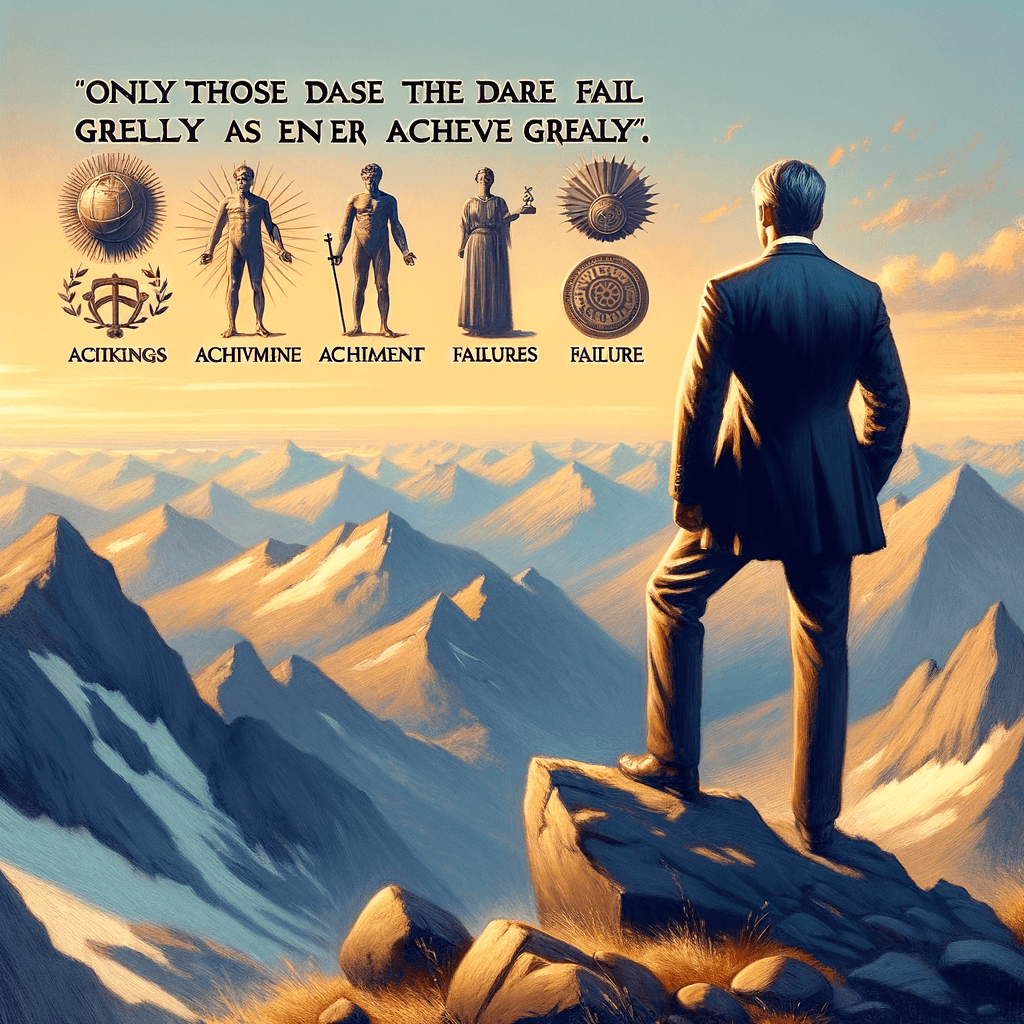
Only those who dare to fail greatly can ever achieve greatly. — Robert F. Kennedy, United States.
—What lingers after this line?
Courage in Pursuit of Dreams
This quote emphasizes the importance of courage and willingness to take risks in the journey towards success. It suggests that stepping out of one's comfort zone is essential for achieving significant accomplishments.
Redefining Failure
It challenges the traditional perception of failure, proposing that failing is not a setback but a stepping stone towards greater success. Embracing failure as a part of the process can lead to more profound achievements.
Growth Through Challenges
The message underscores that personal and professional growth often comes from overcoming challenges and failures. Each setback provides valuable lessons that contribute to eventual success.
Ambition and Aspiration
Kennedy's quote reflects an ambitious spirit, suggesting that those who aspire for greatness must be willing to confront the possibility of failure. This mindset is crucial for innovators and pioneers who seek to make a significant impact.
Historical Context
Robert F. Kennedy, a prominent political figure in the United States during the 20th century, advocated for social justice and equality. This context adds weight to his message about the importance of daring to take risks in the pursuit of a better future.
One-minute reflection
Where does this idea show up in your life right now?
Related Quotes
6 selectedTo be courageous is to act with the heart. — Molière
Molière
Molière’s line suggests that courage is not merely the absence of fear, but the decision to move despite it. By connecting courage with the heart, he frames bravery as an emotional and moral act rather than a simple disp...
Read full interpretation →The best people possess a feeling for beauty, the courage to take risks, the discipline to tell the truth, the capacity for sacrifice. — Ernest Hemingway
Ernest Hemingway
Hemingway’s line presents goodness not as politeness or success, but as a demanding inner code. The “best people” are those who combine sensitivity, bravery, honesty, and self-denial—qualities that do not always coexist...
Read full interpretation →You can be cautious or you can be creative, but there's no such thing as a cautious creative. — George Lois
George Lois
George Lois draws a sharp line between two mindsets: caution protects what already exists, while creativity risks making something new. At first glance, the statement sounds absolute, yet that severity is exactly its poi...
Read full interpretation →If you are not willing to look stupid, nothing great is ever going to happen to you. — Julia Cameron
Julia Cameron
Julia Cameron’s remark begins with a hard truth: many people do not fail because they lack talent, but because they fear embarrassment. In that sense, ‘looking stupid’ becomes shorthand for being seen trying, stumbling,...
Read full interpretation →You don't have to bully yourself out of feeling fear. You just have to move while it's still there. — Annie Wright
Annie Wright
At its core, Annie Wright’s quote challenges the common belief that courage begins only after fear has disappeared. Instead, it reframes fear as something that can accompany action rather than prevent it.
Read full interpretation →For what matters in life is not whether we receive a round of applause; what matters is whether we have the courage to venture forth despite the uncertainty of acclaim. — Amor Towles
Amor Towles
At its core, Amor Towles shifts attention away from public approval and toward private resolve. The quote argues that a life’s value is not determined by applause—those visible signs of recognition—but by the willingness...
Read full interpretation →More From Author
More from Robert F. Kennedy, United States. →