
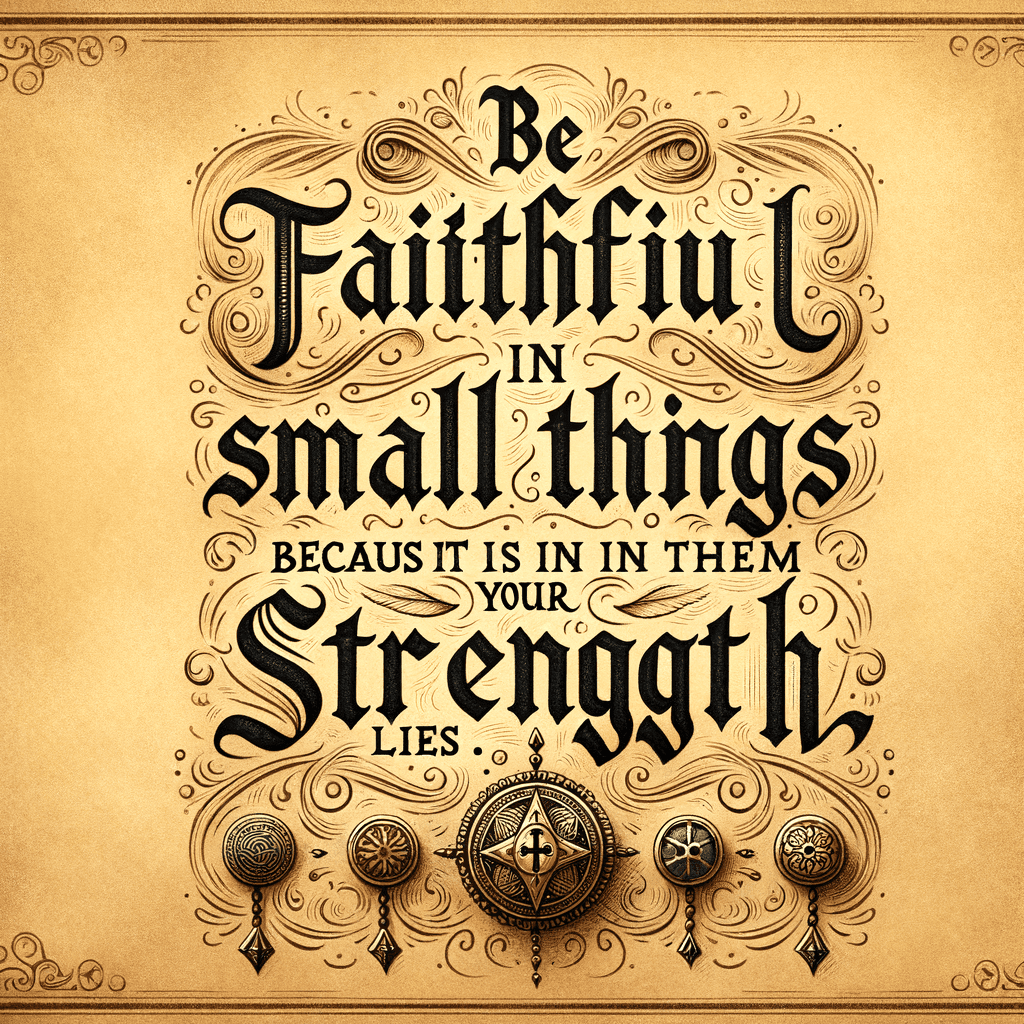
Be faithful in small things because it is in them that your strength lies. — Mother Teresa, India.
—What lingers after this line?
Importance of Small Actions
This quote highlights the significance of small actions and responsibilities. It suggests that even minor tasks or gestures contribute significantly to one's overall character and strength.
Building Strength Through Consistency
Being faithful in small things reflects consistency and discipline. Such habits cultivate inner strength, which is foundational for facing larger challenges.
Value of Diligence
The quote encourages diligence and attention to detail. It implies that true strength and resilience are developed through a commitment to doing even the simplest tasks well.
Faithfulness as a Virtue
Faithfulness in small matters can be seen as a virtue that extends to larger responsibilities. It sets the groundwork for reliability and trustworthiness in all areas of life.
Mother Teresa's Legacy
Mother Teresa, known for her humanitarian work and dedication to serving the poor, often emphasized the value of small acts of kindness. Her philosophy reflects her belief that love and strength arise from humble beginnings.
One-minute reflection
Where does this idea show up in your life right now?
Related Quotes
6 selectedQuiet people are not empty; they are contained. Their power does not seek attention—it waits. — Seneca
Seneca
At first glance, Seneca’s line overturns a common social assumption: that quietness signals absence, weakness, or lack of thought. Instead, he frames silence as containment, suggesting that some people hold their ideas,...
Read full interpretation →A magician is strong because he hurts more than others. He has learned to break the world that has tried to break him. — Haruki Murakami
Haruki Murakami
Murakami’s line begins with a striking reversal: the magician is not powerful because he is untouched, but because he has suffered more deeply than others. In this view, strength does not emerge from comfort; rather, it...
Read full interpretation →True confidence, like deep rivers, flows calmly and silently without the need for continual recognition. — Unknown (Wait: Skipping) -> My limits are not a debate. — Unknown (Wait: Skipping) -> Never bend your head. Always hold it high. Look the world straight in the eye. — Helen Keller
Helen Keller
Helen Keller’s line begins with a physical image, yet it quickly opens into a moral one: to hold one’s head high is to move through the world with unshaken self-respect. In that sense, true confidence does not beg for ap...
Read full interpretation →What you don't react to reveals your strength. — Thibaut
Thibaut
At first glance, Thibaut’s line shifts our attention away from dramatic action and toward restraint. Strength, in this view, is not proven only by what we confront loudly, but by what we decline to let disturb us.
Read full interpretation →True cultivation is a slow, private process that eventually blooms into a public strength. — Anne Lamott
Anne Lamott
At first glance, Anne Lamott’s line emphasizes a truth people often resist: meaningful self-development rarely looks dramatic while it is happening. True cultivation unfolds quietly, in habits, reflection, restraint, and...
Read full interpretation →A truly strong person does not need to dominate. They possess a quiet confidence that is recognized, not announced. — Joyce Rachelle
Joyce Rachelle
At its core, Joyce Rachelle’s quote redefines strength by separating it from force. Many people associate power with control, volume, or the ability to make others submit.
Read full interpretation →More From Author
More from Mother Teresa, India. →