
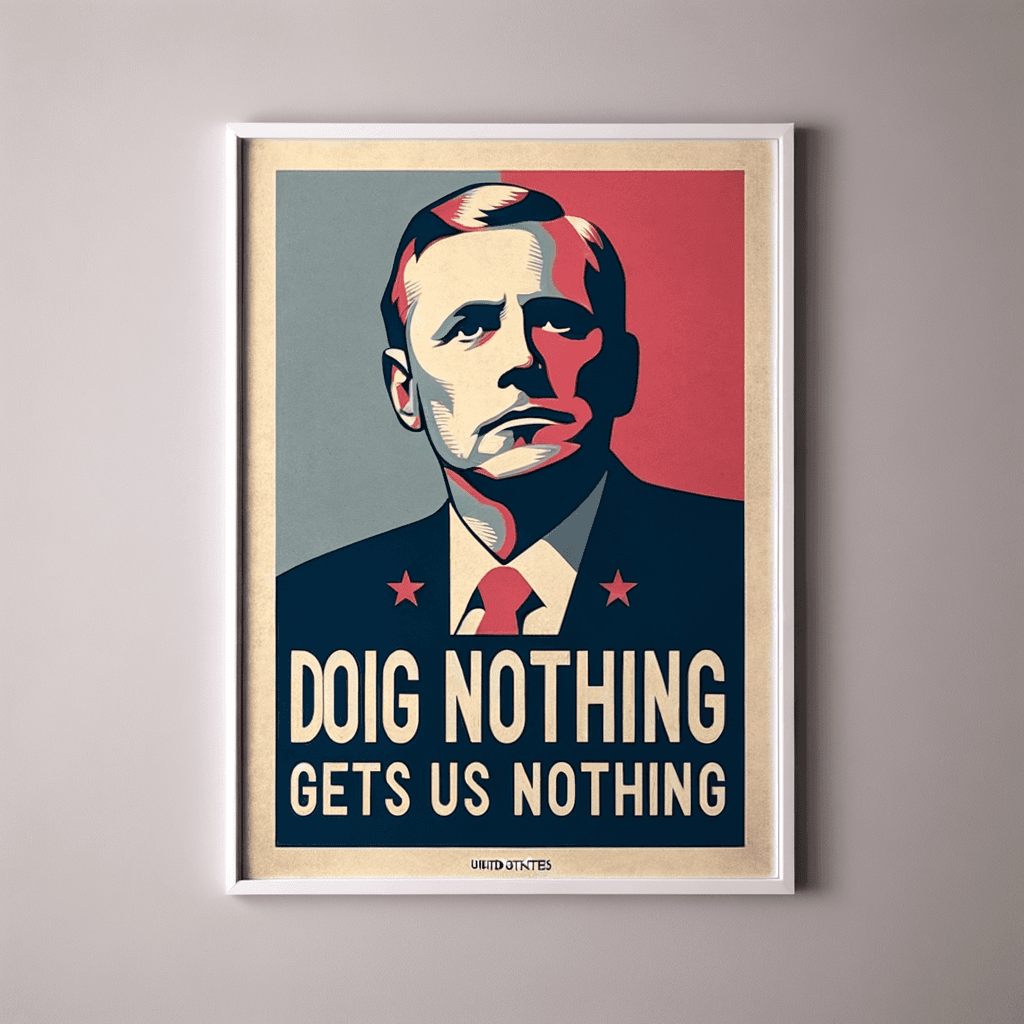
Doing nothing gets us nothing. — John F. Kennedy, United States.
—What lingers after this line?
Importance of Action
This quote emphasizes the necessity of taking action to achieve goals. Without effort and initiative, one cannot expect to see progress or success.
Impact of Inaction
Kennedy highlights the consequences of inaction. Merely waiting or being passive leads to stagnation and missed opportunities.
Motivation for Change
The statement serves as a motivational reminder that to bring about change or improvement in one’s life or society, one must actively participate and contribute.
Call to Responsibility
Kennedy’s words can be interpreted as a call to take personal and collective responsibility. It encourages individuals to engage, strive, and take ownership of their actions.
Historical Context
John F. Kennedy, as the 35th President of the United States, delivered this message during a time of considerable social change and political challenges, advocating for active engagement in civic life.
One-minute reflection
Where does this idea show up in your life right now?
Related Quotes
6 selectedNo matter how full a reservoir of maxims one may possess, if one has not taken advantage of every concrete opportunity to act, one's character may remain entirely unaffected. — William James
William James
At first glance, William James draws a sharp line between knowing and becoming. A person may store up countless moral sayings, noble principles, and wise resolutions, yet these remain largely ornamental if they never pas...
Read full interpretation →A garden is not made by singing 'Oh, how beautiful,' and sitting in the shade. — Rudyard Kipling
Rudyard Kipling
Kipling’s line immediately cuts through passive appreciation. Simply admiring a garden, however sincerely, does nothing to plant seeds, pull weeds, or carry water.
Read full interpretation →Ask not what your country can do for you – ask what you can do for your country. — John F. Kennedy, United States.
John F. Kennedy, United States.
This quote emphasizes the idea of civic duty and the responsibility of individuals towards their community and nation. It encourages citizens to take an active role in contributing to the welfare of their country.
Read full interpretation →You cannot afford to live in potential for the rest of your life; at some point, you have to unleash it. — Eric Thomas
Eric Thomas
Eric Thomas’s quote begins with a stark warning: potential is not a place to live, only a promise of what might be. In other words, talent, intelligence, or ambition mean very little if they remain dormant.
Read full interpretation →The way to do is to be. — B.K.S. Iyengar
B.K.S. Iyengar
At first glance, B.K.S. Iyengar’s line seems to invert common advice.
Read full interpretation →Those who make peaceful revolution impossible will make violent revolution inevitable. — John F. Kennedy, United States.
John F. Kennedy, United States.
This quote highlights the idea that when a government or authority suppresses peaceful efforts for change, it leaves people with no choice but to resort to violence as a means of revolt.
Read full interpretation →More From Author
More from John F. Kennedy, United States. →Ask not what your country can do for you – ask what you can do for your country. — John F. Kennedy, United States.
This quote emphasizes the idea of civic duty and the responsibility of individuals towards their community and nation. It encourages citizens to take an active role in contributing to the welfare of their country.
Read full interpretation →Those who make peaceful revolution impossible will make violent revolution inevitable. — John F. Kennedy, United States.
This quote highlights the idea that when a government or authority suppresses peaceful efforts for change, it leaves people with no choice but to resort to violence as a means of revolt.
Read full interpretation →Every advance in human freedom has been accompanied by the greater realization of the value of human life. — John F. Kennedy, United States.
This quote suggests a direct correlation between the progress of human rights and the increasing appreciation for human life. As societies strive for greater freedom, they also tend to recognize and cherish the intrinsic...
Read full interpretation →