
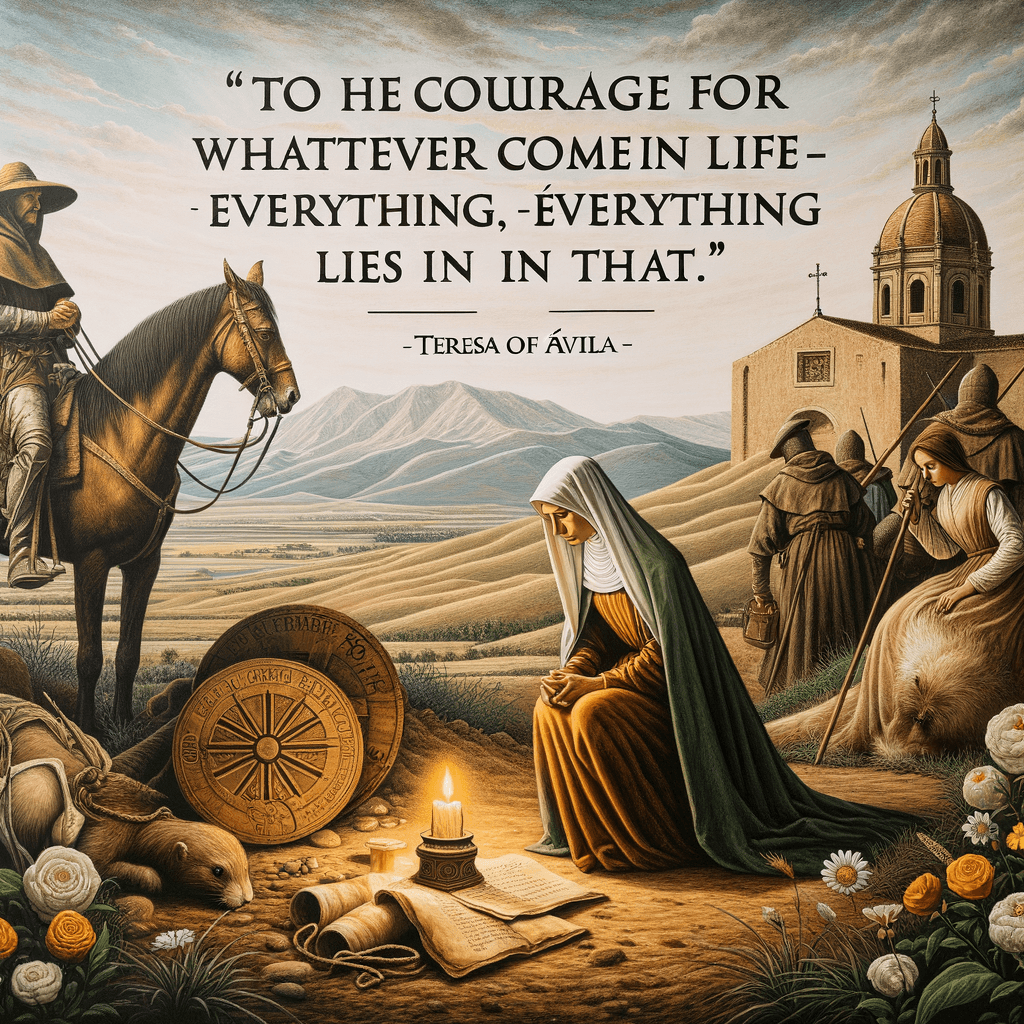
To have courage for whatever comes in life - everything lies in that. — Teresa of Ávila, Spain.
—What lingers after this line?
Defining Courage
This quote highlights the essence of courage as a foundational quality necessary to face the uncertainties and challenges of life. It suggests that true strength lies in the ability to confront whatever comes our way.
Resilience in Adversity
Courage is portrayed as essential for resilience. By having the courage to face difficulties, individuals can navigate obstacles and emerge stronger from their experiences.
Acceptance of Life's Unpredictability
The quote acknowledges that life is unpredictable and often presents unforeseen challenges. Embracing courage allows one to accept this unpredictability and face it with a positive mindset.
Spiritual Perspective
Teresa of Ávila was a notable mystic and reformer in the Catholic Church. Her spiritual teachings often centered on inner strength and reliance on faith, and this quote reflects her belief in the importance of courage as a divine gift.
Empowerment Through Courage
This quote serves as a reminder that by cultivating courage, individuals empower themselves to take action, grow, and live fully, despite the challenges that may arise.
One-minute reflection
Why might this line matter today, not tomorrow?
Related Quotes
6 selectedThe best people possess a feeling for beauty, the courage to take risks, the discipline to tell the truth, the capacity for sacrifice. — Ernest Hemingway
Ernest Hemingway
Hemingway’s line presents goodness not as politeness or success, but as a demanding inner code. The “best people” are those who combine sensitivity, bravery, honesty, and self-denial—qualities that do not always coexist...
Read full interpretation →Quiet people are not empty; they are contained. Their power does not seek attention—it waits. — Seneca
Seneca
At first glance, Seneca’s line overturns a common social assumption: that quietness signals absence, weakness, or lack of thought. Instead, he frames silence as containment, suggesting that some people hold their ideas,...
Read full interpretation →If you are not willing to look stupid, nothing great is ever going to happen to you. — Julia Cameron
Julia Cameron
Julia Cameron’s remark begins with a hard truth: many people do not fail because they lack talent, but because they fear embarrassment. In that sense, ‘looking stupid’ becomes shorthand for being seen trying, stumbling,...
Read full interpretation →You don't have to bully yourself out of feeling fear. You just have to move while it's still there. — Annie Wright
Annie Wright
At its core, Annie Wright’s quote challenges the common belief that courage begins only after fear has disappeared. Instead, it reframes fear as something that can accompany action rather than prevent it.
Read full interpretation →For what matters in life is not whether we receive a round of applause; what matters is whether we have the courage to venture forth despite the uncertainty of acclaim. — Amor Towles
Amor Towles
At its core, Amor Towles shifts attention away from public approval and toward private resolve. The quote argues that a life’s value is not determined by applause—those visible signs of recognition—but by the willingness...
Read full interpretation →A magician is strong because he hurts more than others. He has learned to break the world that has tried to break him. — Haruki Murakami
Haruki Murakami
Murakami’s line begins with a striking reversal: the magician is not powerful because he is untouched, but because he has suffered more deeply than others. In this view, strength does not emerge from comfort; rather, it...
Read full interpretation →More From Author
More from Teresa of Ávila, Spain. →