
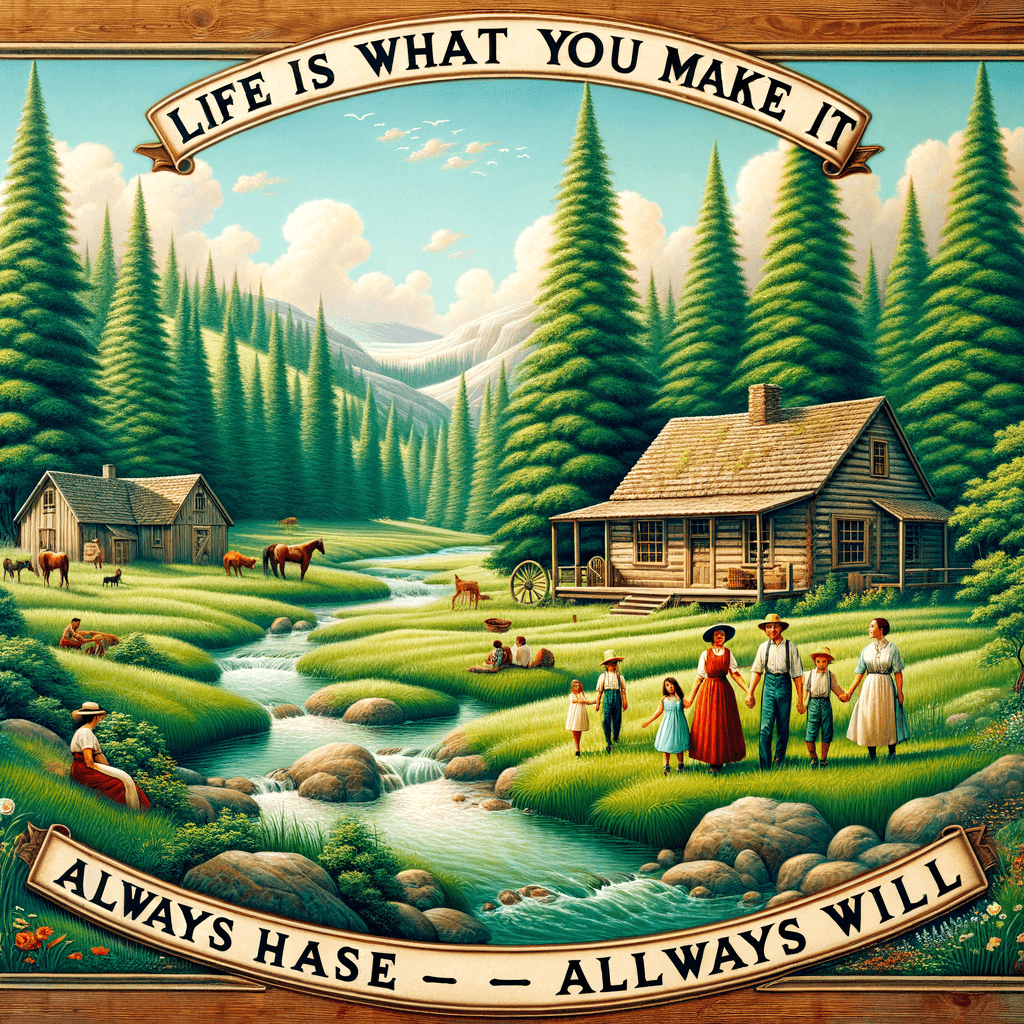
Life is what we make it, always has been, always will be. — Grandma Moses
—What lingers after this line?
Personal Responsibility
This quote emphasizes the idea that individuals hold the power to shape their lives through their choices and actions. It suggests that we are responsible for our own happiness and success.
Agency and Empowerment
Grandma Moses highlights the importance of taking control of one’s life. It implies that rather than being passive recipients of circumstances, we have the agency to create our own paths.
Consistency of Life's Nature
The phrase 'always has been, always will be' suggests that this principle is timeless. Throughout history, the ability to influence our lives has been a constant aspect of the human experience.
Optimism and Hope
This quote carries a hopeful message, encouraging individuals to view life as a canvas they can paint. It promotes a positive outlook that reinforces the idea that change is possible through effort.
Historical Context of Grandma Moses
Grandma Moses, an American folk artist from the early 20th century, began painting in her seventies. Her life story and artistic journey exemplify the themes of perseverance, creativity, and self-creation reflected in this quote.
One-minute reflection
Where does this idea show up in your life right now?
Related Quotes
6 selectedLife is what we make it, always has been, always will be. — Eleanor Roosevelt, USA.
Eleanor Roosevelt, USA.
This quote emphasizes the importance of personal agency and responsibility. It suggests that individuals have the power to shape their own lives through their decisions and actions.
Read full interpretation →If things go wrong, don't go with them. — Roger Babson
Roger Babson
At first glance, Roger Babson’s line sounds simple, yet it captures a difficult discipline: when events begin to unravel, we do not have to unravel with them. Problems often create their own momentum, pulling emotions, j...
Read full interpretation →A deadline is, simply put, optimism in its most kick-ass form. — Chris Baty
Chris Baty
At first glance, Chris Baty’s remark sounds like a joke about stress, yet it quickly turns into something sharper: a deadline is faith disguised as urgency. To set a date for finishing anything is to believe, perhaps stu...
Read full interpretation →It is a new dawn, it is a new day, it is a new life for me, and I am feeling good. — Nina Simone
Nina Simone
At its core, Nina Simone’s line turns ordinary time—dawn, day, life—into a sequence of renewal. Each phrase builds on the last, moving from the external world to the speaker’s inner state, until the declaration “I am fee...
Read full interpretation →You cannot command things, but you can command yourself. — Michael D. Pollock
Michael D. Pollock
At first glance, Michael D. Pollock’s line draws a sharp boundary between the outer world and the inner one.
Read full interpretation →A boundary is not a wall; it is a door with a lock that you control. — Annie Wright
Annie Wright
At first glance, Annie Wright’s quote corrects a common misunderstanding: people often treat boundaries as acts of distance or punishment, when in fact they are tools of intentional relationship. A wall shuts everyone ou...
Read full interpretation →More From Author
More from Grandma Moses →