
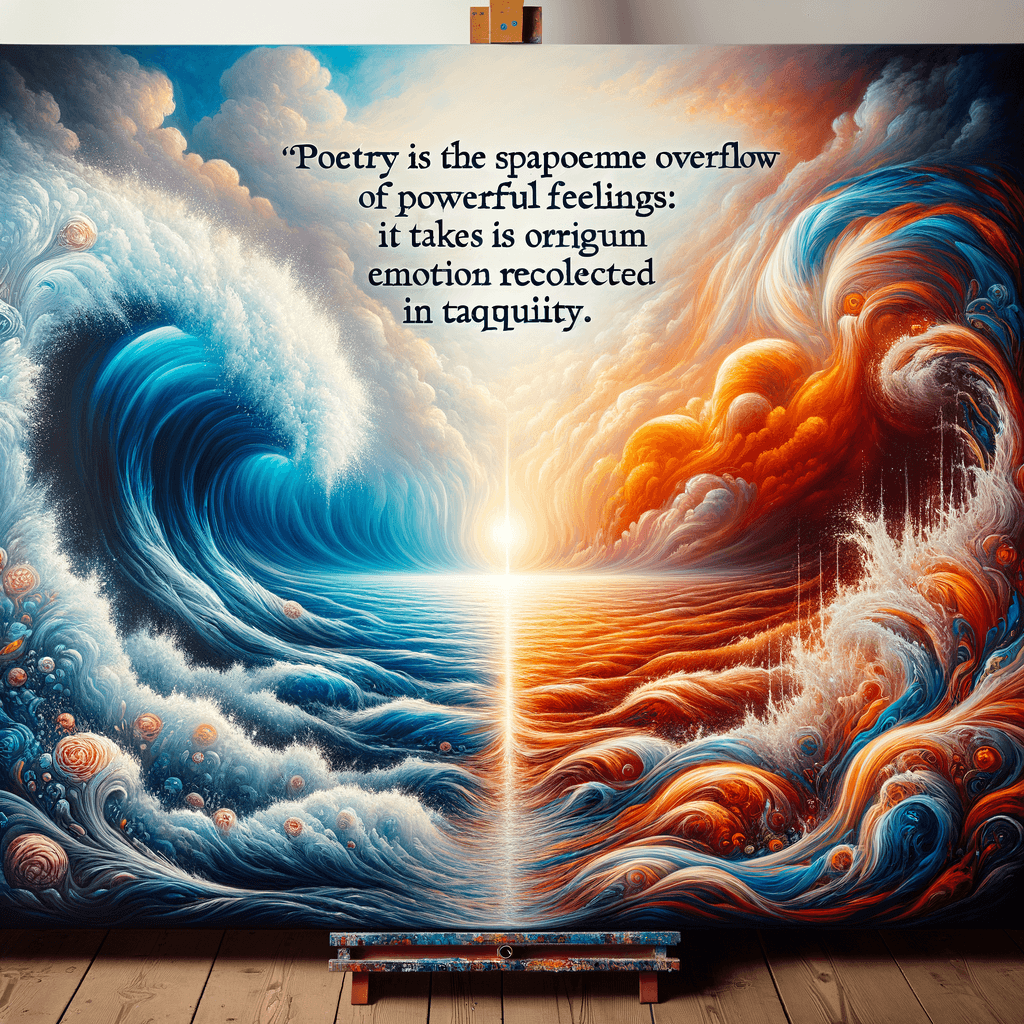
Poetry is the spontaneous overflow of powerful feelings: it takes its origin from emotion recollected in tranquility. — William Wordsworth
—What lingers after this line?
Nature of Poetry
This quote highlights the idea that poetry is born from deep emotional experiences that are later contemplated and expressed in a moment of calm, underscoring the emotional depth that poetry can convey.
Emotional Recollection
Wordsworth emphasizes the importance of recollection in the poetic process; powerful feelings are not just spontaneous outbursts but are best understood and articulated after a period of reflection.
Connection with Nature
Wordsworth, known for his appreciation of nature, suggests that true feelings often emerge in the tranquility of natural settings, linking the beauty of the world with the creation of art.
Romanticism and Emotion
As a leading figure of the Romantic era, Wordsworth's perspective aligns with the movement's focus on personal emotion, nature, and the subjective experience of individuals.
The Poetic Process
The quote outlines a process where raw emotions undergo a transformation — from instinctual feeling to structured artistic expression, highlighting the dynamic interplay between feeling and art.
One-minute reflection
Where does this idea show up in your life right now?
Related Quotes
6 selectedOut of the quarrel with others we make rhetoric; out of the quarrel with ourselves, we make poetry. — W.B. Yeats
W.B. Yeats
At its core, W.B. Yeats draws a sharp line between two kinds of struggle.
Read full interpretation →Compose your day like a poem: choose each word, then let it sing. — Pablo Neruda
Pablo Neruda
Neruda’s invitation reframes a day as a stanza waiting for breath: compose it, word by chosen word, until meaning gathers. His Odes to Common Things (1954)—to onions, socks, salt—model this care, revealing how attention...
Read full interpretation →Make your living a poem of commitment; then read it aloud to the world. — Rabindranath Tagore
Rabindranath Tagore
At the outset, Tagore’s imperative transforms life from a sequence of errands into an act of making. The Greek root of poem—poiesis—means to craft, to bring forth.
Read full interpretation →Fill your paper with the breathings of your heart. — William Wordsworth
William Wordsworth
This quote encourages writers to pour their genuine emotions and feelings into their work. Wordsworth urges writers to make their creations heartfelt and authentic.
Read full interpretation →Every great and original writer, in proportion as he is great and original, must himself create the taste by which he is to be relished. — William Wordsworth
William Wordsworth
Wordsworth’s claim begins with a bold premise: truly original writers cannot be fully judged by old measures because their work changes the very standards of appreciation. In other words, greatness is not simply a matter...
Read full interpretation →Rest and be thankful. — William Wordsworth
William Wordsworth
Wordsworth’s brief line joins two simple acts—resting and giving thanks—as if one naturally completes the other. At first glance, it sounds almost like gentle advice from a trusted friend, yet its power lies in that calm...
Read full interpretation →More From Author
More from William Wordsworth →Every great and original writer, in proportion as he is great and original, must himself create the taste by which he is to be relished. — William Wordsworth
Wordsworth’s claim begins with a bold premise: truly original writers cannot be fully judged by old measures because their work changes the very standards of appreciation. In other words, greatness is not simply a matter...
Read full interpretation →Rest and be thankful. — William Wordsworth
Wordsworth’s brief line joins two simple acts—resting and giving thanks—as if one naturally completes the other. At first glance, it sounds almost like gentle advice from a trusted friend, yet its power lies in that calm...
Read full interpretation →Fill your paper with the breathings of your heart. — William Wordsworth
This quote encourages writers to pour their genuine emotions and feelings into their work. Wordsworth urges writers to make their creations heartfelt and authentic.
Read full interpretation →Wisdom is oftentimes nearer when we stoop than when we soar. — William Wordsworth
William Wordsworth’s observation suggests that genuine wisdom emerges not in moments of pride, but through humility and self-awareness. Rather than equating greatness with lofty ambition, he reminds us that stooping—symb...
Read full interpretation →