Seeing Potential: A Quote by Albert Einstein
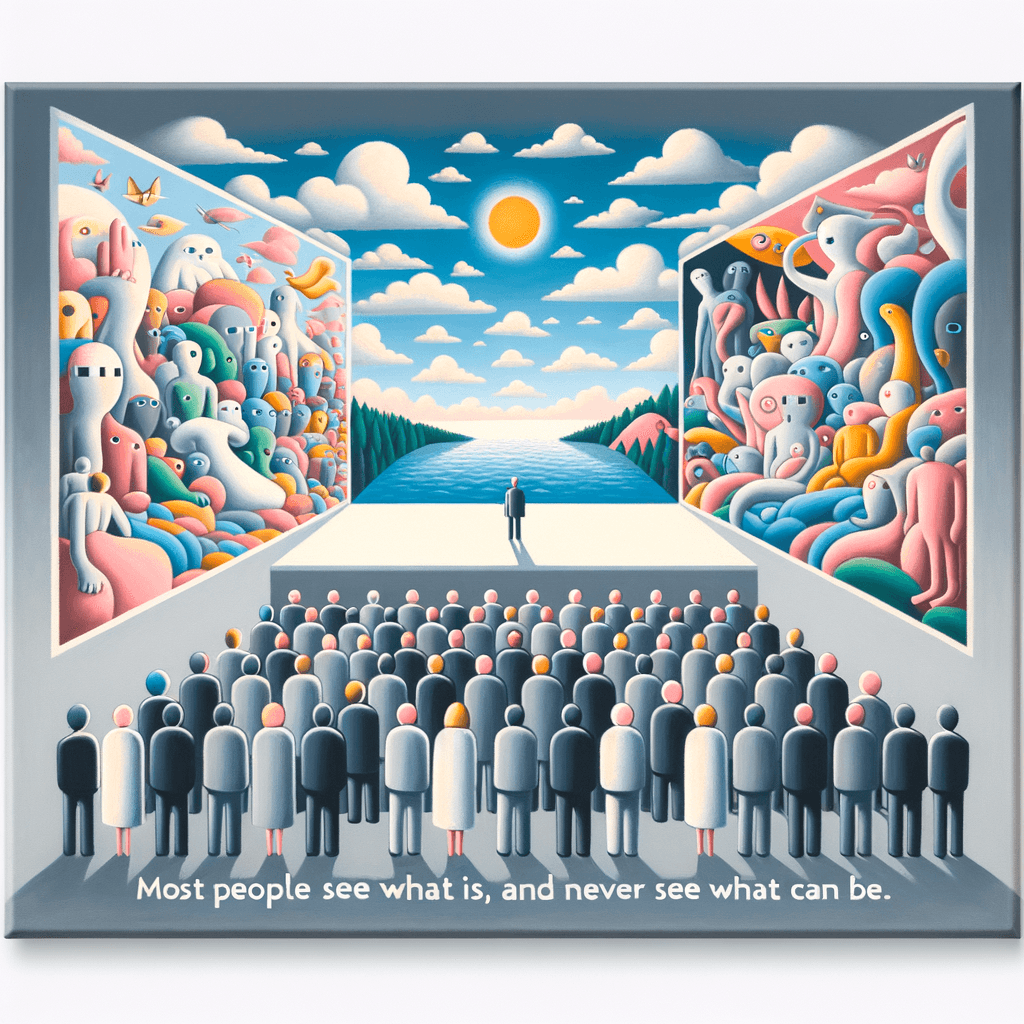
Most people see what is, and never see what can be. — Albert Einstein
—What lingers after this line?
Vision and Imagination
This quote emphasizes the difference between mere observation of the present reality and the ability to envision possibilities for the future. It highlights the importance of imagination in achieving innovation and progress.
Limitations of Conventional Thinking
Einstein points out that many individuals are constrained by conventional thinking, focusing only on what currently exists rather than considering what could potentially be created or achieved.
Encouragement for Change
The quote serves as a motivational call to challenge the status quo and encourages individuals to look beyond their current circumstances to identify opportunities for growth and transformation.
Creativity and Problem Solving
By urging people to see what can be, Einstein advocates for creativity and innovative problem-solving, which are essential skills for those seeking to make meaningful changes in their lives and in society.
Influence of Albert Einstein
As a renowned physicist, Einstein was not only concerned with scientific principles but also with broader philosophical implications. His insights often provoke deeper thinking about human potential and societal advancements.
Recommended Reading
One-minute reflection
Why might this line matter today, not tomorrow?
Related Quotes
6 selectedDreams are the seeds of possibility planted in the soil of the future. - Unknown
Unknown
This quote highlights the importance of dreams as the foundation for what can be achieved in the future. Dreams ignite the potential within us to create and accomplish great things.
Read full interpretation →Vision without execution is just hallucination. — Thomas Edison
Thomas Edison
This quote emphasizes that having a vision or idea is not enough. Implementation or execution is crucial to bring that vision into reality.
Read full interpretation →And now let us believe in a long year that is given to us, new, untouched, full of things that have never been. — Rainer Maria Rilke
Rainer Maria Rilke
Rilke opens by shifting the tone from planning to believing: the year is “given to us,” implying something received rather than conquered. This framing matters because it replaces the pressure of achievement with the hum...
Read full interpretation →Underneath the grid is a field—it was always there—where to be lost is never to be wrong, but simply more. — Ocean Vuong
Ocean Vuong
Vuong opens with a quiet contrast: a “grid” suggests order, measurement, and right angles—an imposed way of seeing life as legible and correct. Underneath it, however, is a “field,” something organic and unruled, where g...
Read full interpretation →The world is before you, and you need not take it as it was. — James Baldwin
James Baldwin
James Baldwin’s line begins as a simple act of opening a door: the world is “before you,” available to your attention and judgment rather than locked behind tradition. Instead of treating reality as fixed scenery, he fra...
Read full interpretation →Open one window of wonder each day and the light of possibility will rush in. — Gabriel García Márquez
Gabriel García Márquez
García Márquez frames wonder not as a rare accident, but as something you can choose—one “window” at a time. The image suggests a small, deliberate action: a pause, a question, a moment of attention.
Read full interpretation →More From Author
More from Albert Einstein →A quiet and modest life brings more joy than a pursuit of success bound with constant unrest. — Albert Einstein
Einstein’s line frames happiness as a matter of inner climate rather than outer trophies. By contrasting “a quiet and modest life” with “success bound with constant unrest,” he implies that what we call success can becom...
Read full interpretation →Everything should be made as simple as possible, but not simpler. — Albert Einstein
Einstein’s remark urges us to strip ideas down to their essentials while resisting the temptation to oversimplify. He is not praising simplicity for its own sake, but rather clarity that preserves the full truth.
Read full interpretation →Every day we know more and understand less. — Albert Einstein
This quote highlights a paradox where the accumulation of knowledge does not necessarily lead to a deeper understanding. As we gather more information, it can sometimes create confusion rather than clarity.
Read full interpretation →Every day we know more and understand less. - Albert Einstein
This quote highlights the paradox where the accumulation of information and data does not necessarily lead to a deeper understanding of the world. As we gather more facts, the complexity of interpreting and integrating t...
Read full interpretation →