
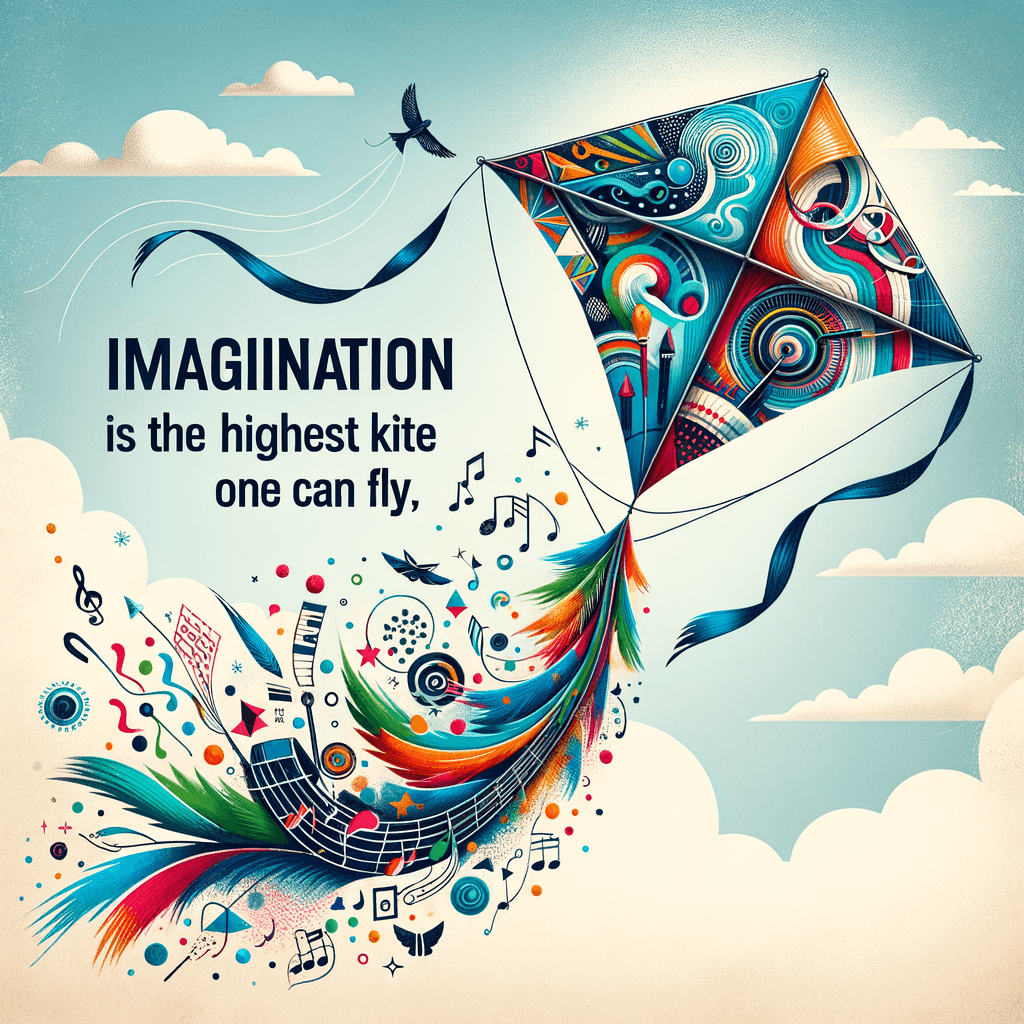
Imagination is the highest kite one can fly. — Lauren Bacall
—What lingers after this line?
The Power of Imagination
This quote highlights the boundless nature of imagination. It suggests that imagination allows individuals to soar above limitations, much like a kite that flies freely in the sky.
Creativity and Expression
Imagination is linked to creativity. Bacall emphasizes that through imagination, one can create and express ideas that transcend reality, thus enriching personal and artistic expression.
Freedom of Thought
The metaphor of a kite signifies freedom. The quote implies that imaginative thinking frees one from conventional boundaries and encourages exploration of new possibilities.
Pursuit of Dreams
By likening imagination to flying a kite, Bacall suggests the importance of dreaming and striving towards aspirations. It encourages individuals to pursue their dreams, regardless of how lofty they may seem.
Legacy of Lauren Bacall
Lauren Bacall was a celebrated actress known for her powerful presence in film and theatre. Her insights into imagination reflect her own creative journey and contributions to the arts, resonating with those who admire her work.
One-minute reflection
Where does this idea show up in your life right now?
Related Quotes
6 selectedAnxiety is just the imagination working overtime, and most of that overtime is completely unpaid. — Alain de Botton
Alain de Botton
At first glance, Alain de Botton’s remark frames anxiety with disarming humor: the mind behaves like an overworked employee, generating scenarios, rehearsing disasters, and collecting no reward for the effort. By calling...
Read full interpretation →Creativity is not the finding of a thing, but the making something out of it after it is found. — James Russell Lowell
James Lowell
James Russell Lowell’s line shifts attention away from the romantic myth of the sudden genius who invents from nothing. Instead, he argues that creativity truly begins after the initial encounter—after an idea, object, p...
Read full interpretation →One that desires to excel should endeavor in those things that are in themselves most excellent. — Epictetus
Epictetus
Epictetus condenses a demanding moral vision into a single sentence: anyone who wants to become excellent must direct effort toward what is genuinely worthy, not merely impressive. At once, he shifts the focus from ambit...
Read full interpretation →In art, the hand can never execute anything higher than the heart can imagine. — Ralph Waldo Emerson
Ralph Waldo Emerson
Emerson’s line shifts attention from technique to inner vision. At first glance, he seems to be speaking about painting or sculpture, yet his deeper claim is that craftsmanship cannot surpass the emotional and imaginativ...
Read full interpretation →It is the main earthly business of a human being to make his home, and the immediate surroundings of his home, as symbolic and significant to his own imagination as he can. — G. K. Chesterton
G. K. Chesterton
Chesterton begins with a striking claim: making a home is not a secondary chore but one of our central earthly tasks. By calling it our “main earthly business,” he elevates domestic life into something almost moral and a...
Read full interpretation →A rock pile ceases to be a rock pile the moment a single man contemplates it, bearing within him the image of a cathedral. — Antoine de Saint-Exupéry
Exupéry
At first glance, Saint-Exupéry’s line seems to describe an ordinary heap of stones. Yet the moment someone looks at it while carrying the image of a cathedral within, the pile is transformed in meaning.
Read full interpretation →More From Author
More from Lauren Bacall →