
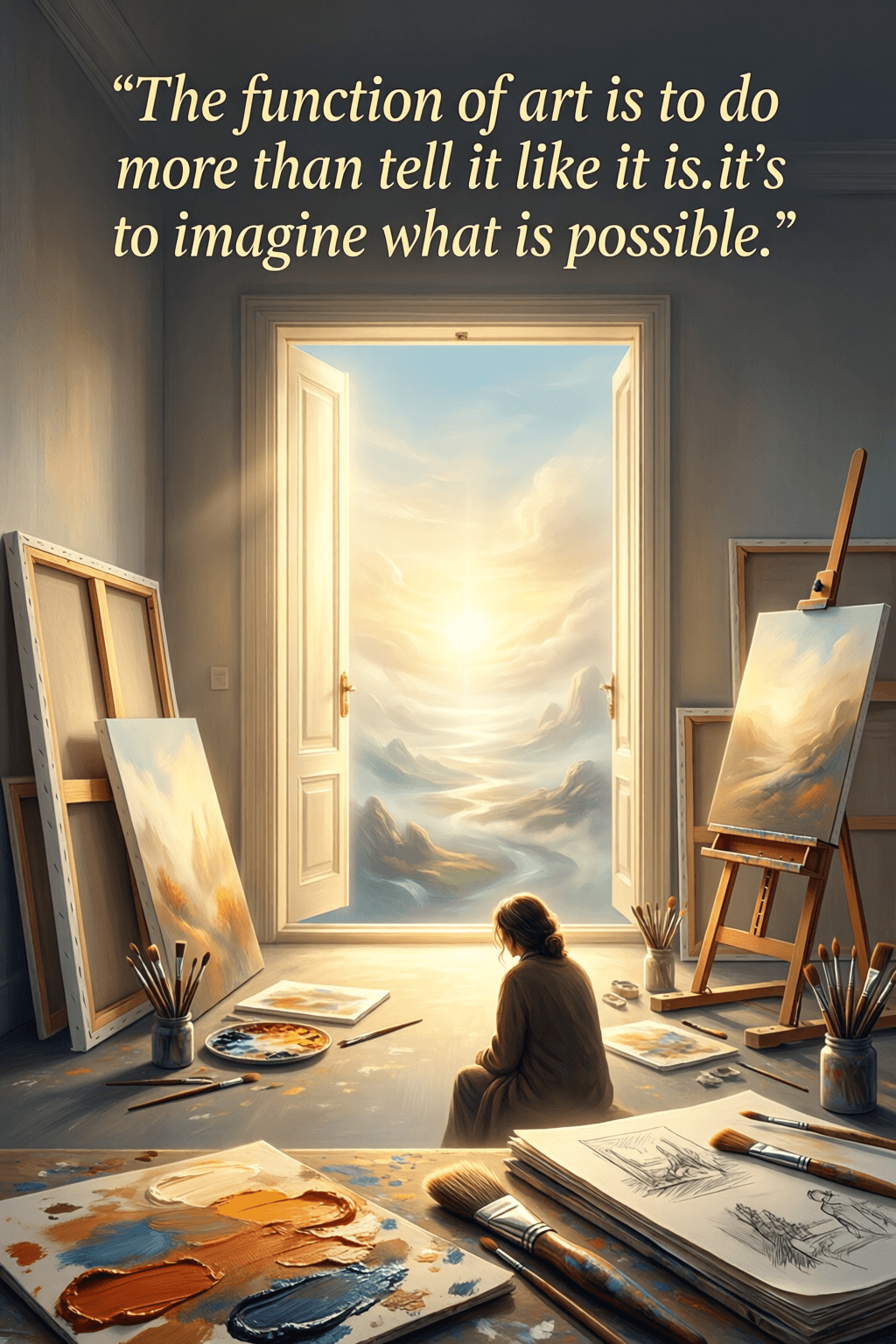
The function of art is to do more than tell it like it is—it's to imagine what is possible. — bell hooks
—What lingers after this line?
Beyond Mere Description
bell hooks argues that art should not stop at documenting reality, however honestly. Instead, it must move one step further and open a window onto possibility, suggesting that creativity is not only reflective but transformative. In this view, art becomes a force that unsettles resignation and challenges the assumption that the world must remain as it is. From this starting point, her statement shifts the purpose of artistic work from passive observation to active imagination. A painting, poem, or film may begin with lived conditions—inequality, longing, joy, conflict—but it gains deeper power when it also hints at change, dignity, or freedom not yet fully realized.
Imagination as a Political Force
Seen this way, imagination is never merely decorative; it is political. bell hooks repeatedly linked culture and liberation in works such as Art on My Mind: Visual Politics (1995), where she explored how representation shapes what people believe can exist. If communities are shown only suffering or limitation, their futures appear narrow; if they are shown complexity and possibility, new futures become thinkable. Consequently, art helps build the emotional and intellectual groundwork for social change. Before institutions shift, people often need language, images, and stories that let them conceive of another arrangement of life. Art, then, prepares the mind to recognize that injustice is not fate.
A Tradition of Visionary Creation
This idea has deep roots across artistic history. For example, Harriet Beecher Stowe’s Uncle Tom’s Cabin (1852) did more than portray the cruelty of slavery; it stirred readers to imagine a moral order in which such cruelty could no longer be tolerated. Likewise, Pablo Picasso’s Guernica (1937) is not a neutral report of violence but a searing reconfiguration of suffering that demands a different human future. In turn, these works show that art’s imaginative function does not require optimism in a simplistic sense. Even when art depicts devastation, it can still point beyond it by refusing indifference and insisting that another world must be possible.
The Role of Hope in Creative Work
Because of this, hooks’s statement is also a defense of hope. Hope here is not naïve cheerfulness but a disciplined refusal to let present conditions exhaust reality. Toni Morrison’s Beloved (1987), for instance, confronts trauma with unflinching honesty, yet it also creates space for memory, healing, and the recovery of selfhood. The work does not deny pain; rather, it imagines life after pain’s domination. Accordingly, art becomes a shelter for futures still under construction. It gives form to desires that may be difficult to articulate in ordinary political language, allowing people to feel the shape of freedom before they can fully describe or achieve it.
Why Possibility Matters Now
In the present moment, hooks’s insight feels especially urgent because contemporary life often floods audiences with relentless realism—statistics, crises, and spectacle. While truth-telling remains essential, constant exposure to what is broken can produce paralysis. Art answers this problem by pairing witness with invention, helping people endure reality without surrendering to it. Ultimately, the quote suggests that art fulfills its highest purpose when it enlarges human consciousness. It tells us where we are, certainly, but then carries us further, toward where we might go. In that movement from fact to possibility, art becomes not an escape from the world but a way of remaking it.
One-minute reflection
Why might this line matter today, not tomorrow?
Related Quotes
6 selectedThe goal of life is rapture. Art is the way we experience it. — Joseph Campbell
Joseph Campbell
Joseph Campbell’s statement begins with a bold claim: life is not merely about survival, achievement, or social approval, but about rapture—a heightened state of wonder, intensity, and felt aliveness. By placing rapture...
Read full interpretation →Anxiety is just the imagination working overtime, and most of that overtime is completely unpaid. — Alain de Botton
Alain de Botton
At first glance, Alain de Botton’s remark frames anxiety with disarming humor: the mind behaves like an overworked employee, generating scenarios, rehearsing disasters, and collecting no reward for the effort. By calling...
Read full interpretation →Creativity is not the finding of a thing, but the making something out of it after it is found. — James Russell Lowell
James Lowell
James Russell Lowell’s line shifts attention away from the romantic myth of the sudden genius who invents from nothing. Instead, he argues that creativity truly begins after the initial encounter—after an idea, object, p...
Read full interpretation →All the arts we practice are apprenticeship. The big art is our life. — M.C. Richards
M.C. Richards
M.C. Richards turns the usual hierarchy upside down by suggesting that painting, music, poetry, and craft are not ultimate achievements but forms of preparation.
Read full interpretation →Craftsmanship is the visible edge of art. — David Bayles
David Bayles
At first glance, David Bayles’s line suggests that craftsmanship is the point where inner vision becomes outward form. Art may begin in imagination, intuition, or feeling, but it only enters the world through skillful ex...
Read full interpretation →Art is not a thing; it is a way. — Elbert Hubbard
Elbert Hubbard
Elbert Hubbard’s line immediately shifts attention away from paintings, sculptures, or books as isolated products. Instead, he suggests that art lives in the manner of seeing, choosing, and shaping experience.
Read full interpretation →More From Author
More from bell hooks →But many of us seek community solely to escape the fear of being alone. Knowing how to be solitary is central to the art of loving. — bell hooks
Bell hooks begins with a quiet but difficult observation: not every search for community is rooted in love. Sometimes, we reach for others because solitude feels threatening, as though being alone exposes a lack within u...
Read full interpretation →Your presence is a form of resistance against a culture that profits from your isolation. Show up for those you love, even when it is inconvenient. — bell hooks
At first glance, bell hooks reframes something ordinary—being present for others—as a political and moral act. Her words suggest that care is not merely private sentiment; rather, it pushes back against a social order th...
Read full interpretation →If you don't build your own sanctuary, you will spend your life living in the wreckage of someone else's expectations. — Bell Hooks
Bell hooks frames sanctuary as more than a physical refuge; it is an inner and outer space where a person can live by values they have consciously chosen. At first glance, the quote sounds like a warning about independen...
Read full interpretation →The art of living is a constant process of refining one's own sanctuary against the tide of external expectations. — bell hooks
At its core, bell hooks presents living not as a finished achievement but as a continuous act of shaping and reshaping the self. The phrase “constant process” suggests that identity, peace, and integrity are never perman...
Read full interpretation →