
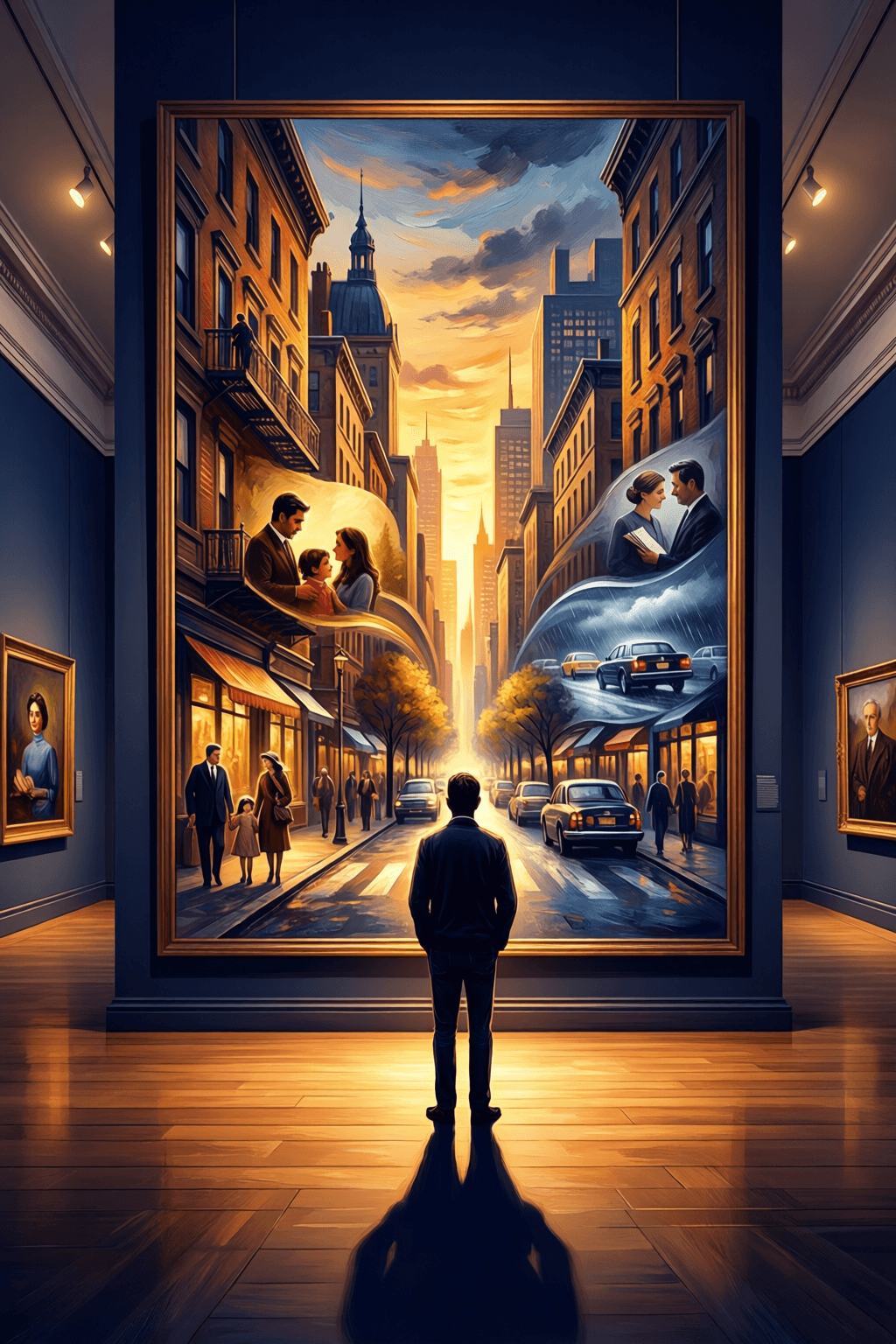
The role of art has never been to escape reality, but to help us understand it. — Toni Morrison
—What lingers after this line?
Beyond Escape
At first glance, art is often treated as a refuge from hardship, a private world where pain can be softened or forgotten. Toni Morrison overturns that expectation by arguing that art’s deeper purpose is not avoidance but revelation. In her view, a novel, painting, song, or poem does not merely distract us from life; it returns us to life with sharper sight. This shift matters because it reframes creativity as an act of engagement. Rather than building a wall between the viewer and the world, art opens a passage back into human experience. Morrison’s own Beloved (1987), for instance, confronts the historical trauma of slavery not by simplifying it, but by making its emotional truth impossible to ignore.
Making the Invisible Visible
From that starting point, art becomes a tool for perception. Many of the forces shaping ordinary life—memory, grief, injustice, desire, fear—are difficult to measure directly, yet art gives them form. A story can embody social pressure in a single household; a painting can compress an era’s anxieties into color and gesture; a song can articulate sorrow before we have language for it ourselves. In this way, artistic works often clarify what daily life leaves blurred. Pablo Picasso’s Guernica (1937), for example, does not offer a literal report of war, yet its fractured figures communicate terror and devastation with a force that facts alone may not achieve. Art, then, reveals reality by rendering its hidden textures visible.
Truth Through Imagination
Yet Morrison’s statement also suggests a productive paradox: imagination can tell the truth. Although fiction invents characters and events, it frequently reaches emotional and moral realities more directly than documentary description. By entering imagined worlds, audiences test motives, confront consequences, and recognize patterns that exist beyond the page or stage. This is why works separated by centuries still feel urgent. Plato’s Republic (c. 375 BC) worried about art’s persuasive power, while Aristotle’s Poetics (c. 335 BC) defended tragedy for revealing universal truths through imitation. Morrison stands closer to that latter tradition, implying that art’s inventions are not lies but instruments for understanding what human beings repeatedly live through.
Empathy as Understanding
Moreover, art helps us understand reality by enlarging empathy. Facts can inform us that suffering exists, but narrative and image can make us feel its weight in specific lives. Once a reader inhabits another person’s fear, longing, or dignity, reality is no longer abstract; it becomes relational and morally charged. That is one reason Morrison’s claim carries ethical force. Her novels repeatedly insist that history is not a set of distant events but a field of human consequences. Similarly, Harper Lee’s To Kill a Mockingbird (1960) guides readers into the lived experience of prejudice through a child’s perspective. Art does more than report reality from the outside—it teaches us to encounter it from within.
Confronting History and Power
As this empathy deepens, art also becomes a means of confronting collective realities that societies prefer to evade. Morrison’s wording rejects the comforting idea that beauty exists apart from politics, memory, or power. Instead, art can expose the structures that shape lives, especially when official narratives minimize or distort them. Throughout history, artists have served precisely this role. Francisco Goya’s The Third of May 1808 (1814) transforms political violence into unforgettable witness, while James Baldwin’s essays, especially The Fire Next Time (1963), merge literary craft with social diagnosis. In each case, art does not flee reality’s harshness; it insists that we look at it clearly and reckon with what we see.
A Deeper Return to the World
Finally, Morrison’s insight suggests that the highest achievement of art is not temporary escape but transformed return. After encountering serious art, we may go back to ordinary life changed—more attentive to language, more alert to injustice, more conscious of beauty, and more capable of recognizing complexity where we once saw simplicity. For that reason, art’s value lies in the way it prepares us to live more truthfully. It steadies perception rather than numbing it. Morrison’s statement ultimately presents art as a companion to reality: not a curtain drawn across the world, but a lens through which the world becomes more legible, more human, and more urgently ours.
One-minute reflection
Why might this line matter today, not tomorrow?
Related Quotes
6 selectedArt is not a mirror held up to reality, but a hammer with which to shape it. — Bertolt Brecht
Bertolt Brecht
Bertolt Brecht’s line rejects the comforting idea that art merely copies the world as it is. A mirror suggests observation, distance, and faithful reproduction, but a hammer implies pressure, intervention, and change.
Read full interpretation →The function of art is to do more than tell it like it is—it's to imagine what is possible. — bell hooks
bell hooks
bell hooks argues that art should not stop at documenting reality, however honestly. Instead, it must move one step further and open a window onto possibility, suggesting that creativity is not only reflective but transf...
Read full interpretation →Nothing is wrong—whatever is happening is just real life. — Tara Brach
Tara Brach
At first glance, Tara Brach’s line gently interrupts a habit many people carry: the reflex to label discomfort as evidence that something has gone wrong. Instead, she proposes a quieter interpretation—what is happening i...
Read full interpretation →All the arts we practice are apprenticeship. The big art is our life. — M.C. Richards
M.C. Richards
M.C. Richards turns the usual hierarchy upside down by suggesting that painting, music, poetry, and craft are not ultimate achievements but forms of preparation.
Read full interpretation →Craftsmanship is the visible edge of art. — David Bayles
David Bayles
At first glance, David Bayles’s line suggests that craftsmanship is the point where inner vision becomes outward form. Art may begin in imagination, intuition, or feeling, but it only enters the world through skillful ex...
Read full interpretation →Art is not a thing; it is a way. — Elbert Hubbard
Elbert Hubbard
Elbert Hubbard’s line immediately shifts attention away from paintings, sculptures, or books as isolated products. Instead, he suggests that art lives in the manner of seeing, choosing, and shaping experience.
Read full interpretation →More From Author
More from Toni Morrison →The building of the architecture of a novel - the craft of it - is something I never tire of. — Toni Morrison
At its core, Toni Morrison’s remark celebrates not merely storytelling, but the deliberate construction behind it. By speaking of the “architecture of a novel,” she shifts attention from inspiration alone to design, sugg...
Read full interpretation →The ability to endure is the discipline of the soul. — Toni Morrison
Toni Morrison’s line shifts endurance from a mere survival trait into a deliberate inner practice: a discipline cultivated in the soul. Rather than glorifying pain for its own sake, she suggests that the capacity to cont...
Read full interpretation →You are your best thing. — Toni Morrison
Toni Morrison’s line, “You are your best thing,” quietly overturns a common habit: looking outward for proof of worth. Instead of treating love, status, or achievement as the final measure, the quote plants value inside...
Read full interpretation →Keep a stubborn heart and a flexible plan. — Toni Morrison
Toni Morrison’s sentence splits strength into two complementary forms: a “stubborn heart” that refuses to surrender what matters, and a “flexible plan” that accepts reality’s constant revisions. Rather than treating grit...
Read full interpretation →