
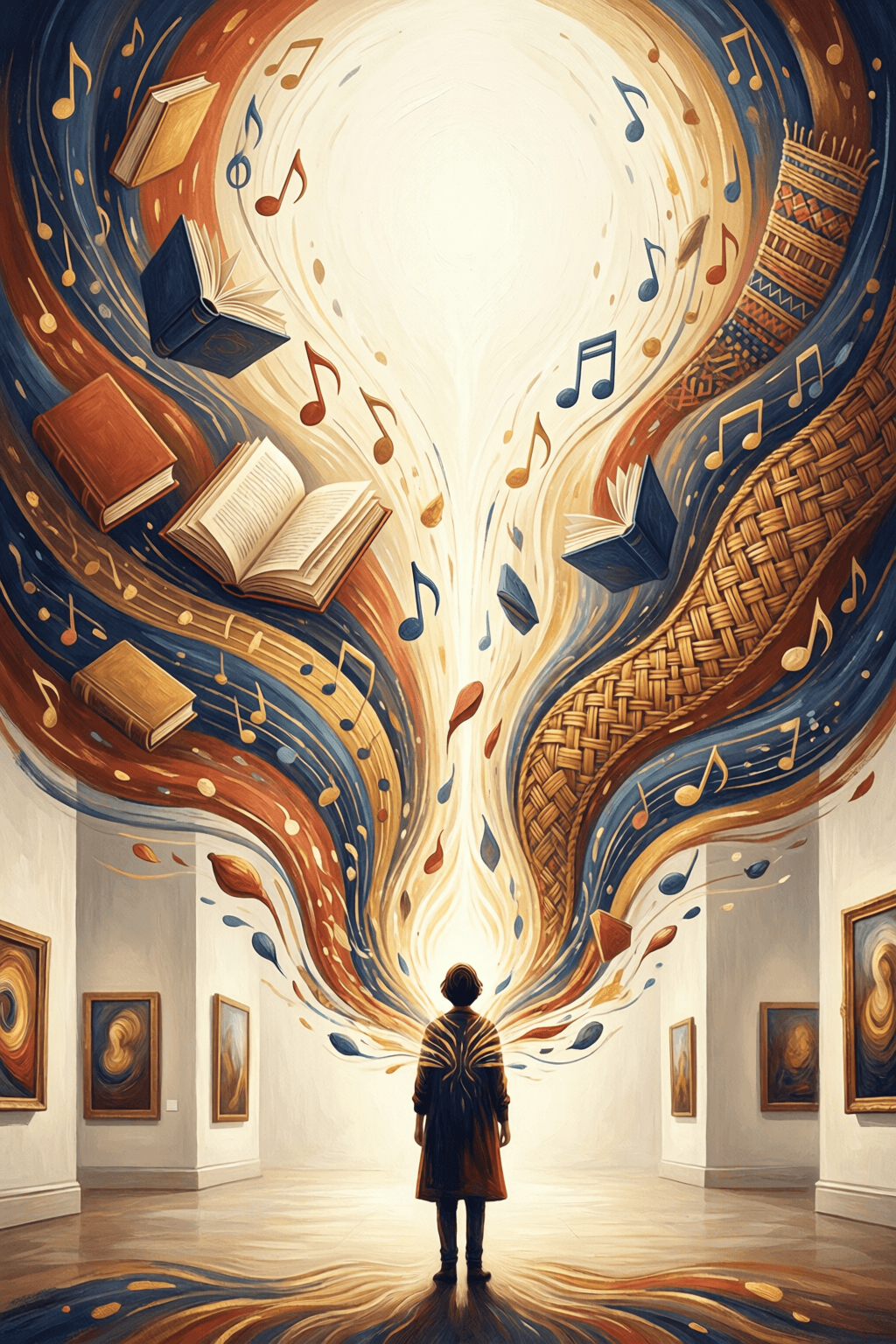
It is a common mistake to think that art is a luxury. It is a necessity of the human spirit. — Chinua Achebe
—What lingers after this line?
Beyond the Idea of Luxury
At first glance, Achebe challenges a deeply rooted modern assumption: that art belongs to the realm of extras, something pleasant but dispensable. By calling this belief a “common mistake,” he suggests that reducing art to decoration misunderstands its true function. In his view, art is not a reward reserved for comfort or wealth; rather, it is woven into the very structure of human existence. This distinction matters because luxuries can be removed without changing who we are, whereas necessities sustain inner life. Just as food nourishes the body, art nourishes feeling, memory, and imagination. Achebe’s statement therefore shifts the conversation from consumption to survival, asking us to see painting, music, storytelling, and ritual as conditions of a fully human life.
Art as Spiritual Nourishment
From that foundation, the phrase “necessity of the human spirit” opens a broader meaning of need. Achebe is not speaking only about religion or transcendence; he is naming the inner life that seeks expression, consolation, and significance. Art gives form to grief, joy, longing, and wonder, especially when ordinary language feels too limited to hold them. In this sense, art becomes a vessel through which people endure suffering and celebrate existence. Consider how sacred music, oral poetry, or memorial sculpture often appear in every culture, not as surplus but as response. Viktor Frankl’s Man’s Search for Meaning (1946) similarly argues that human beings require meaning as much as material support. Achebe’s insight aligns with that tradition by presenting art as one of the chief ways meaning enters experience.
Culture, Memory, and Identity
Moreover, Achebe’s words carry special force when read alongside his lifelong defense of African storytelling. In novels such as Things Fall Apart (1958), he showed that art preserves a people’s voice against distortion and erasure. Stories, songs, proverbs, and performances do more than entertain; they store values, histories, and collective memory, allowing communities to recognize themselves across generations. As a result, to dismiss art as luxury is also to underestimate its political and cultural importance. A society without living artistic expression risks losing not only beauty but continuity. Achebe’s own career demonstrates this vividly: by writing back against colonial narratives, he used literature as a necessary instrument of cultural self-definition. Art, then, sustains both the individual spirit and the memory of a people.
A Quiet Form of Resistance
Yet Achebe’s claim also implies that art becomes most visibly necessary in times of pressure. When societies face censorship, war, displacement, or injustice, poems, novels, murals, and songs often emerge not as indulgences but as acts of endurance. Pablo Picasso’s Guernica (1937), for instance, transformed political horror into an image the world could not easily forget, showing how art resists silence. In this way, art protects the interior freedom that oppressive systems try to crush. Even when material conditions are harsh, people continue to sing, tell stories, and make images because these acts affirm dignity. Achebe’s statement therefore has moral force: it reminds us that to support art is not merely to fund pleasure, but to defend a space where human beings remain emotionally and imaginatively alive.
Reimagining Public Priorities
Finally, if art is truly a necessity, then education, public policy, and daily life must treat it differently. Schools cannot relegate literature, music, and visual expression to the margins without diminishing students’ emotional and moral development. Likewise, communities that cut museums, libraries, theaters, or cultural programs may save money in the short term while impoverishing the spirit in the long term. Achebe’s sentence thus ends as a quiet but powerful call to action. It asks us to measure civilization not only by infrastructure or wealth, but by the seriousness with which it cultivates imagination. Once art is recognized as essential rather than optional, we begin to see creative expression not as a luxury for a few, but as a birthright of all human beings.
One-minute reflection
Why might this line matter today, not tomorrow?
Related Quotes
6 selectedArt is man's expression of his joy in labor. — Henry Kissinger
Henry Kissinger
At first glance, Henry Kissinger’s remark suggests that art does not arise apart from work but grows directly out of it. In this view, labor is not merely toil or obligation; it becomes meaningful when human beings impri...
Read full interpretation →In every work of art the spirit of humanity must be present. — Franz Kafka
Franz Kafka
Kafka emphasizes that true art must reflect the human experience. Regardless of the medium, a piece of art should encapsulate the emotions, struggles, and essence of what it means to be human.
Read full interpretation →All the arts we practice are apprenticeship. The big art is our life. — M.C. Richards
M.C. Richards
M.C. Richards turns the usual hierarchy upside down by suggesting that painting, music, poetry, and craft are not ultimate achievements but forms of preparation.
Read full interpretation →Craftsmanship is the visible edge of art. — David Bayles
David Bayles
At first glance, David Bayles’s line suggests that craftsmanship is the point where inner vision becomes outward form. Art may begin in imagination, intuition, or feeling, but it only enters the world through skillful ex...
Read full interpretation →Art is not a thing; it is a way. — Elbert Hubbard
Elbert Hubbard
Elbert Hubbard’s line immediately shifts attention away from paintings, sculptures, or books as isolated products. Instead, he suggests that art lives in the manner of seeing, choosing, and shaping experience.
Read full interpretation →It is not the language of painters but the language of nature which one should listen to. — Pablo Picasso
Pablo Picasso
At first glance, Picasso’s remark challenges the authority of artistic convention. By contrasting ‘the language of painters’ with ‘the language of nature,’ he suggests that art should not merely imitate established techn...
Read full interpretation →More From Author
More from Chinua Achebe →The sun does not forget a village just because it is small. — Chinua Achebe
Achebe’s line begins with a quietly radical premise: importance is not measured by scale. By imagining the sun as impartial, he suggests that attention, care, and recognition are not rewards reserved for the powerful; th...
Read full interpretation →Rise with the sun of your intentions and work until the horizon answers — Chinua Achebe
Achebe’s line opens with a vivid image: rising “with the sun of your intentions.” Intention here isn’t a vague wish—it’s something bright, scheduled, and unavoidable, like sunrise itself. By pairing waking with purpose,...
Read full interpretation →An army of sheep led by a lion can defeat an army of lions led by a sheep. — Chinua Achebe
Achebe’s line hinges on a startling reversal: the weaker group can prevail if guided by a forceful, capable leader, while the stronger group can squander its natural advantages under timid direction. By contrasting sheep...
Read full interpretation →Offer your hand first; leadership begins where service takes root. — Chinua Achebe
Achebe’s line turns leadership into a simple, concrete action: offering your hand first. Before titles, strategies, or authority, there is a moment of initiative—someone chooses to step forward, welcome, assist, or stead...
Read full interpretation →