
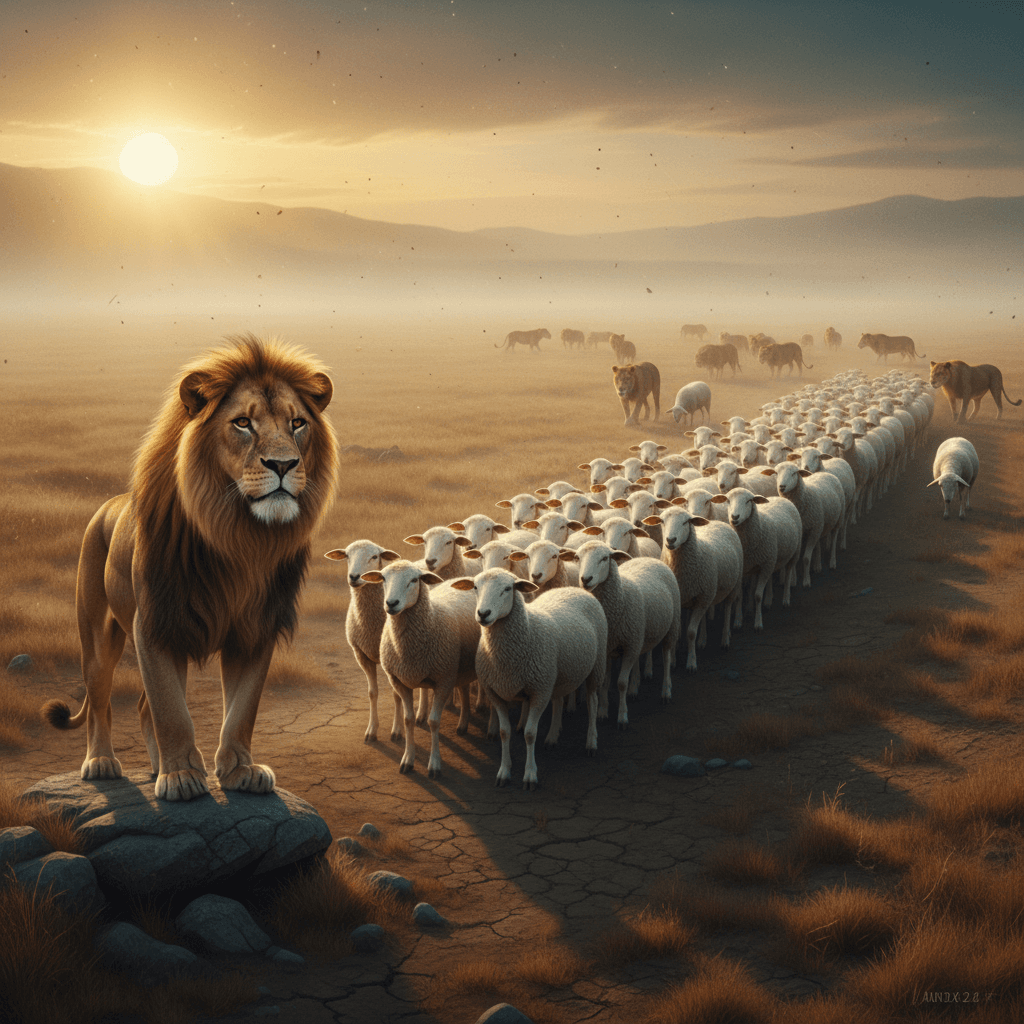
An army of sheep led by a lion can defeat an army of lions led by a sheep. — Chinua Achebe
—What lingers after this line?
The Quote’s Core Reversal
Achebe’s line hinges on a startling reversal: the weaker group can prevail if guided by a forceful, capable leader, while the stronger group can squander its natural advantages under timid direction. By contrasting sheep and lions, he strips the idea down to essentials—courage, clarity, and cohesion matter as much as raw power. From the start, the image also suggests that “strength” is not only physical; it includes morale, coordination, and belief. A lion at the head of sheep can transform a scattered herd into a disciplined movement, whereas a sheep leading lions can turn confidence into confusion.
Leadership as a Force Multiplier
Building on that reversal, the quote frames leadership as a multiplier: it amplifies what followers already have and compensates for what they lack. A decisive leader sets priorities, creates shared intent, and reduces hesitation, so even ordinary individuals act with unusual effectiveness. In that sense, the lion is less a symbol of brutality than of direction—someone willing to choose a course and bear the risk. When a group knows what to do next and why it matters, small advantages compound quickly, often outpacing the “natural” superiority of an unled or poorly led rival.
The Cost of Timid or Misaligned Command
Yet the second half of Achebe’s comparison is the sharper warning: strong people can be made weak by weak leadership. A “sheep” leader is not merely gentle; the metaphor implies indecision, fear of conflict, or an inability to command respect, all of which fracture unity. As a result, the lions’ talents become isolated—each one powerful alone but ineffective together. Without coherent strategy and accountability, resources are wasted, internal rivalries grow, and hesitation spreads, turning superior capability into disorganized motion that a cohesive opponent can exploit.
Discipline, Morale, and Shared Purpose
Moving from command to culture, the quote also points to what leaders cultivate: discipline and morale. A lion leading sheep can instill a shared purpose that helps people endure hardship and stay coordinated when pressure rises, which is often when battles—literal or figurative—are decided. Conversely, if leadership fails to provide meaning or direction, even the “lions” may fight only for themselves, retreat early, or refuse to take necessary risks. In practical terms, the difference between victory and defeat can be the group’s willingness to trust the plan and one another.
Echoes in History and Literature
This logic has long roots: Sun Tzu’s The Art of War (c. 5th century BC) emphasizes that organization, deception, and leadership can overcome superior strength. Similarly, Plutarch’s Lives (1st–2nd century AD) repeatedly contrasts commanders who unify armies with those who waste elite forces through vanity or indecision. Achebe’s phrasing, however, modernizes the lesson with vivid economy. Rather than debating tactics, it dramatizes how a leader’s character can reassign the “identity” of an entire group—sheep can fight like lions, and lions can behave like sheep.
A Contemporary Lens: Teams and Institutions
Finally, the quote translates cleanly into workplaces, politics, and community organizing. A modestly skilled team with a clear strategy, decisive priorities, and psychological safety can outperform a team of stars led by someone who avoids hard decisions or plays favorites. The takeaway is not hero worship but responsibility: leadership must turn individual ability into collective performance. Achebe’s provocation lingers because it suggests that outcomes often hinge less on who is “strongest” and more on who can align people toward decisive, coordinated action.
One-minute reflection
Where does this idea show up in your life right now?
Related Quotes
6 selectedCarry one brave idea forward and the others will follow like a parade. — Chinua Achebe
Chinua Achebe
Achebe’s image suggests that progress rarely begins with a crowd; it begins with a keystone—one brave idea carried forward with enough clarity to lower the world’s uncertainty. As a keystone holds an arch together, a sin...
Read full interpretation →True leadership is recognizing the potential in others and helping them reach it. A light does not lose its brightness by lighting another flame.
lighting another flame.
True leadership involves recognizing the potential within individuals and providing them with the support and resources needed to help them achieve their full potential.
Read full interpretation →If you want to be out front, then act as if you were behind. — Lao Tzu
Lao Tzu
Lao Tzu’s saying begins with a paradox: to move ahead of others, one must behave as though one is behind them. Rather than urging weakness or hesitation, the quote points to a subtler form of strength—leadership that doe...
Read full interpretation →If you wouldn't follow yourself, why should anyone else? — John C. Maxwell
John C. Maxwell
Maxwell’s line turns leadership inward before it points outward. In essence, he argues that credibility starts with a private standard: if your own behavior would not inspire your loyalty, your authority rests on appeara...
Read full interpretation →You cannot expect the level of excitement of your audience to be greater than your own. If you want a life that is alive, lead it with purpose. — Leonardo da Vinci
Leonardo da Vinci
Leonardo da Vinci’s insight begins with a simple but demanding truth: people rarely rise above the emotional energy of the person leading them. Whether in art, teaching, or daily life, enthusiasm is contagious precisely...
Read full interpretation →Freedom is knowing what is yours to influence. — Zeno of Citium
Zeno of Citium
At its heart, Zeno’s statement defines freedom not as unlimited power, but as clear discernment. The founder of Stoicism, writing in the early 3rd century BC, argued that human beings suffer when they confuse what belong...
Read full interpretation →More From Author
More from Chinua Achebe →It is a common mistake to think that art is a luxury. It is a necessity of the human spirit. — Chinua Achebe
At first glance, Achebe challenges a deeply rooted modern assumption: that art belongs to the realm of extras, something pleasant but dispensable. By calling this belief a “common mistake,” he suggests that reducing art...
Read full interpretation →The sun does not forget a village just because it is small. — Chinua Achebe
Achebe’s line begins with a quietly radical premise: importance is not measured by scale. By imagining the sun as impartial, he suggests that attention, care, and recognition are not rewards reserved for the powerful; th...
Read full interpretation →Rise with the sun of your intentions and work until the horizon answers — Chinua Achebe
Achebe’s line opens with a vivid image: rising “with the sun of your intentions.” Intention here isn’t a vague wish—it’s something bright, scheduled, and unavoidable, like sunrise itself. By pairing waking with purpose,...
Read full interpretation →Offer your hand first; leadership begins where service takes root. — Chinua Achebe
Achebe’s line turns leadership into a simple, concrete action: offering your hand first. Before titles, strategies, or authority, there is a moment of initiative—someone chooses to step forward, welcome, assist, or stead...
Read full interpretation →