
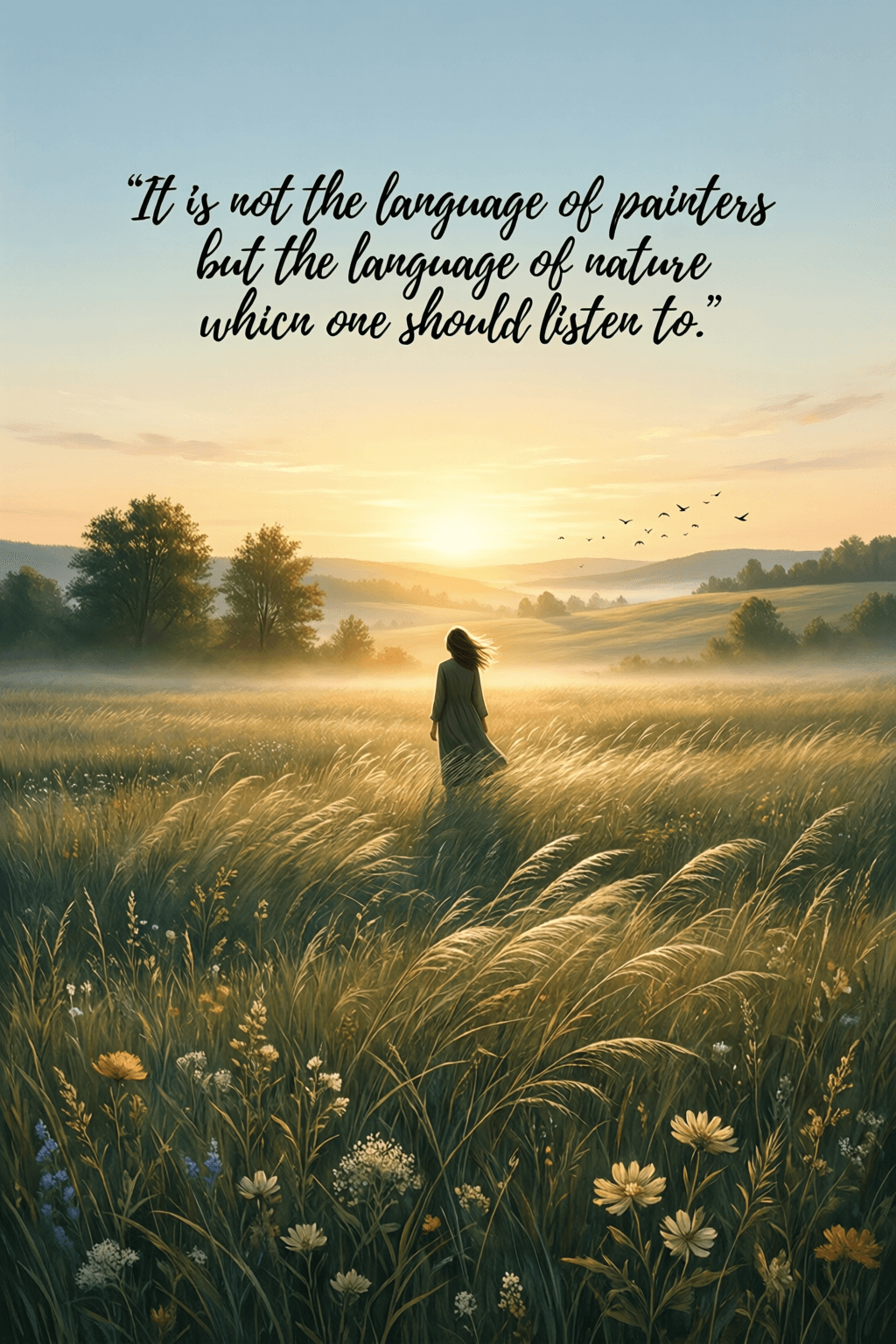
It is not the language of painters but the language of nature which one should listen to. — Pablo Picasso
—What lingers after this line?
Art Beyond Technical Style
At first glance, Picasso’s remark challenges the authority of artistic convention. By contrasting ‘the language of painters’ with ‘the language of nature,’ he suggests that art should not merely imitate established techniques, schools, or fashionable theories. Instead, the artist must attend to something more immediate and original: the rhythms, forms, and energies already present in the world. In this sense, Picasso shifts the source of truth away from the studio’s inherited rules and toward direct encounter. His statement implies that genuine creation begins not with obedience to tradition, but with perception sharpened by curiosity. Nature, here, becomes the deeper teacher.
Nature as the First Master
From that starting point, Picasso’s idea places nature above artistic jargon or formal training. This does not mean that craft is useless; rather, craft should remain secondary to living observation. Leonardo da Vinci’s notebooks (late 15th to early 16th century), for example, show an artist studying water, plants, anatomy, and light with relentless attention, as if the world itself were a text to be read before any theory was applied. Thus, Picasso points toward a humbler artistic stance. The painter is not the final authority but a listener, someone who learns from growth, movement, decay, and structure. Art becomes strongest when it answers that larger conversation.
A Rebellion Against Empty Convention
At the same time, the quotation carries a rebellious edge that suits Picasso well. Across many periods, artists have been pressured to paint according to accepted ideals of beauty, proportion, or realism. Yet movements from Impressionism to Cubism emerged precisely because artists refused to treat convention as sacred. Picasso’s own Les Demoiselles d’Avignon (1907) broke decisively with academic expectations, privileging raw force over polished conformity. Seen this way, ‘the language of painters’ can mean stale repetition—art speaking only to itself. By urging us to listen to nature instead, Picasso rejects formula and asks for a more vital source of inspiration, one untouched by habit.
The Meaning of Nature’s Language
However, Picasso’s ‘nature’ need not be limited to landscapes, flowers, or visible scenery. Nature can also mean fundamental reality: bodily movement, instinct, emotion, structure, and the patterns underlying life. Even highly abstract art may still respond to nature if it captures tension, balance, growth, fracture, or energy in a truthful way. This broader interpretation helps explain Picasso’s own work. Though he often distorted faces and bodies, those distortions were not necessarily rejections of nature; rather, they were attempts to express a deeper experience of it. In that sense, nature’s language may be less about surface appearance than about inner force.
Seeing Before Naming
Furthermore, Picasso’s statement encourages a discipline of perception. People often see through labels—tree, hand, sky, face—rather than through fresh attention to shape, weight, color, and movement. The language of painters, when reduced to formula, can reinforce these habits by offering ready-made ways to represent things. Nature, by contrast, demands that one look again. This is why many drawing teachers ask students to study shadows or negative space before trying to produce a finished image. The exercise interrupts assumption and restores vision. Picasso’s advice, then, is not only aesthetic but mental: real seeing begins when received categories fall silent.
A Lasting Lesson for Creativity
Ultimately, the quotation reaches beyond painting. Writers, musicians, designers, and thinkers of all kinds can become trapped in the language of their field—its clichés, trends, and approved gestures. Picasso reminds them to return to firsthand reality, to the underlying world that existed before style turned into habit. For that reason, his insight still feels modern. It asks creators to remain porous to life itself rather than enclosed within professional codes. By listening to nature—whether external or internal—they recover originality, because what is deeply observed is rarely secondhand.
One-minute reflection
What's one small action this suggests?
Related Quotes
6 selectedThe goal of life is rapture. Art is the way we experience it. — Joseph Campbell
Joseph Campbell
Joseph Campbell’s statement begins with a bold claim: life is not merely about survival, achievement, or social approval, but about rapture—a heightened state of wonder, intensity, and felt aliveness. By placing rapture...
Read full interpretation →There is nothing pleasanter than spading when the ground is soft and damp. — John Steinbeck
John Steinbeck
At first glance, Steinbeck’s line seems almost modest, yet its pleasure is precise and deeply felt. Spading soft, damp ground turns labor into something nearly sensual: the tool enters easily, the earth yields without re...
Read full interpretation →Nature is not only all that is visible to the eye, it also includes the inner pictures of the soul. — Edvard Munch
Edvard Munch
At first glance, Munch’s statement expands the ordinary idea of nature beyond forests, skies, and seas. He argues that nature is not limited to what the eye can measure; it also includes the emotional and imaginative ima...
Read full interpretation →The glory of gardening: hands in the dirt, head in the sun, heart with nature. — Alfred Austin
Alfred Austin
Alfred Austin’s line condenses the appeal of gardening into one vivid scene: the body grounded in soil, the mind lifted by sunlight, and the emotions attuned to the natural world. At once physical and poetic, the quote s...
Read full interpretation →All the arts we practice are apprenticeship. The big art is our life. — M.C. Richards
M.C. Richards
M.C. Richards turns the usual hierarchy upside down by suggesting that painting, music, poetry, and craft are not ultimate achievements but forms of preparation.
Read full interpretation →Craftsmanship is the visible edge of art. — David Bayles
David Bayles
At first glance, David Bayles’s line suggests that craftsmanship is the point where inner vision becomes outward form. Art may begin in imagination, intuition, or feeling, but it only enters the world through skillful ex...
Read full interpretation →More From Author
More from Pablo Picasso →The chief enemy of creativity is good sense. — Pablo Picasso
At first glance, Picasso’s claim sounds like a provocation against reason itself. Yet his point is subtler: ‘good sense’ often means the habits, rules, and social expectations that keep people from taking imaginative ris...
Read full interpretation →The artist is a receptacle for emotions that come from all over the place: from the sky, from the earth, from a scrap of paper, from a passing shape, from a spider's web. — Pablo Picasso
At the heart of Picasso’s remark is a striking redefinition of creativity: the artist is not merely a maker, but a receiver. Rather than inventing emotion from nothing, the artist absorbs impressions that drift in from t...
Read full interpretation →Computers are useless. They can only give you answers. — Pablo Picasso
Pablo Picasso’s jab—“Computers are useless. They can only give you answers.”—is less a literal dismissal than a provocation about what humans value.
Read full interpretation →I'd like to live as a poor man with lots of money. — Pablo Picasso
Picasso’s line sounds like a quip, yet it immediately opens a deeper question: what is money for if not to change how we live? By wishing to be “a poor man” while having “lots of money,” he highlights the tension between...
Read full interpretation →