
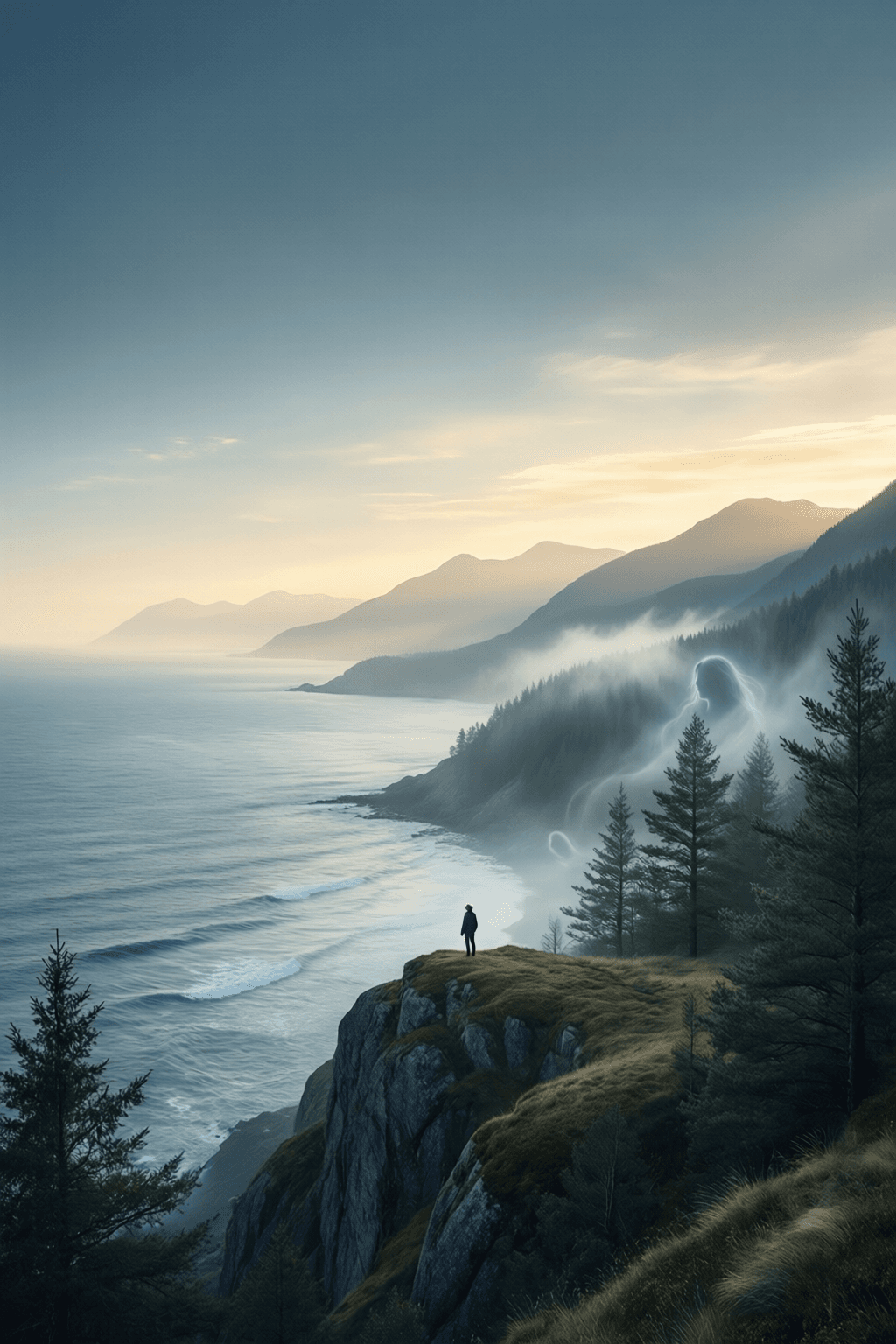
Nature is not only all that is visible to the eye, it also includes the inner pictures of the soul. — Edvard Munch
—What lingers after this line?
A Wider Meaning of Nature
At first glance, Munch’s statement expands the ordinary idea of nature beyond forests, skies, and seas. He argues that nature is not limited to what the eye can measure; it also includes the emotional and imaginative images that arise within us. In this view, the outer landscape and the inner life are not separate realms but reflections of one another. This shift matters because it turns observation into participation. Rather than standing apart from the world as detached viewers, we become part of a living exchange in which external scenes awaken memory, longing, fear, and wonder. Munch’s insight therefore invites us to see nature as both environment and experience.
The Soul as an Inner Landscape
From there, the quote moves naturally inward, suggesting that the soul itself holds landscapes just as vivid as mountains or shorelines. These “inner pictures” may be dreams, moods, memories, or symbolic visions, and they shape how each person encounters the world. A gray sky, for example, may appear peaceful to one viewer and full of sorrow to another. In this sense, Munch anticipates a psychological truth: perception is never purely objective. As Carl Jung’s writings in the early 20th century often suggest, the mind projects meaning onto what it sees. Thus, nature becomes partly external fact and partly inward revelation.
Munch’s Art and Emotional Vision
This idea becomes even clearer when placed beside Munch’s own paintings. Works such as The Scream (1893) do not simply depict a setting; they transform the landscape into a visible echo of inner anguish. The swirling sky and unstable lines feel less like a record of place than a portrait of emotional reality. Consequently, Munch’s quote reads almost like a statement of artistic method. He was not trying only to paint what stood before him, but also what stirred within him. The natural world, in his hands, became a surface onto which the soul’s hidden images could be revealed.
Romantic and Symbolist Echoes
At the same time, Munch’s thought belongs to a larger cultural tradition. Romantic writers such as William Wordsworth, especially in Lines Composed a Few Miles above Tintern Abbey (1798), treated nature as something deeply entwined with memory and feeling. Later, Symbolist artists likewise sought meanings beneath appearances, believing visible forms could hint at invisible states of mind. Munch pushes this inheritance further by fusing outer scenery with inner disturbance. As a result, nature is no longer merely comforting or sublime; it can also be haunted, intimate, and psychologically charged. His words preserve that richer, more unsettling vision.
Why the Quote Still Resonates
Finally, the enduring power of the quote lies in how accurately it describes modern experience. People still turn to landscapes not only for beauty but for self-recognition: a storm can mirror turmoil, a quiet lake can suggest healing, and a winter field can evoke loneliness. What we see outside often helps us name what we feel inside. For that reason, Munch’s insight remains more than an artistic remark. It offers a way of understanding human perception itself. Nature is never just scenery; it is also a meeting place where the visible world and the soul’s hidden images quietly come together.
Recommended Reading
As an Amazon Associate, we earn from qualifying purchases.
One-minute reflection
What's one small action this suggests?
Related Quotes
6 selectedThe glory of gardening: hands in the dirt, head in the sun, heart with nature. — Alfred Austin
Alfred Austin
Alfred Austin’s line condenses the appeal of gardening into one vivid scene: the body grounded in soil, the mind lifted by sunlight, and the emotions attuned to the natural world. At once physical and poetic, the quote s...
Read full interpretation →It is not the language of painters but the language of nature which one should listen to. — Pablo Picasso
Pablo Picasso
At first glance, Picasso’s remark challenges the authority of artistic convention. By contrasting ‘the language of painters’ with ‘the language of nature,’ he suggests that art should not merely imitate established techn...
Read full interpretation →Great art picks up where nature ends. — Marc Chagall
Marc Chagall
At its core, Marc Chagall’s remark suggests that art does not compete with nature but continues its unfinished conversation. Nature gives us raw forms—color, light, movement, emotion—while art reshapes them into meaning.
Read full interpretation →Your home is your larger body. It grows in the sun and sleeps in the stillness of the night. — Kahlil Gibran
Kahlil Gibran
At first glance, Gibran transforms the idea of home from a mere structure into something intimate and organic: “your larger body.” In this image, a dwelling is not separate from the person who inhabits it, but an outward...
Read full interpretation →Everything is blooming most recklessly; if it were voices instead of colors, there would be an unbelievable shrieking into the heart of the night. — Rainer Maria Rilke
Rainer Maria Rilke
At first glance, Rilke turns a peaceful image of blooming nature into something almost overwhelming. Flowers do not merely open; they burst forth “most recklessly,” suggesting a vitality so abundant that it exceeds calm...
Read full interpretation →Nature is infinitely creative. It is always producing the possibility of new beginnings. — Marianne Williamson
Marianne Williamson
Marianne Williamson’s reflection begins with a quiet but radical claim: creativity is not rare, accidental, or confined to human artists. Instead, it is built into nature itself.
Read full interpretation →More From Author
More from Edvard Munch →