
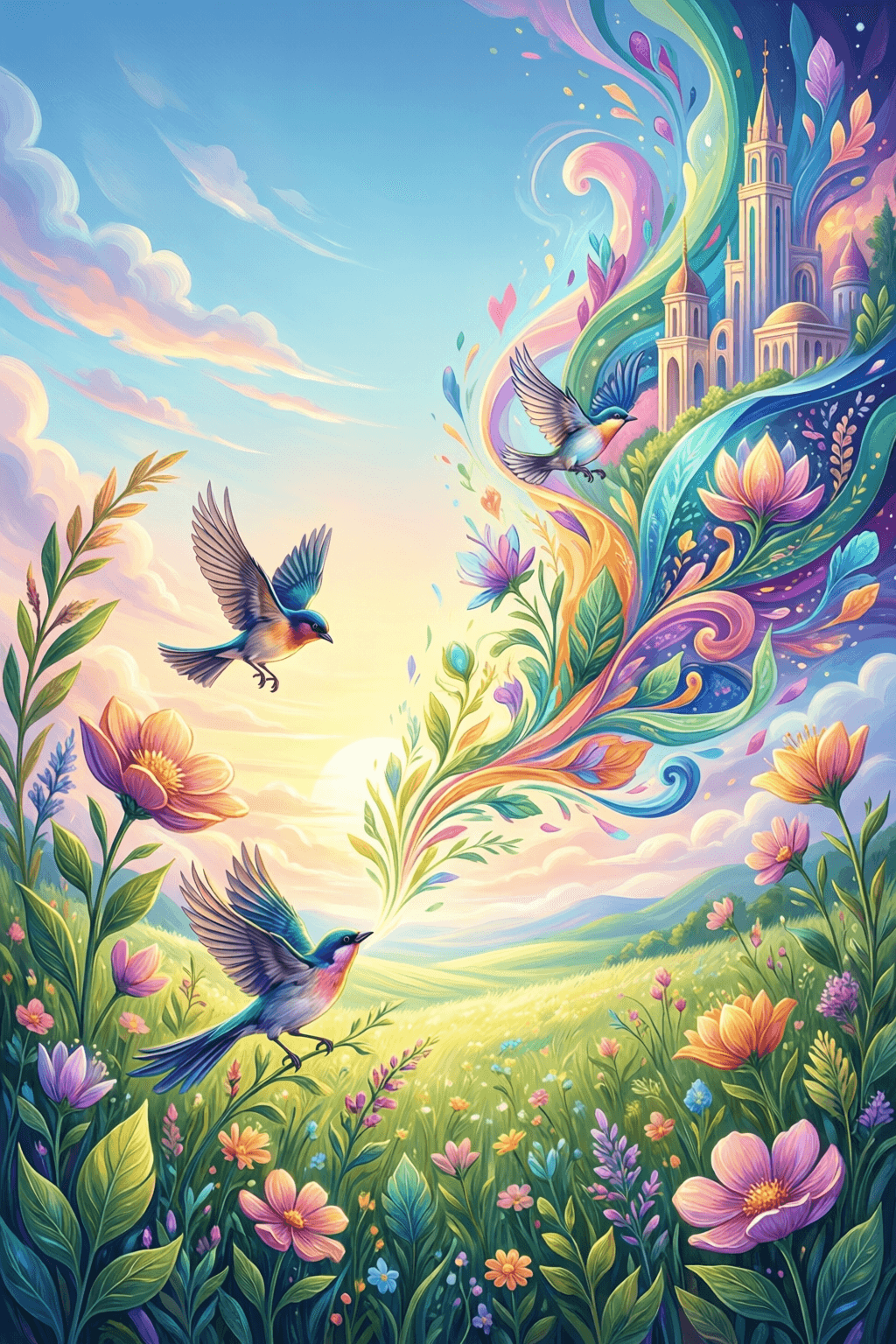
Great art picks up where nature ends. — Marc Chagall
—What lingers after this line?
Art as Nature’s Continuation
At its core, Marc Chagall’s remark suggests that art does not compete with nature but continues its unfinished conversation. Nature gives us raw forms—color, light, movement, emotion—while art reshapes them into meaning. In this sense, the painter, poet, or composer takes what already exists and carries it beyond mere appearance into imagination. This idea helps explain why art often feels both familiar and surprising. We recognize the sky, the body, the animal, or the village scene, yet through artistic vision these ordinary elements become charged with memory and wonder. Chagall’s own paintings, filled with floating lovers and dreamlike landscapes, show how nature can be transformed into a more intimate truth.
From Observation to Transformation
Building on that thought, Chagall implies that seeing alone is never enough for great art. A camera may record a field or a face, but an artist interprets it, selecting what matters and altering what reality leaves unsaid. Thus art begins with observation, yet it reaches fulfillment only through transformation. This principle appears throughout art history. Claude Monet’s water lilies, especially in the series painted between the 1890s and 1926, do not merely document a pond; they turn shifting light into an emotional atmosphere. Likewise, J. M. W. Turner’s seascapes dissolve natural forms into storms of color, suggesting that art’s task is not just to imitate the world, but to reveal what ordinary sight misses.
The Human Imagination Enters
From there, the quote opens onto the role of imagination. Nature provides the materials, but the human mind adds metaphor, memory, longing, and dream. Great art emerges precisely at that threshold where the visible world meets inner life, allowing landscapes and objects to carry emotional and spiritual weight. Chagall’s own work offers a vivid example. In paintings such as I and the Village (1911), goats, houses, and human faces appear, yet they are arranged according to poetic association rather than physical law. As a result, nature is not abandoned; rather, it is lifted into a symbolic realm. The world becomes more than what it is, because imagination teaches us to see beyond surface reality.
Why Art Feels More Than Real
Consequently, some of the most powerful artworks feel truer than literal realism. They exceed nature not by rejecting it, but by intensifying its emotional resonance. A melody can make a landscape feel lonelier, a painting can make light seem holier, and a poem can make a passing season feel eternal. This is why Vincent van Gogh’s The Starry Night (1889) still moves viewers so deeply. The night sky remains recognizable, yet its swirling energy conveys awe, unrest, and transcendence in ways no ordinary glance at the heavens could capture. In that sense, great art picks up where nature ends by giving form to the feelings nature awakens but does not itself explain.
A Spiritual Dimension of Creation
At the same time, Chagall’s statement carries a spiritual undertone. If nature is creation in its primary form, then art becomes a secondary act of creation—human beings participating in the shaping of meaning. Rather than standing outside the natural world, the artist enters into collaboration with it, drawing out hidden harmony, mystery, or tenderness. This view echoes older traditions. Aristotle’s Physics and Poetics suggest that art imitates nature not mechanically but purposively, completing what nature leaves incomplete. Centuries later, Paul Klee famously wrote in his Creative Credo (1920) that art does not reproduce the visible but makes visible. Chagall’s quote belongs to this lineage, where artistic creation deepens reality instead of merely copying it.
A Lasting Lesson for Viewers
Finally, the quote speaks not only to artists but also to those who encounter art. It encourages viewers to look for the point at which representation turns into revelation. When a work of art truly succeeds, it helps us notice patterns, emotions, and possibilities that nature alone may place before us, but that only imagination can fully uncover. For that reason, Chagall’s insight remains enduringly relevant. Great art reminds us that the world is not exhausted by what is physically present. Instead, it invites us to continue nature’s work inwardly—through feeling, thought, and wonder—until the seen world becomes inseparable from the life of the soul.
Recommended Reading
As an Amazon Associate, we earn from qualifying purchases.
One-minute reflection
What's one small action this suggests?
Related Quotes
6 selectedThere is nothing pleasanter than spading when the ground is soft and damp. — John Steinbeck
John Steinbeck
At first glance, Steinbeck’s line seems almost modest, yet its pleasure is precise and deeply felt. Spading soft, damp ground turns labor into something nearly sensual: the tool enters easily, the earth yields without re...
Read full interpretation →Nature is not only all that is visible to the eye, it also includes the inner pictures of the soul. — Edvard Munch
Edvard Munch
At first glance, Munch’s statement expands the ordinary idea of nature beyond forests, skies, and seas. He argues that nature is not limited to what the eye can measure; it also includes the emotional and imaginative ima...
Read full interpretation →Great work is done when one does what one loves. — Marc Chagall
Marc Chagall
This quote highlights that passion fuels productivity and leads to outstanding achievements.
Read full interpretation →The glory of gardening: hands in the dirt, head in the sun, heart with nature. — Alfred Austin
Alfred Austin
Alfred Austin’s line condenses the appeal of gardening into one vivid scene: the body grounded in soil, the mind lifted by sunlight, and the emotions attuned to the natural world. At once physical and poetic, the quote s...
Read full interpretation →All the arts we practice are apprenticeship. The big art is our life. — M.C. Richards
M.C. Richards
M.C. Richards turns the usual hierarchy upside down by suggesting that painting, music, poetry, and craft are not ultimate achievements but forms of preparation.
Read full interpretation →Craftsmanship is the visible edge of art. — David Bayles
David Bayles
At first glance, David Bayles’s line suggests that craftsmanship is the point where inner vision becomes outward form. Art may begin in imagination, intuition, or feeling, but it only enters the world through skillful ex...
Read full interpretation →More From Author
More from Marc Chagall →Harmony is one step on the road to freedom. — Marc Chagall
This quote implies that attaining inner or societal harmony is a prerequisite to achieving true freedom. Without peace and balance, freedom remains elusive.
Read full interpretation →Great work is done when one does what one loves. — Marc Chagall
This quote highlights that passion fuels productivity and leads to outstanding achievements.
Read full interpretation →If I create from the heart, nearly everything works; if from the head, almost nothing. — Marc Chagall
Marc Chagall’s well-known insight draws a line between intellectual calculation and authentic emotional expression in the creative arts. By asserting that art succeeds when it emerges from the heart, Chagall privileges i...
Read full interpretation →