
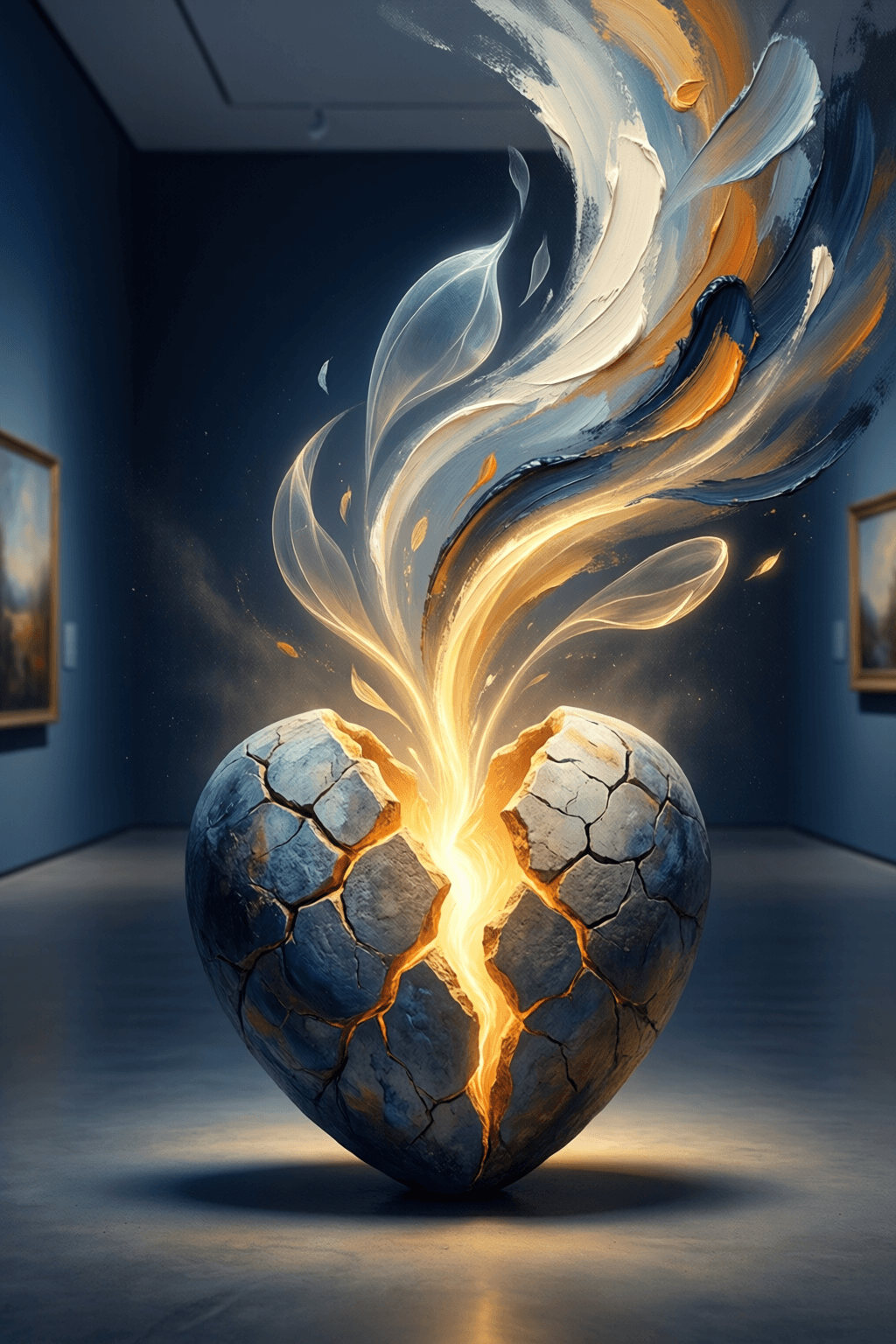
Art is a wound turned into light. — Georges Braque
—What lingers after this line?
The Metaphor at the Heart
At its core, Georges Braque’s line suggests that art does not erase suffering; instead, it converts injury into meaning. A wound is intimate, raw, and often hidden, while light is what reveals, guides, and makes things visible. By joining these opposites, Braque implies that creative expression can turn private pain into something sharable and even clarifying. In that sense, the quote captures a central artistic paradox: what hurts us most may also become the source of what we make most beautifully. Rather than denying damage, the artist works through it, shaping anguish into form, color, rhythm, or language. As a result, suffering becomes not merely endured but transformed.
Pain as Creative Material
From this starting point, the quote also reframes pain as material rather than dead weight. Many artists have drawn directly from grief, alienation, illness, or loss, not because suffering is noble in itself, but because it compels honest expression. Frida Kahlo’s paintings, especially The Broken Column (1944), for example, turn bodily suffering into an image of startling symbolic power. Similarly, Edvard Munch wrote that without anxiety and illness he would have been “a ship without a rudder,” a remark often cited in discussions of The Scream (1893). These cases do not romanticize pain so much as show how art can metabolize it. What begins as injury is given contour and structure, and therefore becomes communicable.
Light as Revelation
Yet Braque’s image depends as much on light as on the wound itself. Light suggests insight, exposure, and a movement outward from inner darkness. Once pain is made into art, it can illuminate not only the artist’s condition but also the hidden feelings of others. In this way, a personal hurt becomes a public language. This is why certain works feel revelatory: they tell us something we knew but could not articulate. Virginia Woolf’s Mrs Dalloway (1925), for instance, gives form to grief, memory, and psychological fragility with such precision that readers often recognize their own unspoken interior lives in it. Consequently, art becomes a lamp held up to human experience.
The Discipline Behind Transformation
Still, the quote should not be mistaken for a claim that pain automatically becomes beauty. A wound turns into light only through labor: revision, technique, patience, and form. Braque himself, a pioneer of Cubism alongside Pablo Picasso, understood that artistic vision required discipline as much as feeling. Raw emotion alone is not yet art; it must be shaped. Therefore, the transformation Braque describes is active rather than passive. The artist selects, arranges, and refines experience until it can bear meaning. Much as a sculptor cuts stone to release a figure, the creative mind works on suffering until it gives off coherence instead of chaos. That process is what makes illumination possible.
From Private Hurt to Shared Consolation
Because of that shaping process, art often creates connection where pain once created isolation. A wound is usually solitary; no one feels it exactly as we do. However, when it is translated into a painting, poem, song, or film, others can enter it sympathetically. The work becomes a bridge between one person’s suffering and another person’s recognition. This helps explain why audiences so often seek art during periods of loss. Whether in Billie Holiday’s “Strange Fruit” (1939) or Joan Didion’s The Year of Magical Thinking (2005), individual anguish is rendered in forms that allow collective witnessing. Thus the light Braque names is not only beauty, but also companionship—the sense that suffering has been seen and answered.
A Lasting Vision of Art’s Purpose
Ultimately, Braque offers a concise philosophy of why art matters. It is not decorative escape alone, nor simply self-expression, but a means of transmutation. The artist takes what is broken, painful, or unresolved and gives it radiance without falsifying its origins. The wound remains real, yet it no longer exists only as damage. For that reason, the quote continues to resonate across modern culture. It affirms that creativity can make life more intelligible precisely where life hurts most. In the end, Braque’s image is hopeful without being sentimental: art does not deny suffering, but by turning it into light, it ensures that pain can become vision.
One-minute reflection
Where does this idea show up in your life right now?
Related Quotes
6 selectedThe goal of life is rapture. Art is the way we experience it. — Joseph Campbell
Joseph Campbell
Joseph Campbell’s statement begins with a bold claim: life is not merely about survival, achievement, or social approval, but about rapture—a heightened state of wonder, intensity, and felt aliveness. By placing rapture...
Read full interpretation →The old skin has to be shed before the new one can come. — Joseph Campbell
Joseph Campbell
Joseph Campbell’s image of old skin being shed before new skin can appear turns personal growth into something vivid and bodily. At its core, the quote suggests that renewal is not simply about adding better habits or br...
Read full interpretation →If seeds in the black earth can turn into such beautiful roses, what might not the heart of man become in its long journey toward the stars? — G.K. Chesterton
G. K. Chesterton
Chesterton begins with a striking contrast: black earth, dark and ordinary, somehow gives rise to roses of astonishing beauty. From that image, he invites us to see human nature in the same light.
Read full interpretation →All the arts we practice are apprenticeship. The big art is our life. — M.C. Richards
M.C. Richards
M.C. Richards turns the usual hierarchy upside down by suggesting that painting, music, poetry, and craft are not ultimate achievements but forms of preparation.
Read full interpretation →Craftsmanship is the visible edge of art. — David Bayles
David Bayles
At first glance, David Bayles’s line suggests that craftsmanship is the point where inner vision becomes outward form. Art may begin in imagination, intuition, or feeling, but it only enters the world through skillful ex...
Read full interpretation →Art is not a thing; it is a way. — Elbert Hubbard
Elbert Hubbard
Elbert Hubbard’s line immediately shifts attention away from paintings, sculptures, or books as isolated products. Instead, he suggests that art lives in the manner of seeing, choosing, and shaping experience.
Read full interpretation →More From Author
More from Georges Braque →