
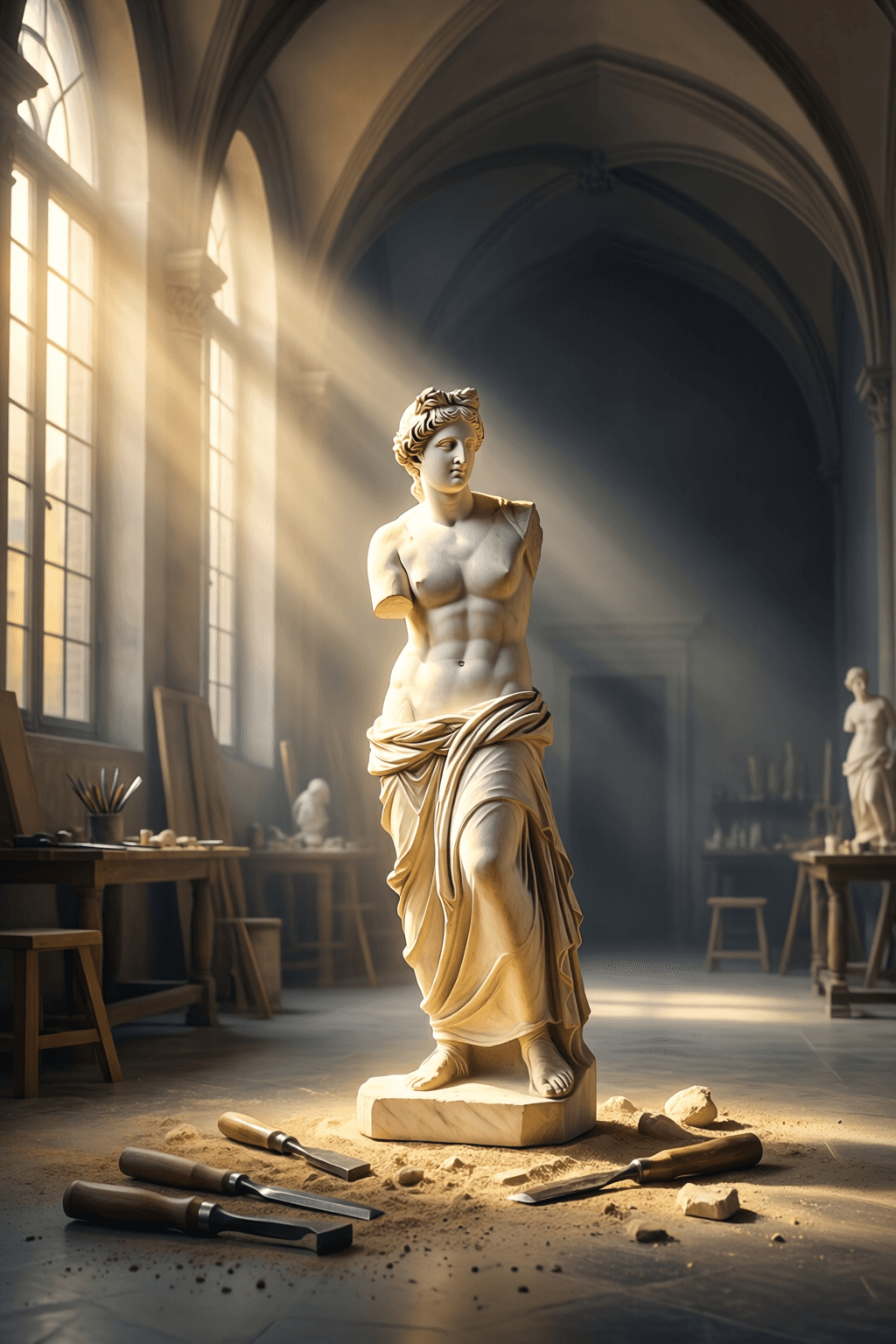
The true work of art is but a shadow of the divine perfection. — Michelangelo
—What lingers after this line?
A Humble View of Artistic Creation
Michelangelo’s statement immediately frames art as an act of humility rather than conquest. Instead of claiming that human creativity rivals ultimate truth, he suggests that even the finest painting or sculpture merely reflects a higher, perfect reality. In this view, the artist does not invent perfection but glimpses it imperfectly and tries to translate that vision into matter. This idea also helps explain the reverence surrounding Renaissance art. Michelangelo, who painted the Sistine Chapel ceiling (1508–1512) and carved the Pietà (1498–1499), worked at a time when beauty was often understood as evidence of divine order. Thus, his quote is not self-deprecation alone; it is a philosophy of creation in which human skill becomes meaningful precisely because it reaches toward something greater than itself.
The Influence of Platonic Ideals
From there, Michelangelo’s words connect naturally to the Platonic tradition. Plato’s Republic (c. 375 BC) and Symposium describe earthly beauty as a reflection of ideal, eternal forms, meaning that what we see in the world is never the fullest version of reality. Michelangelo’s phrase “shadow of the divine perfection” echoes this inheritance almost exactly: art is powerful, but it remains a copy of a higher truth. As a result, the artist becomes a mediator between visible and invisible realms. A statue in marble may suggest courage, grace, or holiness, yet it cannot contain these qualities in their purest state. What it can do, however, is awaken the viewer’s memory of transcendence, pointing beyond itself toward the perfection it can only partially embody.
Christian Beauty and Sacred Purpose
At the same time, Michelangelo’s thought is deeply Christian, not merely classical. In Renaissance theology, beauty often served as a sign of God’s presence, and sacred art functioned as a visual form of devotion. Seen in this light, a fresco or sculpture was not simply decoration but a spiritual instrument, guiding the mind upward. The divine perfection he mentions is therefore not an abstract concept alone but the fullness of God. This sacred purpose appears vividly in works like The Creation of Adam on the Sistine Chapel ceiling, where the near-touching hands dramatize the gap between human limitation and divine life. Accordingly, Michelangelo’s quote suggests that art matters most when it reveals that gap honestly—when it stirs longing for what lies beyond human reach rather than pretending to replace it.
The Tension Between Material and Ideal
Yet the quote also carries a quiet tension: art is made from stubborn materials, while perfection is immaterial. Marble cracks, pigment fades, and human hands tire, so every artwork bears the marks of limitation. Michelangelo knew this intimately, especially in his unfinished Slaves sculptures, whose figures seem to struggle out of stone as though human aspiration itself were trapped within matter. Consequently, the “shadow” in his statement may be understood not as failure but as condition. Art’s incompleteness is what makes it moving. Because it cannot fully become divine perfection, it preserves the drama of striving. The viewer encounters both achievement and absence at once, sensing in the finished surface the unreachable ideal that called the work into being.
Why Imperfect Art Still Moves Us
Finally, Michelangelo’s insight explains why art remains emotionally and spiritually powerful despite its limits. A shadow is not the thing itself, yet it testifies that the thing exists. In the same way, a great work of art can awaken awe, sorrow, peace, or wonder precisely because it hints at a perfection beyond ordinary experience. Its power lies in suggestion rather than possession. This is why viewers still stand in silence before the Pietà or the Sistine Chapel centuries later. They are responding not only to technical brilliance but to the sense that these works open onto something larger than human craftsmanship. Michelangelo’s quote therefore offers a lasting definition of artistic greatness: true art does not claim divinity for itself; it directs the soul toward it.
One-minute reflection
Where does this idea show up in your life right now?
Related Quotes
6 selectedThe goal of life is rapture. Art is the way we experience it. — Joseph Campbell
Joseph Campbell
Joseph Campbell’s statement begins with a bold claim: life is not merely about survival, achievement, or social approval, but about rapture—a heightened state of wonder, intensity, and felt aliveness. By placing rapture...
Read full interpretation →All the arts we practice are apprenticeship. The big art is our life. — M.C. Richards
M.C. Richards
M.C. Richards turns the usual hierarchy upside down by suggesting that painting, music, poetry, and craft are not ultimate achievements but forms of preparation.
Read full interpretation →Craftsmanship is the visible edge of art. — David Bayles
David Bayles
At first glance, David Bayles’s line suggests that craftsmanship is the point where inner vision becomes outward form. Art may begin in imagination, intuition, or feeling, but it only enters the world through skillful ex...
Read full interpretation →Art is not a thing; it is a way. — Elbert Hubbard
Elbert Hubbard
Elbert Hubbard’s line immediately shifts attention away from paintings, sculptures, or books as isolated products. Instead, he suggests that art lives in the manner of seeing, choosing, and shaping experience.
Read full interpretation →It is not the language of painters but the language of nature which one should listen to. — Pablo Picasso
Pablo Picasso
At first glance, Picasso’s remark challenges the authority of artistic convention. By contrasting ‘the language of painters’ with ‘the language of nature,’ he suggests that art should not merely imitate established techn...
Read full interpretation →Art is man's expression of his joy in labor. — Henry Kissinger
Henry Kissinger
At first glance, Henry Kissinger’s remark suggests that art does not arise apart from work but grows directly out of it. In this view, labor is not merely toil or obligation; it becomes meaningful when human beings impri...
Read full interpretation →More From Author
More from Michelangelo →If people knew how hard I had to work to gain my mastery, it would not seem so wonderful at all. — Michelangelo
At first glance, Michelangelo’s remark strips genius of its mystique. Rather than presenting mastery as a gift bestowed at birth, he insists that extraordinary achievement is rooted in sustained and often invisible effor...
Read full interpretation →I am still learning. — Michelangelo
Michelangelo’s brief statement, “I am still learning,” carries unusual force because it comes from a master whose achievements might have justified certainty. Instead, he presents knowledge as unfinished and the self as...
Read full interpretation →Chisel away the needless to reveal the bold figure of what you are meant to be. — Michelangelo
Michelangelo’s line frames identity as something already present, waiting beneath excess. Instead of “building” a self from scratch, he suggests we uncover a truer form by removing what obscures it—habits, fears, and bor...
Read full interpretation →Chisel away at your fears until only the sculpture of your purpose remains. — Michelangelo
Michelangelo’s metaphor invites us to imagine fear not as an enemy to be destroyed, but as surplus marble hiding who we really are. Just as a block of stone contains a statue within it, our lives often contain a clear pu...
Read full interpretation →