
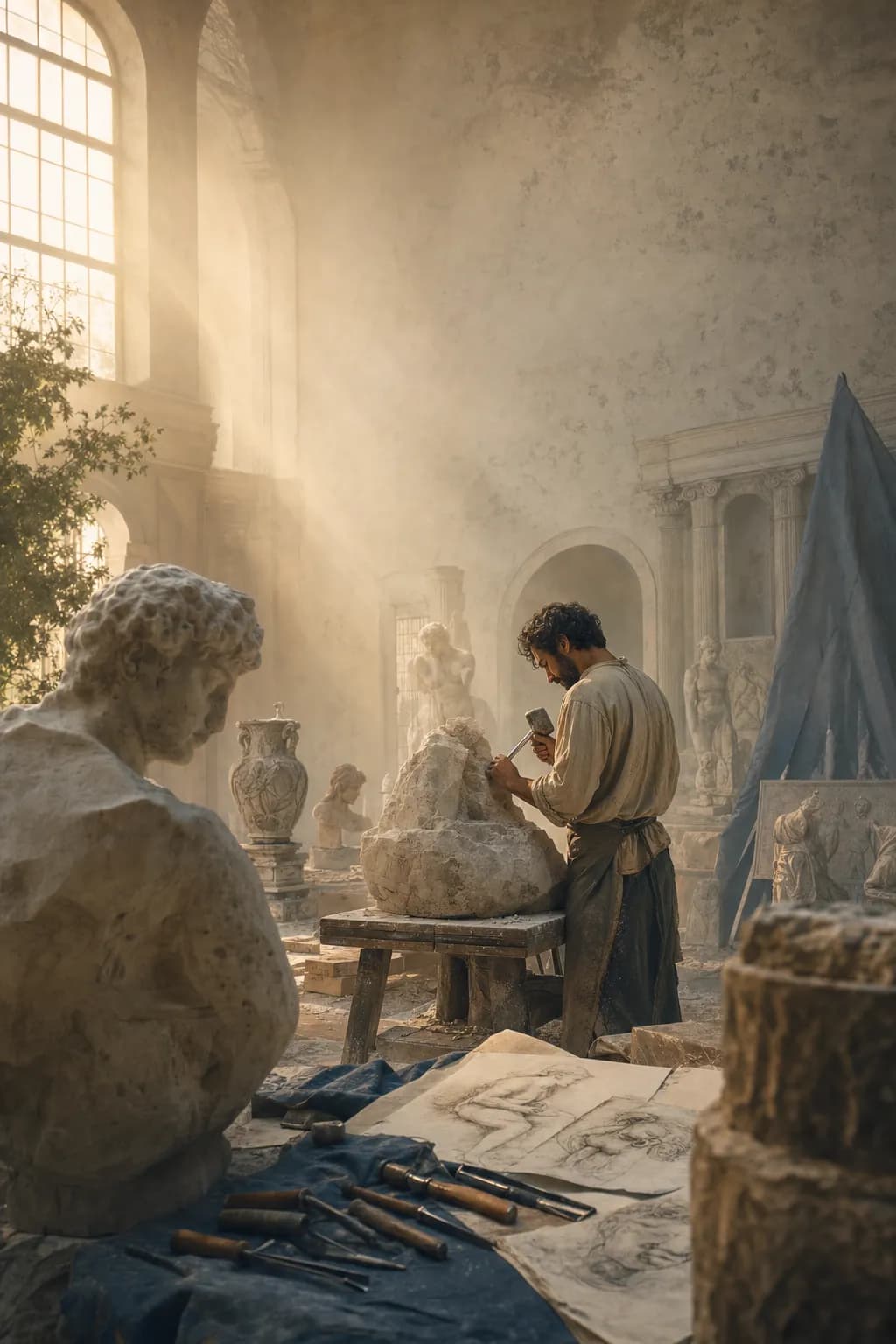
I am still learning. — Michelangelo
—What lingers after this line?
Humility in a Few Words
Michelangelo’s brief statement, “I am still learning,” carries unusual force because it comes from a master whose achievements might have justified certainty. Instead, he presents knowledge as unfinished and the self as always in progress. In that sense, the quote transforms greatness from a fixed status into an ongoing practice of humility. This humility is precisely what gives the line its enduring appeal. Rather than treating learning as something that ends with age or success, Michelangelo suggests that wisdom begins when we admit how much remains unknown. The remark therefore feels less like a confession of inadequacy and more like a declaration of intellectual vitality.
A Master Who Refused Completion
Seen in context, the quote becomes even more striking. Michelangelo, the sculptor of the David and painter of the Sistine Chapel ceiling, was already celebrated across Europe, yet accounts often attribute to his later years the phrase “Ancora imparo” or “I am still learning.” Whether repeated exactly as legend tells it or not, the sentiment fits a life marked by relentless revision and ambition. Accordingly, the statement reflects more than modesty; it captures the discipline of a creator who never considered his craft finished. Renaissance artists studied anatomy, architecture, poetry, and theology alongside technique, and Michelangelo’s career shows how mastery often expands, rather than narrows, a person’s curiosity.
The Renaissance Ideal of Lifelong Study
From there, the quote opens onto a larger Renaissance worldview. Humanists such as Petrarch and Erasmus promoted the continual cultivation of the mind, arguing that education was not merely for youth but for the shaping of a whole life. Michelangelo’s words fit naturally within that tradition, where learning meant becoming more fully human through constant effort. As a result, the phrase resists the modern temptation to divide life neatly into periods of schooling and periods of expertise. Instead, it suggests a more fluid model: one learns, creates, fails, adjusts, and learns again. In this way, the line becomes not only personal but civilizational, expressing a culture that prized growth over complacency.
Why the Quote Still Resonates
Even so, the saying feels distinctly modern because it answers a familiar anxiety: the fear of not knowing enough. In classrooms, workplaces, and creative fields, people often assume competence means having immediate answers. Michelangelo offers a gentler alternative, implying that the truly accomplished person remains open, curious, and corrigible. Consequently, the quote can be read as encouragement for beginners as much as for experts. A student struggling with first attempts may hear permission to continue imperfectly, while a seasoned professional may hear a warning against stagnation. The same words thus bridge insecurity and excellence by reminding both groups that learning is the common condition.
Learning as a Sign of Inner Youth
Finally, Michelangelo’s remark carries a subtle philosophy of aging. To say “I am still learning” is to refuse spiritual rigidity; it keeps the mind active and the imagination porous. In many traditions, from Socrates’ profession of ignorance in Plato’s Apology (c. 399 BC) to modern educational thought, openness to learning signals not weakness but aliveness. Therefore, the quote endures because it joins dignity with incompleteness. It suggests that a meaningful life is not measured by reaching a final state of mastery, but by preserving the willingness to grow. What sounds simple at first ultimately becomes profound: as long as one is learning, one is still becoming.
Recommended Reading
As an Amazon Associate, we earn from qualifying purchases.
One-minute reflection
Why might this line matter today, not tomorrow?
Related Quotes
6 selectedGrowth often looks more like subtraction than addition. — Brené Brown
Brené Brown
At first glance, growth seems like an act of accumulation: more skills, more confidence, more achievements. Yet Brené Brown’s line reverses that expectation by suggesting that development often begins with removal.
Read full interpretation →One doesn't get to be a master of one's own life by rushing. You have to learn the patience of a gardener who knows the harvest cannot be hurried. — Paulo Coelho
Paulo Coelho
At its core, Paulo Coelho’s reflection challenges a modern obsession with speed. He argues that mastery over one’s life does not come from frantic action or constant acceleration, but from learning when to wait, observe,...
Read full interpretation →Everything that happens is a form of instruction if you choose to listen. — Rumi
Rumi
At its core, Rumi’s line reframes ordinary experience as a living classroom. Nothing is merely random noise if one approaches it with attention; instead, each success, disappointment, encounter, or delay carries the poss...
Read full interpretation →If you are not willing to learn, no one can help you. If you are determined to learn, no one can stop you. — Zig Ziglar
Zig Ziglar
Zig Ziglar’s quote begins with a blunt truth: learning cannot be forced from the outside. Teachers, mentors, and books may offer guidance, yet none of them can move a closed mind.
Read full interpretation →When you plant seeds in the garden, you don't dig them up every day to see if they have sprouted yet. You simply water them and clear away the weeds; you know that the seeds will grow in time. — Thubten Chodron
Thubten Chodron
Thubten Chodron’s image of planting seeds turns patience into something practical and visible. Once a seed is placed in the soil, constant interference does not help it grow; in fact, it can damage what is beginning invi...
Read full interpretation →Learning technique is a way to make your soul grow. So do it. — Vincent van Gogh
Vincent van Gogh
Van Gogh’s brief statement turns learning into more than a practical task; it becomes an ethical and spiritual imperative. By saying that learning technique helps the soul grow, he suggests that disciplined study does no...
Read full interpretation →More From Author
More from Michelangelo →The true work of art is but a shadow of the divine perfection. — Michelangelo
Michelangelo’s statement immediately frames art as an act of humility rather than conquest. Instead of claiming that human creativity rivals ultimate truth, he suggests that even the finest painting or sculpture merely r...
Read full interpretation →Chisel away the needless to reveal the bold figure of what you are meant to be. — Michelangelo
Michelangelo’s line frames identity as something already present, waiting beneath excess. Instead of “building” a self from scratch, he suggests we uncover a truer form by removing what obscures it—habits, fears, and bor...
Read full interpretation →Chisel away at your fears until only the sculpture of your purpose remains. — Michelangelo
Michelangelo’s metaphor invites us to imagine fear not as an enemy to be destroyed, but as surplus marble hiding who we really are. Just as a block of stone contains a statue within it, our lives often contain a clear pu...
Read full interpretation →Treat each mistake as a sketch toward the masterpiece you intend to carve. — Michelangelo
Michelangelo’s admonition invites a shift in perspective: see every mistake not as a blot to erase but as a guiding line toward form. In sculpture, the subtractive process makes this literal—one removes what does not bel...
Read full interpretation →