
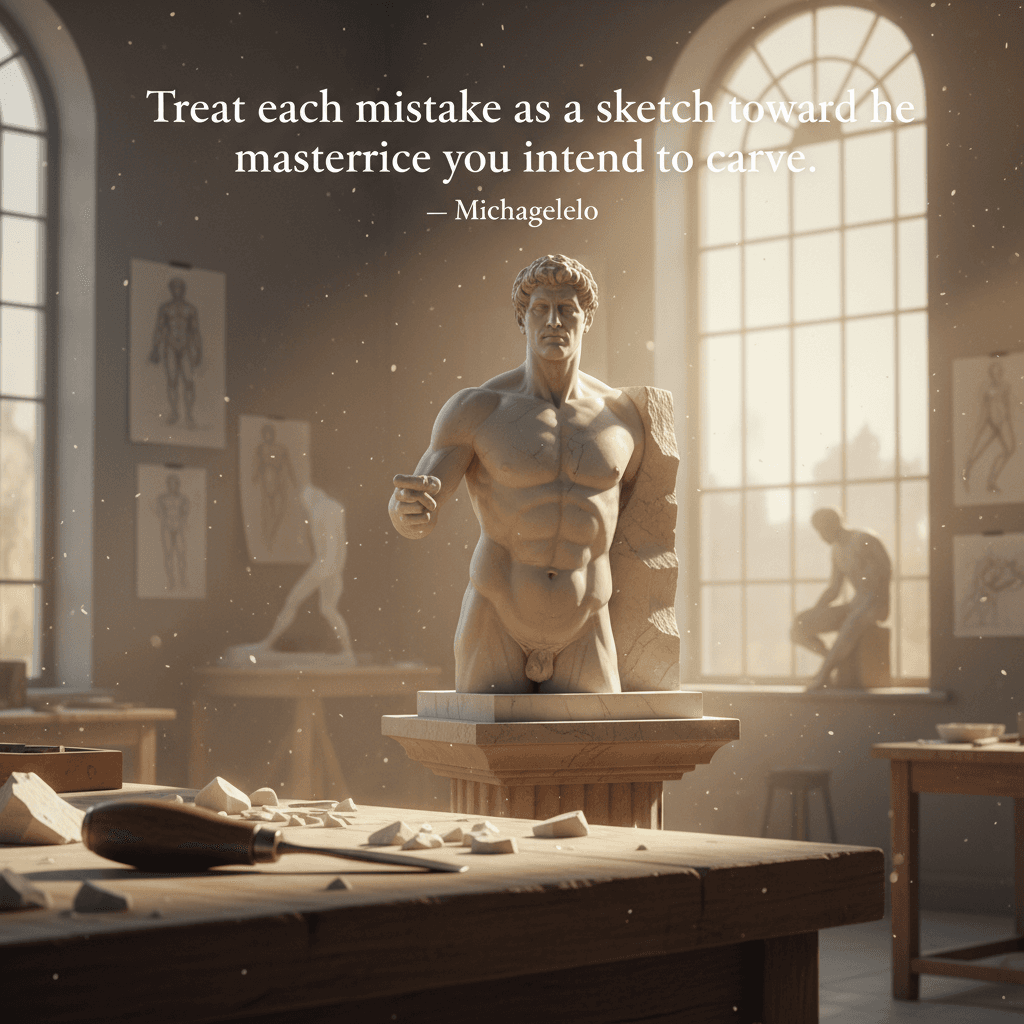
Treat each mistake as a sketch toward the masterpiece you intend to carve. — Michelangelo
—What lingers after this line?
From Error to Outline
Michelangelo’s admonition invites a shift in perspective: see every mistake not as a blot to erase but as a guiding line toward form. In sculpture, the subtractive process makes this literal—one removes what does not belong to reveal what does. So too in life and craft, missteps become provisional marks that map the distance between intention and execution. By treating each error as a sketch, we move from self-judgment to discovery.
Renaissance Workshop Habits
Building on that idea, Renaissance studios normalized iteration. Artists produced studies, cartoons, and clay bozzetti before touching marble, translating mistakes into plans for refinement. Cennino Cennini’s Il Libro dell’Arte (c. 1400) advises practice through repeated trials, corrections, and patient reworking—habits that convert uncertainty into method. In this lineage, a flawed attempt becomes a rehearsal, sharpening hand and eye for the final stroke.
Michelangelo’s Non-finito and the Flawed Block
Michelangelo turned imperfection into momentum. David (1501–1504) rose from a weathered, previously rejected block known as “the Giant,” a fact noted by Vasari’s Lives (1550/1568) and Ascanio Condivi’s biography (1553). The block’s defects did not halt the work; they shaped it. Likewise, his non-finito “Prisoners” seem to wrest themselves from stone, as if the rough toolmarks and “mistakes” were evidence of emergence. Even the apocryphal remark attributed to him—“I saw the angel in the marble and carved until I set him free”—captures this stance: the unwanted is not waste but a waypoint.
Iteration Across Creative Fields
Extending beyond marble, creative progress often looks like disciplined trial. James Dyson recounts building 5,127 prototypes before his cyclone vacuum worked as intended (Against the Odds, 1997), each failed device a sketch of the next. In music, improvisers practice “call and response” with their own errors, folding stray notes into new motifs. Similarly, design teams prototype quickly, test, and revise—treating every flaw as feedback that clarifies the final form.
The Psychology of a Growth Mindset
Psychology reinforces this craft wisdom. Carol Dweck’s research on growth mindset (Mindset, 2006) shows that people who frame errors as information persist longer and learn faster. Rather than equating failure with identity, they translate it into strategy: What did this attempt reveal? What adjustment becomes obvious now? In that light, mistakes cease to be verdicts; they become instructions for the next cut of the chisel.
Practices for Sculpting Forward
Finally, the mindset becomes habit through structure. Keep micro-drafts and versioned work so each revision inherits lessons from the last. Write brief postmortems after setbacks, recording what to try differently. Invite red-team critiques early, when change is still cheap. Even aesthetics can guide resilience: kintsugi, the 15th‑century Japanese art of repairing ceramics with lacquer and gold, honors cracks as part of the object’s story. Likewise, by inlaying our process with the gold of insight, we let each mistake sketch the contours of a masterpiece in progress.
One-minute reflection
Where does this idea show up in your life right now?
Related Quotes
6 selectedStart thinking of yourself as an artist and your life as a work-in-progress. Works-in-progress are never perfect, but changes can be made. — Dean Graziosi
Dean Graziosi
Dean Graziosi’s quote invites us to shift from judgment to creation. Rather than seeing life as a finished product that must already be flawless, he asks us to imagine it as a canvas still being painted.
Read full interpretation →The painting has a life of its own. I try to let it come through. — Jackson Pollock
Jackson Pollock
At first glance, Jackson Pollock’s remark gives the painting an almost independent existence, as though the canvas carries its own pulse before the artist fully understands it. Rather than describing painting as pure con...
Read full interpretation →The creative process is not a straight line, but a labyrinth. To get lost in it is not a failure; it is the only way to find the hidden things worth saying. — M.C. Richards
M.C. Richards
At its core, M.C. Richards rejects the comforting myth that creative work unfolds through orderly steps.
Read full interpretation →To create something new, one must first learn to be comfortable with the mess of the process. — Yayoi Kusama
Yayoi Kusama
At first glance, Yayoi Kusama’s insight reframes creativity as something far less polished than people often imagine. To create something truly new, she suggests, one must stop fearing confusion, failed attempts, and unf...
Read full interpretation →The creative process is a sanctuary for healing, a space where resilience is transformed into art that speaks to our shared humanity. — Ben Okri
Ben Okri
At its heart, Ben Okri’s statement imagines the creative process as more than production; it becomes a refuge. A sanctuary is a place of shelter, and by choosing that word, Okri suggests that making art offers protection...
Read full interpretation →It is through the process of creating that we discover who we are, not by waiting for a finished masterpiece to tell us. — Twyla Tharp
Twyla Tharp
Twyla Tharp’s insight begins with a reversal of a common assumption: we often imagine that identity arrives fully formed and then expresses itself through art, work, or achievement. Instead, she argues that we come to kn...
Read full interpretation →More From Author
More from Michelangelo →If people knew how hard I had to work to gain my mastery, it would not seem so wonderful at all. — Michelangelo
At first glance, Michelangelo’s remark strips genius of its mystique. Rather than presenting mastery as a gift bestowed at birth, he insists that extraordinary achievement is rooted in sustained and often invisible effor...
Read full interpretation →I am still learning. — Michelangelo
Michelangelo’s brief statement, “I am still learning,” carries unusual force because it comes from a master whose achievements might have justified certainty. Instead, he presents knowledge as unfinished and the self as...
Read full interpretation →The true work of art is but a shadow of the divine perfection. — Michelangelo
Michelangelo’s statement immediately frames art as an act of humility rather than conquest. Instead of claiming that human creativity rivals ultimate truth, he suggests that even the finest painting or sculpture merely r...
Read full interpretation →Chisel away the needless to reveal the bold figure of what you are meant to be. — Michelangelo
Michelangelo’s line frames identity as something already present, waiting beneath excess. Instead of “building” a self from scratch, he suggests we uncover a truer form by removing what obscures it—habits, fears, and bor...
Read full interpretation →