
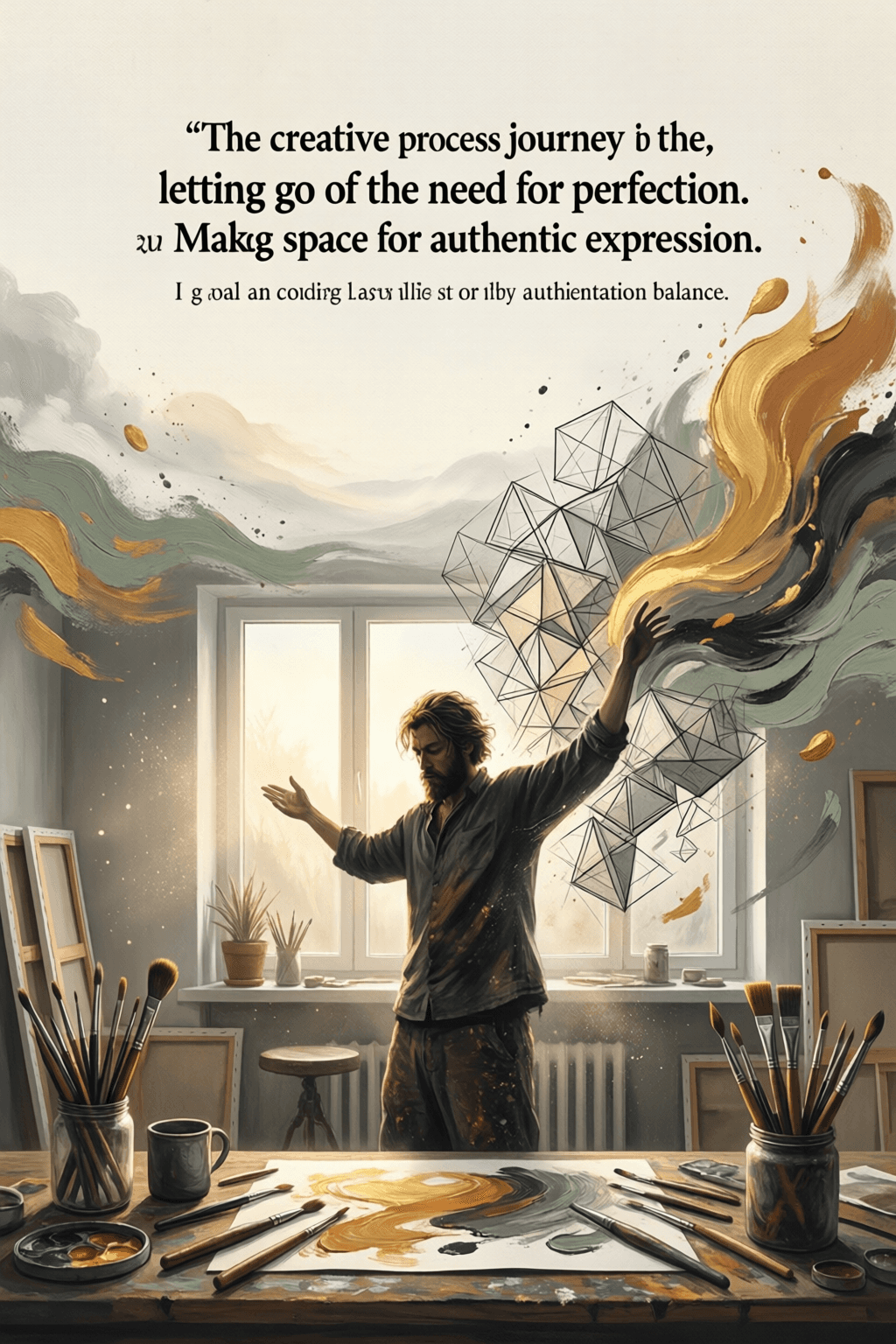
The creative process is a journey of letting go of the need for perfection to make space for the truth of expression. — Rick Rubin
—What lingers after this line?
Perfection as a Creative Barrier
Rick Rubin’s quote begins with a reversal of a common assumption: many people believe great art comes from flawless execution, yet he argues that the creative process starts by releasing that demand. In this view, perfection is not a noble standard but a barrier that can stiffen instinct, delay experimentation, and silence the raw impulses from which original work often emerges. From there, the quote reframes creativity as an act of subtraction rather than control. The artist does not force truth into existence; instead, by loosening the grip of judgment, they allow something honest to surface. What matters is not polish at the outset, but the willingness to make room for expression before evaluating it.
Why Letting Go Feels So Difficult
That said, abandoning perfection is emotionally demanding because perfection often masquerades as safety. If a painter delays the first stroke or a writer endlessly revises the opening sentence, the ritual can feel disciplined, but beneath it may lie fear of exposure. Rubin’s insight suggests that what we call high standards sometimes protects us from the vulnerability of being seen clearly. Consequently, the journey he describes is inward as much as artistic. To let go of perfection is to accept incompleteness, awkward drafts, and uncertain outcomes. Anne Lamott’s Bird by Bird (1994) famously champions the ‘shitty first draft,’ echoing Rubin’s belief that authenticity usually arrives before refinement, not after it.
Expression Before Evaluation
Once perfection loosens its hold, expression can take priority over assessment. This does not mean craft becomes irrelevant; rather, it means timing matters. In the early stages of making something, constant critique can interrupt flow, while open exploration invites surprises that a stricter mindset would reject too quickly. In that sense, Rubin’s quote aligns with many artists’ working methods. Jazz improvisation offers a vivid example: a musician follows feeling, rhythm, and response before deciding what should remain. Similarly, Julia Cameron’s The Artist’s Way (1992) encourages uninterrupted ‘morning pages,’ a practice built on the premise that truth emerges more readily when censorship is temporarily suspended.
Truth as the Core of Art
As the quote moves from perfection to truth, it also defines what creative success might really be. Truth of expression does not necessarily mean autobiography or confession; instead, it points to emotional honesty, tonal integrity, and a sense that the work genuinely belongs to its maker. A technically perfect piece can still feel empty, while an imperfect one can feel startlingly alive. This distinction appears throughout art history. Vincent van Gogh’s letters, especially those collected in The Letters of Vincent van Gogh, reveal his pursuit of feeling over finish, and that urgency remains central to how viewers experience his paintings. Rubin’s idea follows the same path: art lasts not because it is spotless, but because it carries an unmistakable human presence.
The Journey of Making and Becoming
Importantly, Rubin calls the creative process a journey, implying that this release of perfection is not a single breakthrough but a recurring practice. Artists often learn, forget, and relearn the lesson with each new project. Every blank page or empty studio can reactivate the old desire to control outcomes, and every act of beginning asks for surrender again. Therefore, the quote speaks not only to making better art but also to becoming a freer maker. By choosing truth over perfection repeatedly, creators build trust in their own instincts. Over time, the process becomes less about proving skill and more about deepening honesty, which is often where the most resonant work begins.
A Practical Lesson for Everyday Creators
Ultimately, Rubin’s insight extends beyond professional artists to anyone trying to make something meaningful. A student drafting an essay, a designer sketching ideas, or a parent composing a heartfelt letter all face the same temptation to overcorrect before the real feeling arrives. His quote offers a simple but difficult discipline: begin imperfectly, listen closely, and refine later. In practical terms, this approach creates momentum. The first version exists to reveal direction, not to prove worth. Only after truth has been expressed can craft shape it more effectively. Thus, the journey Rubin describes becomes both liberating and useful: by releasing perfection at the door, creators invite work that is more vivid, personal, and alive.
Recommended Reading
As an Amazon Associate, we earn from qualifying purchases.
One-minute reflection
What's one small action this suggests?
Related Quotes
6 selectedThe craft is not in holding tight, but in release: letting the work reveal its own nature. — Lloyd Alexander
Lloyd Alexander
At first glance, Lloyd Alexander’s line reframes craftsmanship in a surprising way: the maker’s skill does not lie in controlling every outcome, but in knowing when to loosen the grip. Rather than forcing a work into a p...
Read full interpretation →The creative process is a journey through your own vulnerability. When you stop running from the discomfort of the blank page, you finally start creating from the truth of who you are. — Brené Brown
Brené Brown
Brené Brown’s quote begins with a familiar image: the blank page as both invitation and threat. At first, that emptiness can feel exposing because it offers no place to hide behind polish, certainty, or imitation.
Read full interpretation →The creative process is not a straight line, but a labyrinth. To get lost in it is not a failure; it is the only way to find the hidden things worth saying. — M.C. Richards
M.C. Richards
At its core, M.C. Richards rejects the comforting myth that creative work unfolds through orderly steps.
Read full interpretation →To create something new, one must first learn to be comfortable with the mess of the process. — Yayoi Kusama
Yayoi Kusama
At first glance, Yayoi Kusama’s insight reframes creativity as something far less polished than people often imagine. To create something truly new, she suggests, one must stop fearing confusion, failed attempts, and unf...
Read full interpretation →The creative process is a sanctuary for healing, a space where resilience is transformed into art that speaks to our shared humanity. — Ben Okri
Ben Okri
At its heart, Ben Okri’s statement imagines the creative process as more than production; it becomes a refuge. A sanctuary is a place of shelter, and by choosing that word, Okri suggests that making art offers protection...
Read full interpretation →It is through the process of creating that we discover who we are, not by waiting for a finished masterpiece to tell us. — Twyla Tharp
Twyla Tharp
Twyla Tharp’s insight begins with a reversal of a common assumption: we often imagine that identity arrives fully formed and then expresses itself through art, work, or achievement. Instead, she argues that we come to kn...
Read full interpretation →More From Author
More from Rick Rubin →The most important work you do will not be the content you feed the machine, but the craft you refine in silence. — Rick Rubin
Rick Rubin’s statement shifts attention away from visible output and toward the invisible discipline that shapes it. At first glance, he contrasts “the content you feed the machine” with “the craft you refine in silence,...
Read full interpretation →Don't worry about being original; worry about being authentic. Originality is a side effect of truth. — Rick Rubin
Rick Rubin’s remark immediately overturns a common creative anxiety: the pressure to be unlike anyone else. Instead, he argues that authenticity should come first, because work grounded in honest perception carries a for...
Read full interpretation →The goal is to get to the point where you're not thinking anymore. You're just reacting to the magic. — Rick Rubin
Rick Rubin’s line points to a subtle creative destination: the moment thinking stops being the driver and becomes, at most, a quiet passenger. Instead of deliberating over each choice, the artist responds in real time—li...
Read full interpretation →You have to be willing to be bad at something to become good at it. — Rick Rubin
Rick Rubin’s line points to an uncomfortable truth: the first step toward competence often looks like incompetence. In a culture that rewards polished outcomes, beginners can feel exposed, as if early mistakes are eviden...
Read full interpretation →