
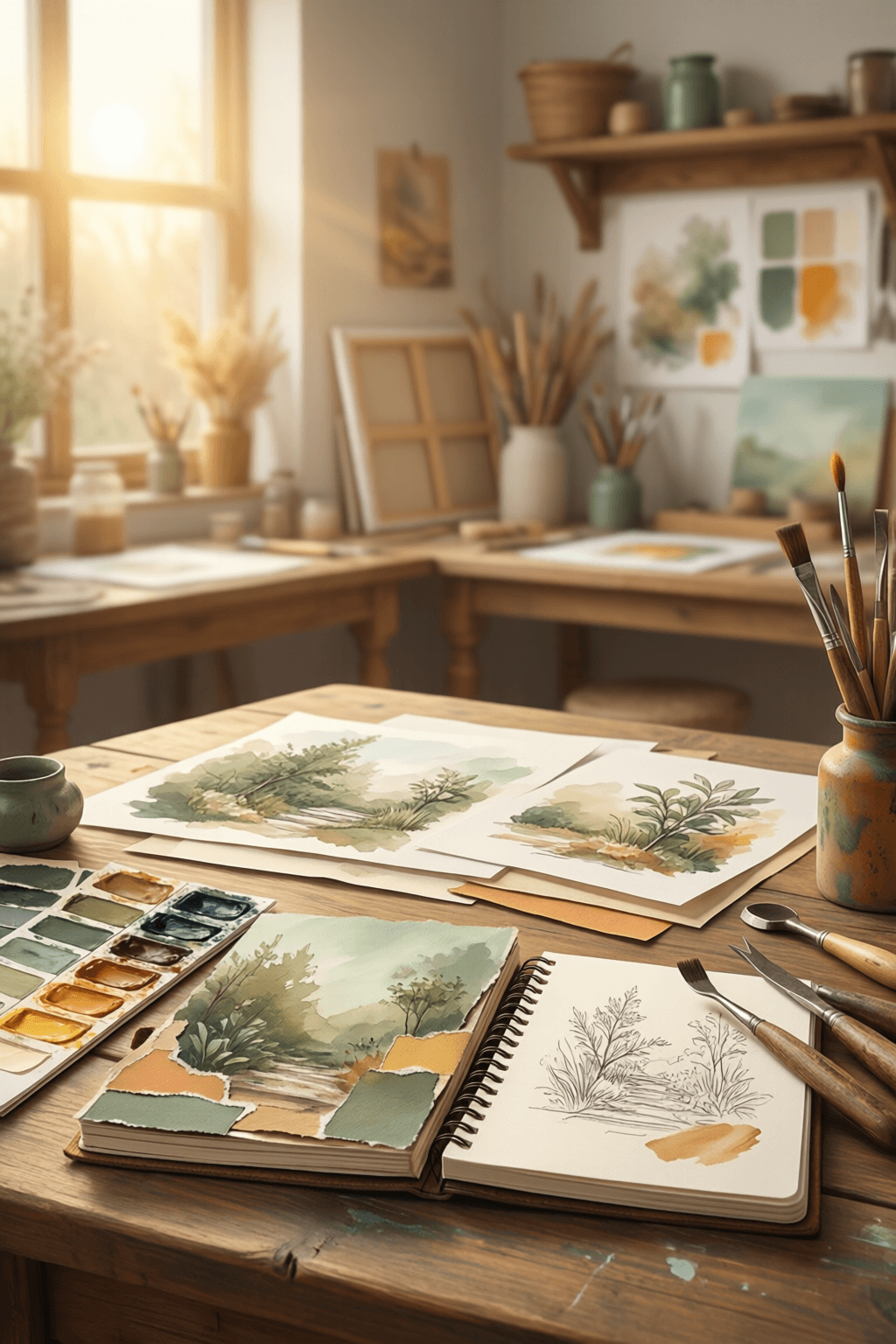
Start thinking of yourself as an artist and your life as a work-in-progress. Works-in-progress are never perfect, but changes can be made. — Dean Graziosi
—What lingers after this line?
The Creative Frame of Selfhood
Dean Graziosi’s quote invites us to shift from judgment to creation. Rather than seeing life as a finished product that must already be flawless, he asks us to imagine it as a canvas still being painted. In that frame, imperfections stop being proof of failure and become evidence that the work is alive, evolving, and still open to revision. This metaphor matters because it restores agency. An artist does not throw away a piece simply because one section is awkward; instead, they return to it, layer by layer, making adjustments. Likewise, a person can revisit habits, beliefs, and goals without treating past missteps as permanent definitions of who they are.
Why Imperfection Becomes Permission
Once life is understood as unfinished, perfection loses its tyranny. Graziosi’s phrase “works-in-progress are never perfect” gently dismantles the common fear that mistakes disqualify us from growth. Instead, flaws become expected features of development, much as visible edits and revisions are part of any serious creative practice. In this way, imperfection becomes permission: permission to learn publicly, to outgrow former versions of oneself, and to begin again. This idea echoes Leonard Cohen’s famous lyric from “Anthem” (1992), “There is a crack in everything, that’s how the light gets in,” suggesting that incompleteness is not merely tolerable but often transformative.
Revision as a Form of Hope
From there, the quote’s second promise becomes crucial: “changes can be made.” That simple statement turns self-reflection into hope. If a painting can be reworked, then so can a routine, a mindset, or a relationship to failure. The emphasis is not on instant reinvention but on the steady belief that revision remains possible. This perspective aligns with psychologist Carol Dweck’s work in Mindset (2006), which argues that people grow more effectively when they see abilities as developable rather than fixed. Graziosi’s artistic language expresses the same truth emotionally: we are not trapped inside our current draft. We can revise, refine, and continue shaping the life we mean to live.
The Courage to Keep Editing
Yet revision is rarely comfortable. To treat life as a work-in-progress requires the humility to admit what is not working and the courage to alter it. Artists often scrape away paint, rewrite pages, or discard promising ideas in service of something truer. Similarly, personal growth may demand letting go of identities, routines, or ambitions that no longer fit. Here the quote offers quiet resilience. It reminds us that editing is not erasure of the self but devotion to a better version of it. Much as Michelangelo reportedly described sculpture as releasing the form within the stone, self-development can be understood as a gradual uncovering rather than a total reinvention.
Patience in the Unfinished Seasons
Just as important, Graziosi’s image encourages patience with unfinished seasons of life. A half-completed artwork can look chaotic before its structure becomes clear, and the same is often true of careers, healing, and identity. What appears messy in the middle may simply be the natural disorder of becoming. This insight resonates with Rainer Maria Rilke’s Letters to a Young Poet (1903), where he advises living the questions rather than rushing prematurely toward answers. Seen this way, uncertainty is not always a sign of failure; sometimes it is the studio space in which a more coherent self is being formed.
Living Deliberately Like an Artist
Ultimately, the quote is a call to live deliberately. Artists make choices about tone, structure, contrast, and emphasis, and Graziosi implies that we can do something similar with our days. We may not control every event, but we do participate in composition through attention, discipline, and repeated small decisions. Therefore, the wisdom of the quote lies in its blend of compassion and responsibility. It asks us to accept our incompletion without surrendering to it. Life, in this view, is neither a fixed verdict nor a random accident, but an unfolding creation—one that remains open to revision as long as we are willing to keep working on it.
Recommended Reading
As an Amazon Associate, we earn from qualifying purchases.
One-minute reflection
What does this quote ask you to notice today?
Related Quotes
6 selectedThe creative process is not a straight line, but a labyrinth. To get lost in it is not a failure; it is the only way to find the hidden things worth saying. — M.C. Richards
M.C. Richards
At its core, M.C. Richards rejects the comforting myth that creative work unfolds through orderly steps.
Read full interpretation →The world changes faster than our habits. Self-improvement is no longer a hobby; it is a necessity for survival. — Matt Norman
Matt Norman
Matt Norman’s quote begins with a simple but unsettling observation: the world now evolves more quickly than the habits we rely on. Skills, industries, and social expectations shift so rapidly that routines once consider...
Read full interpretation →If you want to know what you have accomplished, look at your habits. If you want to know where you are going, look at your habits. — James Clear
James Clear
James Clear’s quote turns attention away from vague intentions and toward repeated behavior. In that sense, habits act like living evidence: they show what a person has actually built, not merely what they once hoped to...
Read full interpretation →To create something new, one must first learn to be comfortable with the mess of the process. — Yayoi Kusama
Yayoi Kusama
At first glance, Yayoi Kusama’s insight reframes creativity as something far less polished than people often imagine. To create something truly new, she suggests, one must stop fearing confusion, failed attempts, and unf...
Read full interpretation →Just as one person delights in improving his farm, and another his horse, so I delight in attending to my own improvement day by day. — Epictetus
Epictetus
Epictetus frames self-improvement as a form of steady, almost ordinary care. Just as a farmer inspects his fields or a horse owner trains and grooms with patience, he finds joy in tending to his own character.
Read full interpretation →The creative process is a sanctuary for healing, a space where resilience is transformed into art that speaks to our shared humanity. — Ben Okri
Ben Okri
At its heart, Ben Okri’s statement imagines the creative process as more than production; it becomes a refuge. A sanctuary is a place of shelter, and by choosing that word, Okri suggests that making art offers protection...
Read full interpretation →More From Author
More from Dean Graziosi →