
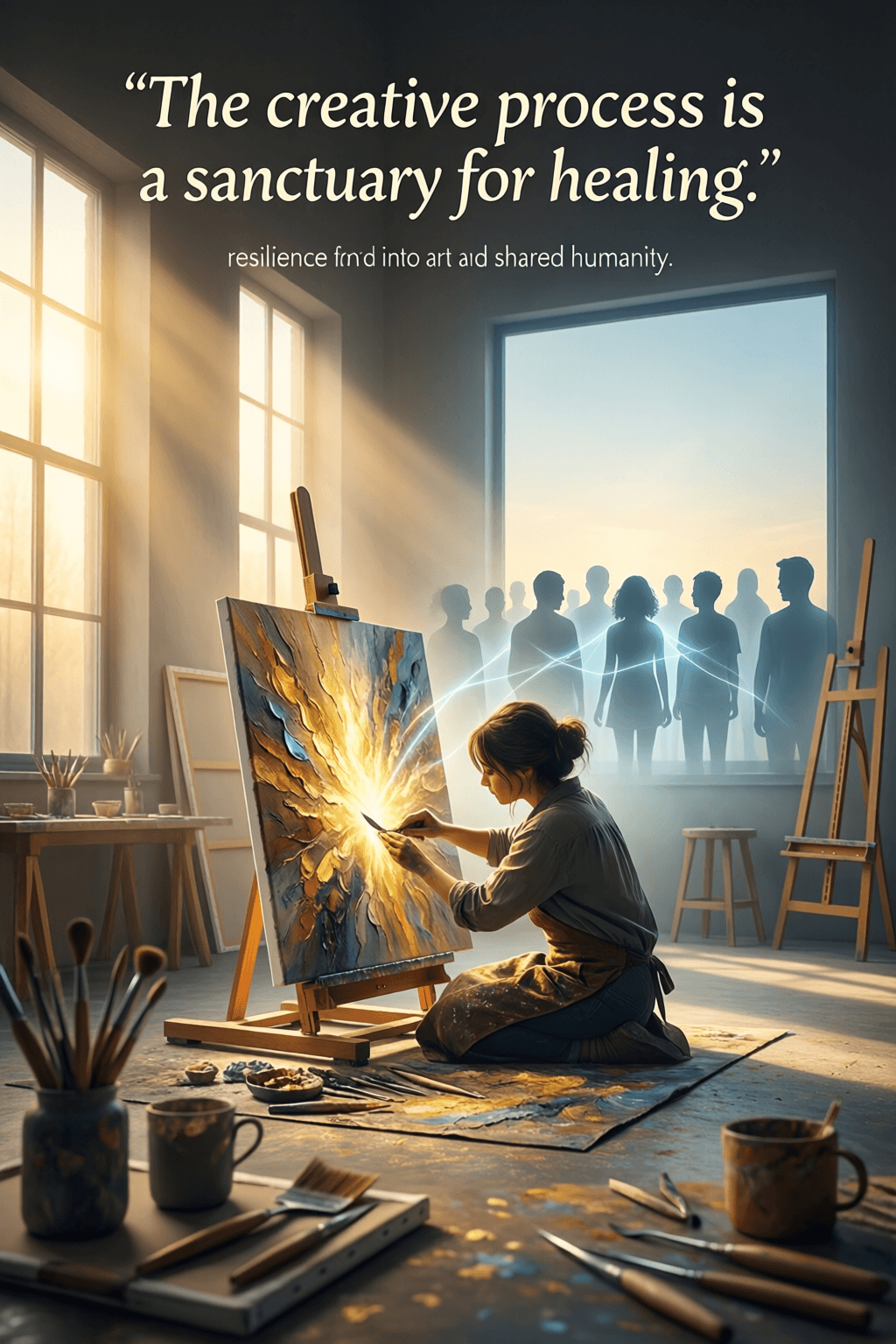
The creative process is a sanctuary for healing, a space where resilience is transformed into art that speaks to our shared humanity. — Ben Okri
—What lingers after this line?
Art as a Safe Interior Space
At its heart, Ben Okri’s statement imagines the creative process as more than production; it becomes a refuge. A sanctuary is a place of shelter, and by choosing that word, Okri suggests that making art offers protection from chaos, grief, and inner fragmentation. In this view, creativity is not an escape from pain so much as a place where pain can be held, examined, and gently reshaped. This idea has deep cultural resonance. Virginia Woolf’s essay A Room of One’s Own (1929) similarly frames artistic space as a necessary condition for self-recovery and expression. Like Woolf, Okri implies that when people create, they claim a protected inner territory where healing can begin.
Transforming Wounds into Meaning
From that sanctuary, the next step is transformation. Okri does not say resilience merely survives; he says it is turned into art. That distinction matters, because survival alone is private, while art gives suffering form, rhythm, and meaning. Through language, image, sound, or movement, hardship is no longer mute; it becomes something shaped and communicable. This transformation recalls Viktor Frankl’s Man’s Search for Meaning (1946), which argues that human beings endure suffering differently when they can make meaning from it. In a similar way, creative work does not erase pain, but it can redeem it by turning endurance into expression.
Resilience as an Artistic Material
Moreover, Okri elevates resilience itself into a medium. Just as a sculptor works with stone or clay, the artist works with memory, loss, endurance, and hope. What has been survived becomes part of the artwork’s texture, giving it depth that purely decorative creation often lacks. The result is art marked not just by skill, but by lived strength. Many readers recognize this quality in Frida Kahlo’s paintings, especially The Broken Column (1944), where physical suffering is transformed into stark visual language. Her work shows how resilience can become an artistic substance—pain disciplined into form, and vulnerability made unforgettable.
Speaking to Shared Humanity
Yet Okri’s thought does not end with the individual artist. He insists that art born from healing speaks to our shared humanity, moving the creative act from private restoration to collective recognition. In other words, what begins as one person’s struggle can become a mirror in which others see their own wounds, hopes, and persistence reflected. This is why deeply personal works so often feel universal. Maya Angelou’s I Know Why the Caged Bird Sings (1969), for example, draws from intimate suffering yet reaches readers far beyond its immediate circumstances. By telling one life truthfully, it opens a path toward many lives being understood.
The Quiet Reciprocity of Creation
As this shared recognition emerges, the creative process becomes reciprocal: the artist is healed in making, and the audience is stirred in receiving. Okri’s sentence therefore describes not a solitary miracle, but a human exchange. Art carries emotion across the distance between lives, allowing one person’s resilience to strengthen another’s sense of endurance. This reciprocity appears in community art practices as well, from post-conflict mural projects to poetry workshops in hospitals and prisons. Such efforts echo what scholars in art therapy, including Judith Rubin in Approaches to Art Therapy (1987), have long observed: creating and witnessing art can restore connection where suffering has imposed isolation.
A Vision of Hope Through Creation
Finally, Okri offers a hopeful philosophy of creativity. He presents art not as ornament, but as evidence that the human spirit can take what is broken and make something generous from it. The sanctuary of creation, then, is valuable precisely because it does not stop at comfort; it produces works that testify to survival and invite others into compassion. Seen this way, the creative process becomes a bridge between inner repair and public meaning. Okri’s insight endures because it affirms that when resilience is transformed into art, healing does not remain locked within the self—it becomes a gift to the world.
One-minute reflection
Where does this idea show up in your life right now?
Related Quotes
6 selectedThe creative process is a journey through your own vulnerability. When you stop running from the discomfort of the blank page, you finally start creating from the truth of who you are. — Brené Brown
Brené Brown
Brené Brown’s quote begins with a familiar image: the blank page as both invitation and threat. At first, that emptiness can feel exposing because it offers no place to hide behind polish, certainty, or imitation.
Read full interpretation →Healing is not the absence of pain—it's a steady return to wholeness despite it. — Mark Nepo
Mark Nepo
Mark Nepo’s reflection begins by challenging a common assumption: that healing means pain has disappeared. Instead, he suggests that pain may remain present while healing is still underway.
Read full interpretation →It's when we start working together that the real healing takes place. — Yoko Ono
Yoko Ono
At its heart, Yoko Ono’s statement shifts healing away from the isolated individual and toward shared effort. The phrase “start working together” suggests that repair begins not merely with intention, but with cooperatio...
Read full interpretation →Healing is the return of the memory of wholeness. — Deepak Chopra
Deepak Chopra
At first glance, Deepak Chopra’s line reframes healing as something larger than the disappearance of pain or illness. To call healing “the return of the memory of wholeness” suggests that wellness is not newly manufactur...
Read full interpretation →Healing is an art. It takes time, it takes practice, it takes love. — Maza Dohta
Maza Dohta
Maza Dohta’s quote begins by reframing healing as an art rather than a mechanical repair. That distinction matters, because art is rarely instant: it involves sensitivity, patience, revision, and care.
Read full interpretation →It is when we start working together that the real healing takes place. — David Hume
David Hume
At its core, David Hume’s line suggests that healing is not merely a private act of endurance but a shared human process. The moment people begin working together, suffering is no longer carried in isolation; instead, it...
Read full interpretation →More From Author
More from Ben Okri →True strength is not about never falling—it is about staying composed, learning from challenges, and continuing forward with a calm and focused mind. — Ben Okri
At first glance, strength is often imagined as invulnerability, the ability to resist every blow without wavering. Ben Okri’s insight gently overturns that assumption by suggesting that real strength appears not in perfe...
Read full interpretation →Often what the artist expresses is unconscious, but we can learn to decode the story by collaboratively finding the pieces to the puzzle that create new possibilities for innovation. — Ben Okri
At the heart of Ben Okri’s statement is the idea that art often says more than the artist consciously intends. A poem, painting, or song may carry hidden fears, cultural memories, or emotional truths that emerge without...
Read full interpretation →The artist must elect to fight for the whole rather than for his own little piece of territory. — Ben Okri
Ben Okri’s statement immediately shifts the artist’s role from private self-expression to public responsibility. Rather than defending a narrow identity, career, or niche, the artist is asked to serve something larger: t...
Read full interpretation →The most authentic thing about us is our capacity to create, to overcome, to endure, to transform, to love and to be greater than our suffering. — Ben Okri
The quote suggests that our ability to create is a fundamental aspect of our true selves.
Read full interpretation →