
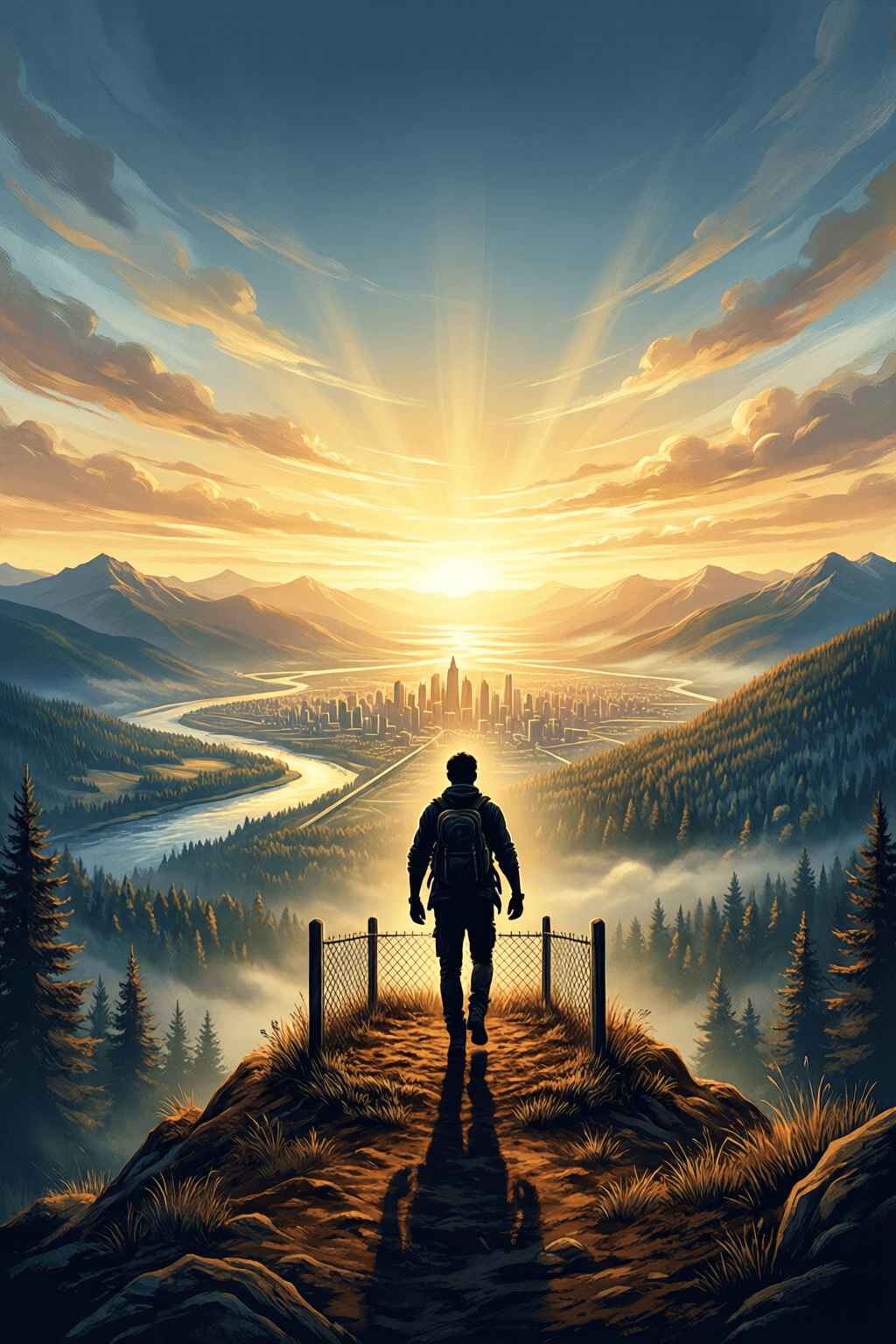
The artist must elect to fight for the whole rather than for his own little piece of territory. — Ben Okri
—What lingers after this line?
A Call to Wider Allegiance
Ben Okri’s statement immediately shifts the artist’s role from private self-expression to public responsibility. Rather than defending a narrow identity, career, or niche, the artist is asked to serve something larger: the shared human world. In this sense, “the whole” suggests society, moral imagination, and the fragile web of connections that bind people together. From the outset, then, Okri frames art as an act of allegiance. The artist must choose whether to protect a small domain of comfort or to engage the broader struggles of the time. That choice transforms creativity from a personal possession into a form of stewardship.
Beyond the Ego’s Small Borders
Seen this way, the phrase “his own little piece of territory” criticizes artistic defensiveness and vanity. Okri warns against the temptation to reduce art to branding, status, or the guarding of a private corner of influence. While individuality matters, he implies that it becomes diminished when it exists only to preserve itself. Consequently, the quote asks artists to resist shrinking into self-protection. Walt Whitman’s Leaves of Grass (1855) offers a useful contrast: Whitman begins with the self, yet continually expands outward until the individual voice becomes a vessel for a democratic multitude. Okri’s thought follows a similar arc, urging the artist to move from possession toward participation.
Art as a Form of Moral Courage
Once the artist looks beyond personal territory, the language of “fight” becomes especially important. Okri does not imagine art as passive decoration; he imagines it as struggle. To fight for the whole is to defend complexity, truth, memory, and human dignity, especially when public life is fractured by fear or division. Accordingly, many artists have taken creative risks in precisely this spirit. Pablo Picasso’s Guernica (1937), for example, did not protect a private aesthetic enclave; it confronted the horror of war in a way meant for collective conscience. Okri’s quote suggests that such courage is not optional ornament but central to the artist’s vocation.
The Whole as Human Interconnectedness
At a deeper level, “the whole” can also be read as an acknowledgment that no life stands alone. Artists draw from languages, histories, myths, and communities they did not invent, so their work is already shaped by others. Because of that, Okri implies that art should honor interdependence rather than pretend to pure isolation. This idea appears in Toni Morrison’s Nobel Lecture (1993), where language is treated as a living communal force that can either sustain or injure a people. In a similar spirit, Okri’s line reminds us that the artist’s task is not merely to claim space, but to illuminate shared reality and enlarge mutual understanding.
Resisting Fragmentation in Culture
From there, the quote speaks powerfully to modern cultural life, where specialization and identity-based competition can fragment the artistic landscape. There is value in distinct voices and local stories, yet Okri warns that these can harden into rival territories if they lose sight of a common human horizon. Art becomes thinner when it serves only factional boundaries. Therefore, fighting for the whole does not mean erasing difference; it means placing difference within a larger vision of coexistence. Chinua Achebe’s Things Fall Apart (1958), for instance, is deeply rooted in Igbo life, yet its reach is global because it reveals a human struggle larger than any single cultural enclosure.
A Lasting Standard for Creative Work
Ultimately, Okri offers a standard by which artists might judge their own practice: does the work merely defend a private patch, or does it widen the field of human awareness? This question does not demand propaganda or grandiosity. Instead, it asks whether art contributes to a fuller, more generous understanding of life. In the end, the quote defines artistic greatness as an outward movement of conscience. The finest work may begin in one person’s experience, but it does not remain trapped there. It reaches beyond ownership, speaks across boundaries, and helps recover a sense of the whole that modern life too easily forgets.
One-minute reflection
What feeling does this quote bring up for you?
Related Quotes
6 selectedTo grasp the full significance of life is the actor’s duty; to interpret it the artist’s privilege. — Marlon Brando
Marlon Brando
Brando highlights that actors must deeply understand the human experience in order to portray it authentically.
Read full interpretation →True strength is not about never falling—it is about staying composed, learning from challenges, and continuing forward with a calm and focused mind. — Ben Okri
Ben Okri
At first glance, strength is often imagined as invulnerability, the ability to resist every blow without wavering. Ben Okri’s insight gently overturns that assumption by suggesting that real strength appears not in perfe...
Read full interpretation →The creative process is a sanctuary for healing, a space where resilience is transformed into art that speaks to our shared humanity. — Ben Okri
Ben Okri
At its heart, Ben Okri’s statement imagines the creative process as more than production; it becomes a refuge. A sanctuary is a place of shelter, and by choosing that word, Okri suggests that making art offers protection...
Read full interpretation →Often what the artist expresses is unconscious, but we can learn to decode the story by collaboratively finding the pieces to the puzzle that create new possibilities for innovation. — Ben Okri
Ben Okri
At the heart of Ben Okri’s statement is the idea that art often says more than the artist consciously intends. A poem, painting, or song may carry hidden fears, cultural memories, or emotional truths that emerge without...
Read full interpretation →The most authentic thing about us is our capacity to create, to overcome, to endure, to transform, to love and to be greater than our suffering. — Ben Okri
Ben Okri
The quote suggests that our ability to create is a fundamental aspect of our true selves.
Read full interpretation →The artist must elect to fight for the beauty of the work, stitch by patient stitch, against the rush of the world. — Ursula K. Le Guin
Ursula K. Le Guin
Ursula K. Le Guin’s line begins with a deliberate verb: the artist must “elect.” In other words, beauty is not an accident or a luxury but a conscious choice made in resistance to haste.
Read full interpretation →More From Author
More from Ben Okri →True strength is not about never falling—it is about staying composed, learning from challenges, and continuing forward with a calm and focused mind. — Ben Okri
At first glance, strength is often imagined as invulnerability, the ability to resist every blow without wavering. Ben Okri’s insight gently overturns that assumption by suggesting that real strength appears not in perfe...
Read full interpretation →The creative process is a sanctuary for healing, a space where resilience is transformed into art that speaks to our shared humanity. — Ben Okri
At its heart, Ben Okri’s statement imagines the creative process as more than production; it becomes a refuge. A sanctuary is a place of shelter, and by choosing that word, Okri suggests that making art offers protection...
Read full interpretation →Often what the artist expresses is unconscious, but we can learn to decode the story by collaboratively finding the pieces to the puzzle that create new possibilities for innovation. — Ben Okri
At the heart of Ben Okri’s statement is the idea that art often says more than the artist consciously intends. A poem, painting, or song may carry hidden fears, cultural memories, or emotional truths that emerge without...
Read full interpretation →The most authentic thing about us is our capacity to create, to overcome, to endure, to transform, to love and to be greater than our suffering. — Ben Okri
The quote suggests that our ability to create is a fundamental aspect of our true selves.
Read full interpretation →