
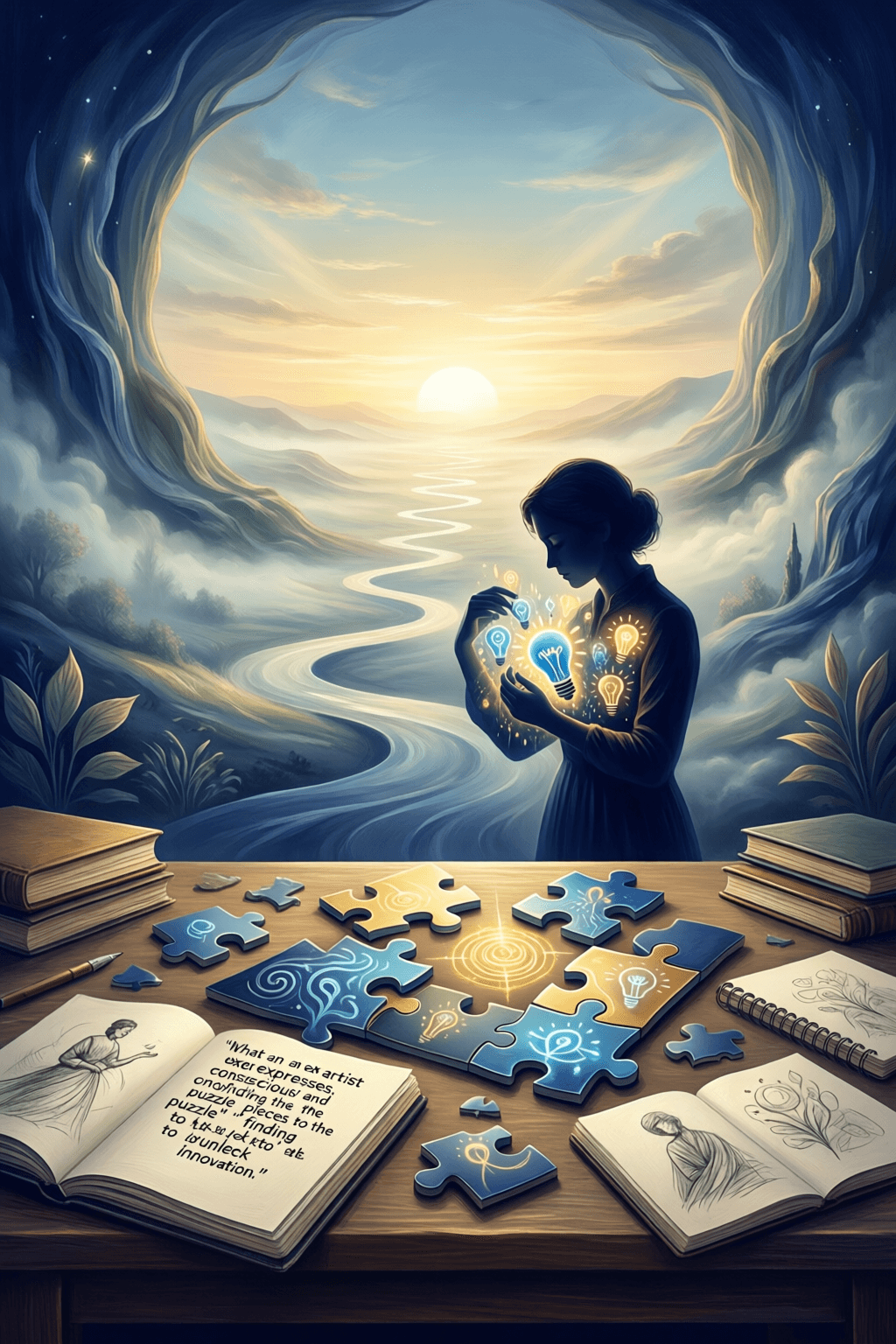
Often what the artist expresses is unconscious, but we can learn to decode the story by collaboratively finding the pieces to the puzzle that create new possibilities for innovation. — Ben Okri
—What lingers after this line?
Art Beyond Deliberate Intention
At the heart of Ben Okri’s statement is the idea that art often says more than the artist consciously intends. A poem, painting, or song may carry hidden fears, cultural memories, or emotional truths that emerge without deliberate planning. In this sense, artistic expression becomes a record not only of craft, but of the deeper currents moving beneath awareness. This insight aligns with long-standing artistic thought. Sigmund Freud’s The Interpretation of Dreams (1899) argued that symbolic meaning often slips past conscious control, and later surrealists embraced this possibility by treating art as a channel for the unseen mind. Okri’s point, however, is less clinical than hopeful: what is hidden is not inaccessible, only waiting to be understood.
The Artwork as a Puzzle
From there, Okri introduces a powerful metaphor: the story inside art can be decoded by gathering its scattered pieces. Images, silences, repetitions, textures, and contradictions all function like fragments of a puzzle. No single detail explains the whole, yet each one contributes to a fuller understanding of what the work is quietly revealing. Accordingly, interpretation becomes an act of careful assembly rather than quick judgment. A novel’s recurring river, for example, may initially seem decorative, but over time it may suggest memory, loss, or rebirth. Plato’s Ion (c. 380 BC) reflects an early fascination with inspired utterance, yet Okri goes further by suggesting that meaning is not merely received—it is patiently constructed.
Why Collaboration Matters
Significantly, Okri does not imagine this decoding as a solitary act. He emphasizes collaboration, implying that meaning grows richer when multiple minds contribute different experiences, questions, and intuitions. What one reader overlooks, another notices; what one viewer feels vaguely, another can name. Together, they widen the field of interpretation. This collaborative process has deep roots in literary and artistic communities. Reader-response critics such as Wolfgang Iser, especially in The Act of Reading (1978), showed that meaning is completed in the encounter between work and audience. Okri’s phrasing adds a communal dimension: not only do audiences help reveal meaning, but shared interpretation can become a creative force in its own right.
Hidden Meaning as a Source of Innovation
Once the hidden story begins to emerge, the process does more than explain the artwork—it opens new possibilities. This is the most forward-looking part of Okri’s quote. Decoding unconscious expression is not simply retrospective analysis; it can generate fresh ideas, new methods, and unexpected forms of invention. In practice, many artistic breakthroughs arise this way. Pablo Picasso’s development of Cubism, for instance, drew on conversations, reinterpretations, and encounters with African sculpture that changed how form itself could be seen. Similarly, creative teams in design or film often discover their most original direction by discussing fragments that initially seemed accidental. Thus, interpretation becomes a bridge from mystery to innovation.
The Artist and Audience as Co-Creators
As the quote unfolds, it also subtly reshapes the role of the artist. If part of what is expressed is unconscious, then the artist is not a perfect authority over meaning. At the same time, this does not diminish artistic power; rather, it makes art more alive, because the final significance of a work develops through exchange. This view recalls Umberto Eco’s The Open Work (1962), which describes artworks as structured yet incomplete fields of possibility. Okri’s insight fits that tradition while remaining especially generous: he suggests that artist and audience meet in a shared search, neither side possessing the whole truth alone. Meaning, then, is not owned but discovered together.
A More Expansive Way to Read Creativity
Ultimately, Okri invites us to see creativity as layered, communal, and unfinished. Instead of asking only what the artist meant, we are encouraged to ask what the work reveals when people engage it deeply and together. That shift matters, because it turns interpretation from a narrow academic exercise into an imaginative practice of listening, assembling, and reimagining. In that light, art becomes a space where unconscious expression meets collective insight. The hidden story is not a locked secret but an evolving constellation of clues. By finding those pieces collaboratively, we do more than understand a work better—we create the conditions for new thought, new feeling, and genuine innovation.
One-minute reflection
Where does this idea show up in your life right now?
Related Quotes
6 selectedThere is no must in art because art is free. — Wassily Kandinsky
Wassily Kandinsky
At its core, Kandinsky’s statement rejects the idea that art must obey fixed obligations. By saying there is no ‘must’ in art, he frees creation from rigid formulas, academic demands, and social expectation.
Read full interpretation →I think that when you create something, you leave a part of yourself in it. — Henri Matisse
Henri Matisse
At its core, Matisse’s reflection suggests that making anything—a painting, a poem, a song, even a room—inevitably transfers something inward into outward form. Creation is not merely the arrangement of materials; rather...
Read full interpretation →There is a deep peace that comes from creating something that didn't exist before. It is your way of telling the universe that you were here, and you felt something. — Maya Angelou
Maya Angelou
At its heart, Maya Angelou’s reflection suggests that creation is not merely productive but restorative. To make something that did not exist before—a poem, a garden, a melody, even a repaired room—is to experience a rar...
Read full interpretation →The creative act is not an escape from reality, but a way to encounter it more deeply. — bell hooks
bell hooks
At first glance, creative work can look like withdrawal: a painter disappears into a studio, a writer vanishes into pages, a musician closes the door and listens inward. Yet bell hooks reverses that assumption.
Read full interpretation →The best use of imagination is creativity. The worst use of imagination is anxiety. — Deepak Chopra
Deepak Chopra
Deepak Chopra frames imagination as a neutral force whose value depends on its direction. In one sense, imagination is the mind’s simulator: it can invent possibilities that do not yet exist, letting us rehearse outcomes...
Read full interpretation →You were not just born to center your entire existence around work and labor. You were born to exist, to dance, to create, to be. — Tricia Hersey
Tricia Hersey
Tricia Hersey’s statement begins by breaking a common spell: the idea that a human life is primarily a productivity machine. By saying we were not born to center our existence on labor, she challenges the quiet assumptio...
Read full interpretation →More From Author
More from Ben Okri →True strength is not about never falling—it is about staying composed, learning from challenges, and continuing forward with a calm and focused mind. — Ben Okri
At first glance, strength is often imagined as invulnerability, the ability to resist every blow without wavering. Ben Okri’s insight gently overturns that assumption by suggesting that real strength appears not in perfe...
Read full interpretation →The creative process is a sanctuary for healing, a space where resilience is transformed into art that speaks to our shared humanity. — Ben Okri
At its heart, Ben Okri’s statement imagines the creative process as more than production; it becomes a refuge. A sanctuary is a place of shelter, and by choosing that word, Okri suggests that making art offers protection...
Read full interpretation →The artist must elect to fight for the whole rather than for his own little piece of territory. — Ben Okri
Ben Okri’s statement immediately shifts the artist’s role from private self-expression to public responsibility. Rather than defending a narrow identity, career, or niche, the artist is asked to serve something larger: t...
Read full interpretation →The most authentic thing about us is our capacity to create, to overcome, to endure, to transform, to love and to be greater than our suffering. — Ben Okri
The quote suggests that our ability to create is a fundamental aspect of our true selves.
Read full interpretation →