
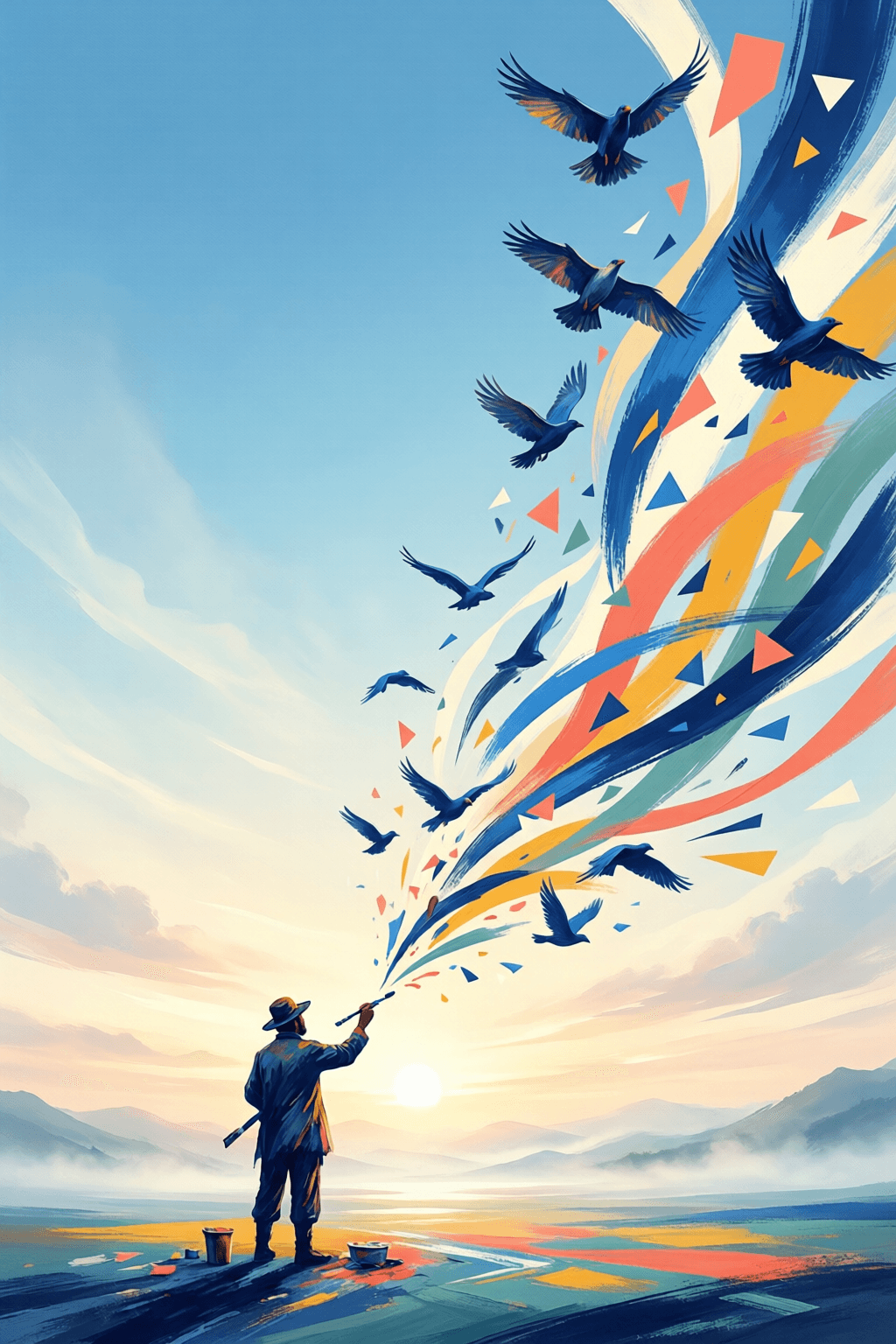
There is no must in art because art is free. — Wassily Kandinsky
—What lingers after this line?
A Declaration of Artistic Liberty
At its core, Kandinsky’s statement rejects the idea that art must obey fixed obligations. By saying there is no ‘must’ in art, he frees creation from rigid formulas, academic demands, and social expectation. Art, in this view, is not a mechanical task but an act of inner necessity that cannot be reduced to external commands. This idea becomes especially powerful when placed beside Kandinsky’s own writings in Concerning the Spiritual in Art (1911), where he argues that genuine art emerges from the artist’s interior life. Thus, freedom is not carelessness; rather, it is the condition that allows authentic expression to appear.
Breaking Away From Convention
From that starting point, Kandinsky’s words also challenge the long history of artistic rules that governed what counted as ‘good’ art. For centuries, academies in Europe privileged realism, proportion, and established subjects, often treating deviation as failure. Against this backdrop, his quote sounds almost revolutionary: art need not imitate accepted models to possess value. Indeed, the rise of modernism confirms this shift. Movements such as Impressionism and Abstract art emerged precisely because artists refused inherited limitations. In that sense, Kandinsky’s remark captures a turning point in cultural history, when freedom itself became a creative principle.
The Birth of Abstraction
Moreover, Kandinsky’s claim is inseparable from his pioneering role in abstract painting. If art is truly free, then it does not have to represent visible objects at all. A painting may communicate through color, line, rhythm, and form alone, much as music moves listeners without depicting concrete things. Kandinsky explored this possibility in works like Composition VII (1913), where swirling forms and vivid contrasts create emotional force without clear narrative. Consequently, his quote is not merely theoretical; it reflects a practice that expanded the very definition of art. Freedom, here, becomes the permission to invent entirely new visual languages.
Freedom and the Inner Voice
Yet Kandinsky was not arguing that art should be random. On the contrary, once external ‘musts’ are removed, the artist becomes more responsible to an internal truth. What guides the work is not public instruction but what he called spiritual resonance—the need to give form to feeling, intuition, and unseen experience. This distinction matters because it separates freedom from chaos. As many artists have discovered, from Paul Klee to Hilma af Klint, liberation from convention often leads not to emptiness but to deeper discipline. The artist listens less to rules imposed from outside and more to the demands of the inner voice.
A Lasting Challenge to Viewers
Finally, Kandinsky’s statement speaks not only to artists but also to audiences. If art is free, then viewers, too, must loosen their expectations about what art should look like or do. A work may resist easy interpretation, abandon realism, or provoke discomfort, yet still succeed on its own terms. For that reason, the quote remains strikingly current. In contemporary art—from installation and performance to digital experimentation—Kandinsky’s principle continues to defend innovation against narrow judgment. His words remind us that art’s vitality depends on openness: without freedom, art becomes instruction; with freedom, it becomes discovery.
One-minute reflection
What feeling does this quote bring up for you?
Related Quotes
6 selectedIn every work of art the spirit of freedom prevails. — Paul Gauguin
Paul Gauguin
This quote highlights the fundamental aspect of freedom in the process of artistic creation. True art arises from an unbound spirit, giving the artist liberty to express thoughts, emotions, and ideas unconstrained by soc...
Read full interpretation →Often what the artist expresses is unconscious, but we can learn to decode the story by collaboratively finding the pieces to the puzzle that create new possibilities for innovation. — Ben Okri
Ben Okri
At the heart of Ben Okri’s statement is the idea that art often says more than the artist consciously intends. A poem, painting, or song may carry hidden fears, cultural memories, or emotional truths that emerge without...
Read full interpretation →I think that when you create something, you leave a part of yourself in it. — Henri Matisse
Henri Matisse
At its core, Matisse’s reflection suggests that making anything—a painting, a poem, a song, even a room—inevitably transfers something inward into outward form. Creation is not merely the arrangement of materials; rather...
Read full interpretation →There is a deep peace that comes from creating something that didn't exist before. It is your way of telling the universe that you were here, and you felt something. — Maya Angelou
Maya Angelou
At its heart, Maya Angelou’s reflection suggests that creation is not merely productive but restorative. To make something that did not exist before—a poem, a garden, a melody, even a repaired room—is to experience a rar...
Read full interpretation →The creative act is not an escape from reality, but a way to encounter it more deeply. — bell hooks
bell hooks
At first glance, creative work can look like withdrawal: a painter disappears into a studio, a writer vanishes into pages, a musician closes the door and listens inward. Yet bell hooks reverses that assumption.
Read full interpretation →The best use of imagination is creativity. The worst use of imagination is anxiety. — Deepak Chopra
Deepak Chopra
Deepak Chopra frames imagination as a neutral force whose value depends on its direction. In one sense, imagination is the mind’s simulator: it can invent possibilities that do not yet exist, letting us rehearse outcomes...
Read full interpretation →More From Author
More from Wassily Kandinsky →