
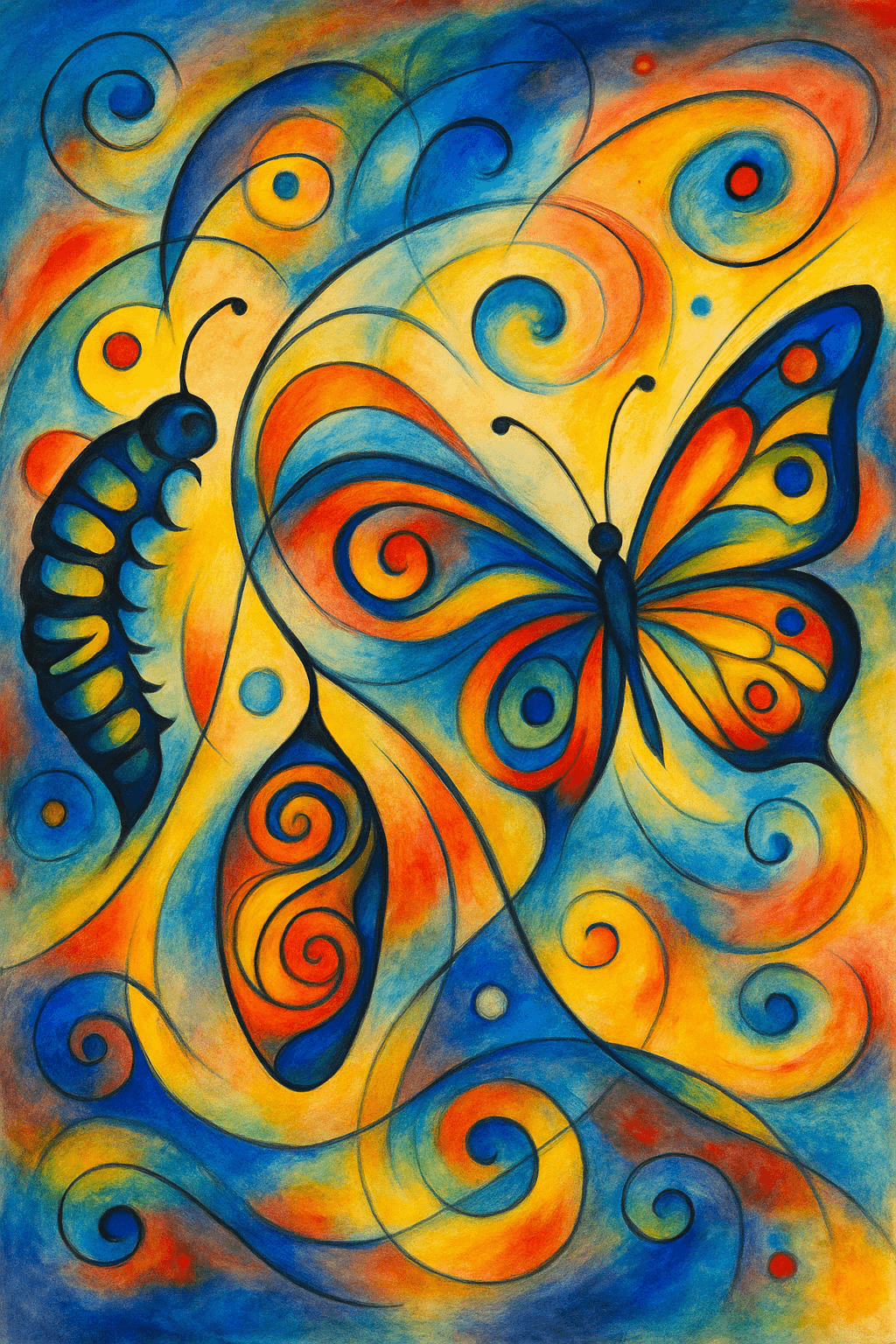
To translate the unseen into the seen is the essence of art. — Wassily Kandinsky
—What lingers after this line?
Kandinsky’s Visionary Philosophy
Wassily Kandinsky, a pioneer of abstract art, believed that the central mission of an artist is to transform internal experiences into outward expression. With this quote, he encapsulates his belief that art’s true purpose is to make the unseen—ideas, emotions, spiritual states—tangible. By doing so, artists offer viewers access to realms typically hidden from ordinary perception.
Abstract Art and Spiritual Expression
Kandinsky’s career marked a radical departure from realistic representation in favor of abstraction. His seminal text, ‘Concerning the Spiritual in Art’ (1911), argues that color, form, and rhythm can evoke feelings inaccessible by literal imagery. This aligns with his assertion that art’s value lies in manifesting the ineffable, allowing subjective realities to be shared communally.
Art as Universal Communication
Building on this, art becomes a universal language, transcending spoken words. Just as music communicates emotion without direct narrative, visual art can reveal the inner worlds of its creators. For example, the swirling lines of Van Gogh’s ‘Starry Night’ externalize his turbulent psyche, making the invisible visible to all who gaze upon it.
Historical Precedents for the Unseen
Throughout history, artists have wrestled with representing the intangible. In Plato’s allegory of the cave, shadows symbolize imperfect perceptions of reality, with art attempting to project truer forms onto the walls of communal experience. Similarly, medieval Christian iconography used symbolism to suggest truths beyond the mortal eye, inviting deeper contemplation.
Contemporary Relevance and Personal Resonance
In the modern era, Kandinsky’s notion remains profoundly relevant—contemporary artists continue to grapple with expressing the unseen, whether through conceptual installations or digital media. By translating inner visions into shared experiences, artists enable viewers to access new perspectives, reaffirming art’s timeless role as a conduit between invisible inspiration and tangible reality.
One-minute reflection
What does this quote ask you to notice today?
Related Quotes
6 selectedAnxiety is just the imagination working overtime, and most of that overtime is completely unpaid. — Alain de Botton
Alain de Botton
At first glance, Alain de Botton’s remark frames anxiety with disarming humor: the mind behaves like an overworked employee, generating scenarios, rehearsing disasters, and collecting no reward for the effort. By calling...
Read full interpretation →Creativity is not the finding of a thing, but the making something out of it after it is found. — James Russell Lowell
James Lowell
James Russell Lowell’s line shifts attention away from the romantic myth of the sudden genius who invents from nothing. Instead, he argues that creativity truly begins after the initial encounter—after an idea, object, p...
Read full interpretation →In art, the hand can never execute anything higher than the heart can imagine. — Ralph Waldo Emerson
Ralph Waldo Emerson
Emerson’s line shifts attention from technique to inner vision. At first glance, he seems to be speaking about painting or sculpture, yet his deeper claim is that craftsmanship cannot surpass the emotional and imaginativ...
Read full interpretation →It is the main earthly business of a human being to make his home, and the immediate surroundings of his home, as symbolic and significant to his own imagination as he can. — G. K. Chesterton
G. K. Chesterton
Chesterton begins with a striking claim: making a home is not a secondary chore but one of our central earthly tasks. By calling it our “main earthly business,” he elevates domestic life into something almost moral and a...
Read full interpretation →A rock pile ceases to be a rock pile the moment a single man contemplates it, bearing within him the image of a cathedral. — Antoine de Saint-Exupéry
Exupéry
At first glance, Saint-Exupéry’s line seems to describe an ordinary heap of stones. Yet the moment someone looks at it while carrying the image of a cathedral within, the pile is transformed in meaning.
Read full interpretation →The function of art is to do more than tell it like it is—it's to imagine what is possible. — bell hooks
bell hooks
bell hooks argues that art should not stop at documenting reality, however honestly. Instead, it must move one step further and open a window onto possibility, suggesting that creativity is not only reflective but transf...
Read full interpretation →More From Author
More from Wassily Kandinsky →