
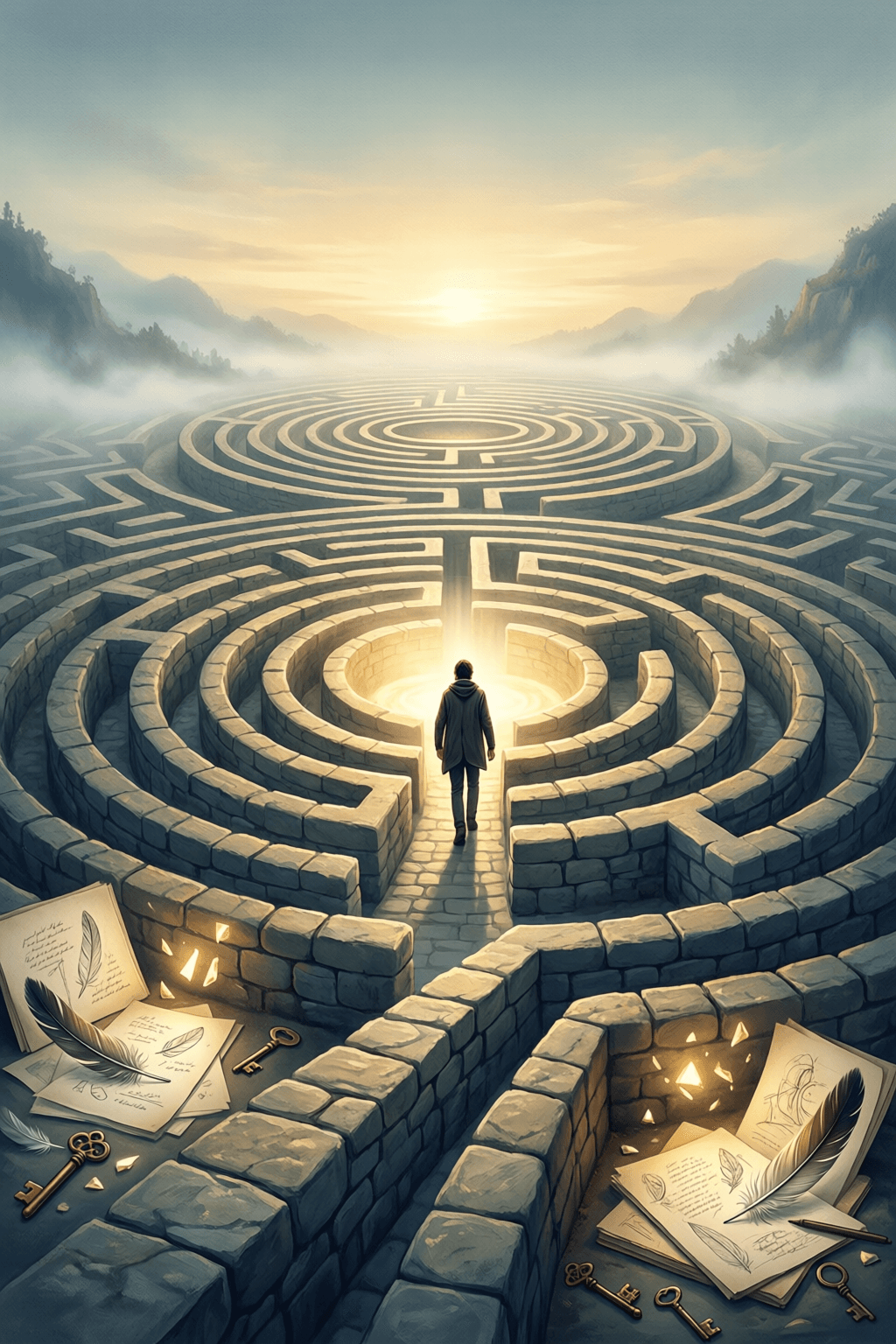
The creative process is not a straight line, but a labyrinth. To get lost in it is not a failure; it is the only way to find the hidden things worth saying. — M.C. Richards
—What lingers after this line?
Creativity as a Nonlinear Journey
At its core, M.C. Richards rejects the comforting myth that creative work unfolds through orderly steps. By calling the process a labyrinth, she suggests that making art, writing, or ideas involves circling, pausing, and revisiting what seemed already passed. In this view, confusion is not a detour from creation but one of its essential conditions. From there, the quote reframes frustration itself. What feels like wasted motion may actually be the movement through complexity that allows deeper insight to emerge. Rather than rewarding speed, Richards honors wandering as the very structure through which original thought takes shape.
Why Getting Lost Matters
Importantly, Richards goes further than merely tolerating uncertainty: she treats getting lost as necessary. In ordinary life, being lost implies error or weakness, yet here it becomes a creative discipline. The artist who does not fully control the route remains open to surprise, and that openness often leads to discoveries that planning alone could never produce. This idea echoes John Keats’s notion of “negative capability” (1817), the capacity to remain in uncertainties without irritably reaching after facts. Likewise, Richards suggests that hidden truths reveal themselves only when the maker stops forcing a direct path and begins listening to what the maze itself is showing.
The Hidden Things Worth Saying
As the image develops, the destination of the labyrinth becomes clear: not efficiency, but revelation. Richards is interested in “the hidden things,” which implies that the most valuable creative insights are buried beneath habit, convention, and first thoughts. What is worth saying rarely appears at the surface; it must be uncovered through patient searching. In that sense, the quote distinguishes between expression and discovery. A creator may begin with the desire to communicate, yet along the way finds meanings not previously known even to themselves. Virginia Woolf’s diaries and essays, including A Writer’s Diary (1953), often show this process of writing toward what can only be understood in the act of composition.
The Labyrinth in Artistic Practice
Seen practically, Richards’s metaphor describes the lived reality of creative labor. Drafts fail, sketches are abandoned, themes recur unexpectedly, and promising beginnings collapse. Yet these apparent dead ends often supply the raw material for stronger work later, much as discarded notebook lines sometimes become the center of a finished poem or painting. In this way, the labyrinth is not chaos without form; it is a structure whose logic becomes visible only in retrospect. Pablo Picasso’s many studies for Guernica (1937) illustrate this truth well: the final painting did not arrive whole, but emerged through revision, uncertainty, and repeated transformation.
A Gentler View of Failure
Consequently, the quote offers more than an artistic method; it offers emotional permission. Many creators interpret doubt as evidence that they lack talent, but Richards invites a kinder reading. If getting lost is the only way forward, then moments of confusion no longer signal collapse. Instead, they mark participation in the real process of making something alive. This perspective can be quietly liberating. It shifts the measure of success from constant clarity to sustained engagement, allowing creators to persist through ambiguity without shame. What seemed like failure becomes, in retrospect, the necessary darkness before articulation.
What the Quote Ultimately Teaches
Finally, Richards presents creativity as an act of trust. One enters the labyrinth without guarantees, guided less by certainty than by intuition, patience, and attention. The hidden things worth saying cannot be seized on command; they must be encountered after wandering long enough for familiar language to give way to deeper perception. For that reason, the quote remains both practical and profound. It reminds us that originality is rarely born from a straight, efficient route. More often, it emerges when we accept disorientation, remain present inside it, and allow the work to lead us somewhere we did not know we needed to go.
Recommended Reading
As an Amazon Associate, we earn from qualifying purchases.
One-minute reflection
Why might this line matter today, not tomorrow?
Related Quotes
6 selectedThe creative process is a journey through your own vulnerability. When you stop running from the discomfort of the blank page, you finally start creating from the truth of who you are. — Brené Brown
Brené Brown
Brené Brown’s quote begins with a familiar image: the blank page as both invitation and threat. At first, that emptiness can feel exposing because it offers no place to hide behind polish, certainty, or imitation.
Read full interpretation →The creative process is a mess, but a beautiful one. Embrace the chaos, because that is where your most authentic creations come to life. — Arastasia
Arastasia
At first glance, Arastasia’s quote rejects the tidy myth that meaningful art emerges from perfect planning. Instead, it frames creativity as inherently unruly, full of false starts, contradictions, and unexpected turns.
Read full interpretation →The creative process is a cocktail of exhaustion and revelation; do not mistake the fatigue for a sign to stop, but rather for the evidence that you are building something new. — Twyla Tharp
Twyla Tharp
At first glance, Twyla Tharp’s quote reframes a feeling many creators dread: exhaustion. Rather than treating fatigue as a warning that the work is failing, she presents it as a natural ingredient in invention itself.
Read full interpretation →To create something new, one must first learn to be comfortable with the mess of the process. — Yayoi Kusama
Yayoi Kusama
At first glance, Yayoi Kusama’s insight reframes creativity as something far less polished than people often imagine. To create something truly new, she suggests, one must stop fearing confusion, failed attempts, and unf...
Read full interpretation →The creative process is a sanctuary for healing, a space where resilience is transformed into art that speaks to our shared humanity. — Ben Okri
Ben Okri
At its heart, Ben Okri’s statement imagines the creative process as more than production; it becomes a refuge. A sanctuary is a place of shelter, and by choosing that word, Okri suggests that making art offers protection...
Read full interpretation →It is through the process of creating that we discover who we are, not by waiting for a finished masterpiece to tell us. — Twyla Tharp
Twyla Tharp
Twyla Tharp’s insight begins with a reversal of a common assumption: we often imagine that identity arrives fully formed and then expresses itself through art, work, or achievement. Instead, she argues that we come to kn...
Read full interpretation →More From Author
More from M.C. Richards →