
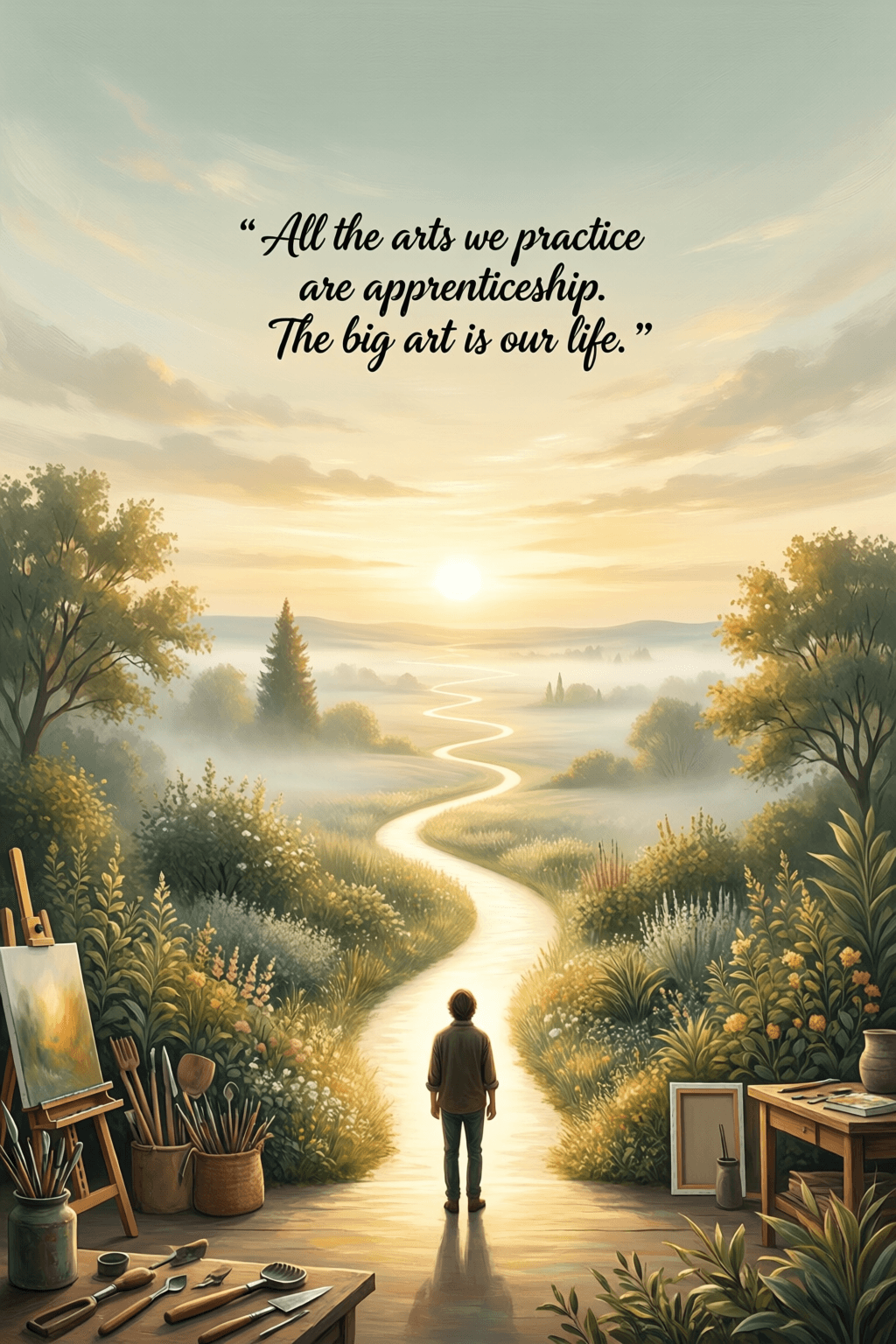
All the arts we practice are apprenticeship. The big art is our life. — M.C. Richards
—What lingers after this line?
A Radical Reframing of Art
M.C. Richards turns the usual hierarchy upside down by suggesting that painting, music, poetry, and craft are not ultimate achievements but forms of preparation. In this view, the skills we refine in formal arts train our perception, discipline, and sensitivity for a larger creative act: the shaping of a human life. Rather than limiting art to galleries or stages, she expands it into the everyday decisions that give a life its tone and texture. From this starting point, the quote invites us to see living itself as an expressive medium. Just as an artist learns through repetition, failure, and revision, a person learns through relationships, work, loss, and renewal. The real masterpiece, Richards implies, is not an object we leave behind but the way we inhabit the world while we are here.
Apprenticeship as a Way of Becoming
The word “apprenticeship” is especially revealing because it emphasizes process over mastery. An apprentice is not finished; instead, they are attentive, humble, and continuously formed by practice. Richards therefore suggests that even our most admired talents remain training grounds, teaching us how to listen, endure frustration, and develop judgment—qualities essential not only to art but to character. Consequently, the quote carries a moral dimension. Life is not merely something that happens to us; it is something we learn to make. Much like Aristotle’s Nicomachean Ethics (4th century BC), which argues that virtue emerges through repeated action, Richards’s insight implies that a meaningful life is composed slowly, habit by habit, gesture by gesture.
Everyday Choices as Creative Acts
Once art is understood this way, ordinary moments begin to matter more. A conversation handled with patience, a meal prepared with care, or a difficult truth spoken kindly can become acts of composition no less real than brushstrokes on canvas. The aesthetic of life then lies not in ornament but in presence, proportion, rhythm, and integrity across daily conduct. In turn, this perspective helps explain why some people seem to bring beauty into a room without producing a single artwork. Their art is relational and lived. The educator and potter Soetsu Yanagi’s reflections in The Unknown Craftsman (1972) similarly honor beauty embedded in humble use, suggesting that grace often appears most fully in what is made—and lived—without vanity.
Failure, Revision, and Human Growth
Just as no artist works without mistakes, no life unfolds without error. Richards’s metaphor is consoling because it allows for revision: awkward phases, broken plans, and unfinished selves are not proof of failure but evidence of practice. In the studio, discarded drafts are part of learning; likewise, in life, regret can become material for deeper wisdom rather than a final verdict. Therefore, the quote resists perfectionism. It suggests that the beauty of a life may emerge precisely through responsiveness—through how one recovers, repairs, and begins again. This echoes Samuel Beckett’s oft-cited line from Worstward Ho (1983), “Fail again. Fail better,” where repeated imperfection becomes not defeat but the very condition of meaningful creation.
Community, Craft, and the Shared Life
At the same time, apprenticeship is rarely solitary. Traditionally, apprentices learn beside teachers, peers, and predecessors, and that social structure deepens Richards’s claim. If life is the big art, then other people are not interruptions to our work; they are part of the medium itself. Family, friendship, and citizenship all become collaborative forms through which the self is shaped. This makes the quote quietly communal rather than purely individualistic. A life well made depends not only on personal expression but also on responsiveness to others. John Dewey’s Art as Experience (1934) similarly dissolves the boundary between art and ordinary living, arguing that meaning arises through interaction, continuity, and shared experience rather than isolated genius.
The Masterpiece We Are Still Making
Ultimately, Richards offers both encouragement and responsibility. If the arts are apprenticeship, then no technique, award, or accomplishment is enough on its own; all of it must feed into the larger work of becoming fully human. Yet this is also liberating, because it means everyone participates in art, not only those formally recognized as artists. The measure of creativity becomes the shape of one’s presence in the world. Thus the quote leaves us with a demanding but hopeful vision: our greatest work is always underway. The life we are making—through attention, courage, tenderness, and choice—is the fullest canvas we will ever receive. Everything else, however beautiful, teaches us how to meet that task.
One-minute reflection
What's one small action this suggests?
Related Quotes
6 selectedCraftsmanship is the visible edge of art. — David Bayles
David Bayles
At first glance, David Bayles’s line suggests that craftsmanship is the point where inner vision becomes outward form. Art may begin in imagination, intuition, or feeling, but it only enters the world through skillful ex...
Read full interpretation →Art is not a thing; it is a way. — Elbert Hubbard
Elbert Hubbard
Elbert Hubbard’s line immediately shifts attention away from paintings, sculptures, or books as isolated products. Instead, he suggests that art lives in the manner of seeing, choosing, and shaping experience.
Read full interpretation →It is not the language of painters but the language of nature which one should listen to. — Pablo Picasso
Pablo Picasso
At first glance, Picasso’s remark challenges the authority of artistic convention. By contrasting ‘the language of painters’ with ‘the language of nature,’ he suggests that art should not merely imitate established techn...
Read full interpretation →Art is man's expression of his joy in labor. — Henry Kissinger
Henry Kissinger
At first glance, Henry Kissinger’s remark suggests that art does not arise apart from work but grows directly out of it. In this view, labor is not merely toil or obligation; it becomes meaningful when human beings impri...
Read full interpretation →Great art picks up where nature ends. — Marc Chagall
Marc Chagall
At its core, Marc Chagall’s remark suggests that art does not compete with nature but continues its unfinished conversation. Nature gives us raw forms—color, light, movement, emotion—while art reshapes them into meaning.
Read full interpretation →Art is a line around your thoughts. — Gustav Klimt
Gustav Klimt
At first glance, Klimt’s remark turns art into a simple but powerful image: a line drawn around thought itself. In other words, ideas are often shapeless, fleeting, and private until art gives them form.
Read full interpretation →More From Author
More from M.C. Richards →