
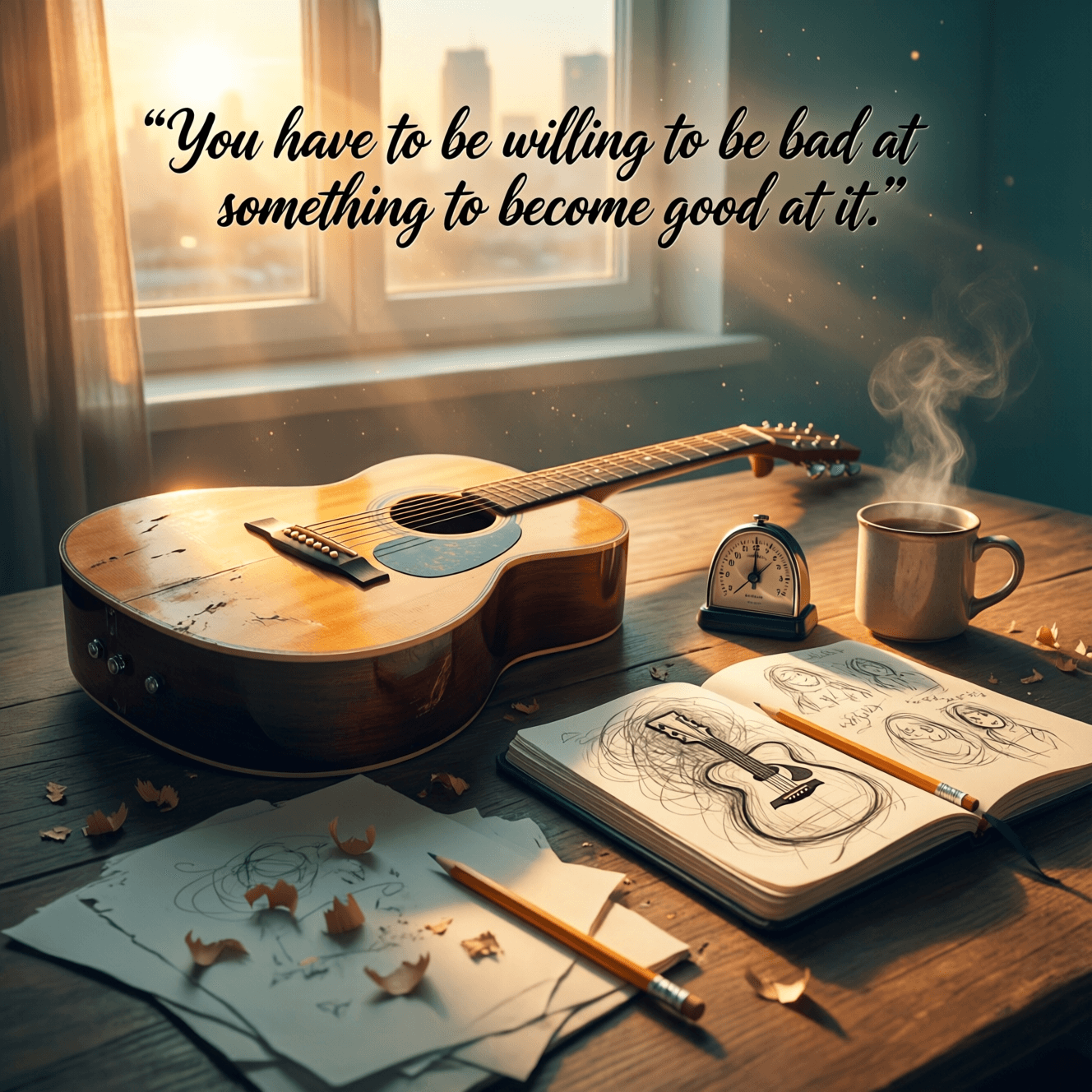
You have to be willing to be bad at something to become good at it. — Rick Rubin
—What lingers after this line?
The Courage to Start Unprepared
Rick Rubin’s line points to an uncomfortable truth: the first step toward competence often looks like incompetence. In a culture that rewards polished outcomes, beginners can feel exposed, as if early mistakes are evidence of not belonging. Yet the willingness to be “bad” is really the willingness to be seen learning. This reframes starting as an act of courage rather than a test of talent. Once you accept that rough drafts, missed notes, and awkward attempts are not disqualifiers but entry fees, you can finally begin moving—because motion, not certainty, is what creates skill.
Why Improvement Requires Friction
Building on that, growth depends on feedback, and feedback usually arrives through failure. If you only do what you can already do well, you stay inside a loop of confirmation; nothing pushes back hard enough to reshape your ability. By contrast, trying something slightly beyond your current level produces friction—errors, strain, and correction—which is precisely where learning happens. This dynamic is echoed in deliberate practice research: Anders Ericsson’s work (e.g., “The Role of Deliberate Practice in the Acquisition of Expert Performance,” 1993) emphasizes targeted effort at the edge of one’s competence, where mistakes are frequent and informative rather than shameful.
Separating Identity from Performance
Even so, people often resist being bad because they confuse performance with identity: a flawed attempt becomes “I am flawed.” Rubin’s advice quietly challenges that fusion. If you can treat an early attempt as data—“this didn’t work yet”—you protect your motivation and keep experimenting. In practical terms, this mindset shift turns embarrassment into curiosity. Instead of asking, “What does this say about me?” you begin asking, “What does this reveal about the task?” That transition is small but decisive, because it keeps the learner in the process long enough for progress to compound.
The Creative Process: Drafts Before Masterpieces
From there, Rubin’s point fits naturally into how creative work is actually made: most great outputs come from imperfect iterations. Anne Lamott’s popularized idea of “shitty first drafts” in Bird by Bird (1994) captures the same reality—initial versions exist to be wrong in useful ways, giving you material to refine. Music production offers an obvious parallel: demos, scratch vocals, and messy takes are not failures; they are scaffolding. By allowing imperfect stages, creators avoid the paralysis of needing every note, sentence, or decision to be correct on the first try.
A Skill Ladder You Can Actually Climb
Finally, the quote offers a practical blueprint: choose tasks where “bad” is safe, then practice consistently until “bad” becomes “okay,” and “okay” becomes “good.” This is less about heroic willpower and more about designing repetition with manageable stakes—private rehearsals, small audiences, short daily sessions, or low-risk prototypes. Over time, the willingness to be bad becomes a competitive advantage, because many people quit at the exact point where the learning curve feels most humiliating. Rubin’s message is that mastery is not a mysterious gift; it is what remains after you’ve survived your own early attempts and kept going.
One-minute reflection
What does this quote ask you to notice today?
Related Quotes
6 selectedSuccess is learning to go from failure to failure without despairing.
Unknown
This quote emphasizes the importance of resilience in the face of failure. Success is not about never failing; it's about how one responds to failure and continues to pursue their goals despite setbacks.
Read full interpretation →The more you do stuff, the better you get at dealing with how you still fail at it a lot of the time. — John Mulaney
John Mulaney
This quote highlights the nature of learning and skill acquisition. It underscores that improvement comes through persistent effort, even if failures are frequent during the process.
Read full interpretation →You are not starting over. You're starting wiser. — Meredith Eastwood
Meredith Eastwood
At first glance, Meredith Eastwood’s line gently challenges the fear that often accompanies change. To say, “You are not starting over,” is to reject the idea that every setback erases what came before.
Read full interpretation →If you are not crashing, you are corroding. Growth requires the courage to be challenged, not just the comfort of being safe. — Jaime Raul Zepeda
Jaime Raul Zepeda
At first glance, Zepeda frames life as a choice between impact and erosion. To be “crashing” suggests collision with difficulty, experimentation, and the visible mess of effort; by contrast, “corroding” evokes a quieter...
Read full interpretation →I don't divide the world into the weak and the strong, or the successes and the failures; I divide the world into the learners and the nonlearners. — Benjamin Barber
Benjamin Barber
Benjamin Barber’s quote immediately shifts attention away from the usual categories people use to rank one another. Instead of sorting humanity by power, status, or outcomes, he proposes a more dynamic distinction: wheth...
Read full interpretation →I am not here to be right. I am here to get it right. — Anne Sullivan
Anne Sullivan
Anne Sullivan’s remark begins with a quiet but radical act of humility. By saying she is not here to be right, she separates personal ego from the larger pursuit of truth, suggesting that correctness is less important th...
Read full interpretation →More From Author
More from Rick Rubin →The most important work you do will not be the content you feed the machine, but the craft you refine in silence. — Rick Rubin
Rick Rubin’s statement shifts attention away from visible output and toward the invisible discipline that shapes it. At first glance, he contrasts “the content you feed the machine” with “the craft you refine in silence,...
Read full interpretation →Don't worry about being original; worry about being authentic. Originality is a side effect of truth. — Rick Rubin
Rick Rubin’s remark immediately overturns a common creative anxiety: the pressure to be unlike anyone else. Instead, he argues that authenticity should come first, because work grounded in honest perception carries a for...
Read full interpretation →The creative process is a journey of letting go of the need for perfection to make space for the truth of expression. — Rick Rubin
Rick Rubin’s quote begins with a reversal of a common assumption: many people believe great art comes from flawless execution, yet he argues that the creative process starts by releasing that demand. In this view, perfec...
Read full interpretation →The goal is to get to the point where you're not thinking anymore. You're just reacting to the magic. — Rick Rubin
Rick Rubin’s line points to a subtle creative destination: the moment thinking stops being the driver and becomes, at most, a quiet passenger. Instead of deliberating over each choice, the artist responds in real time—li...
Read full interpretation →