
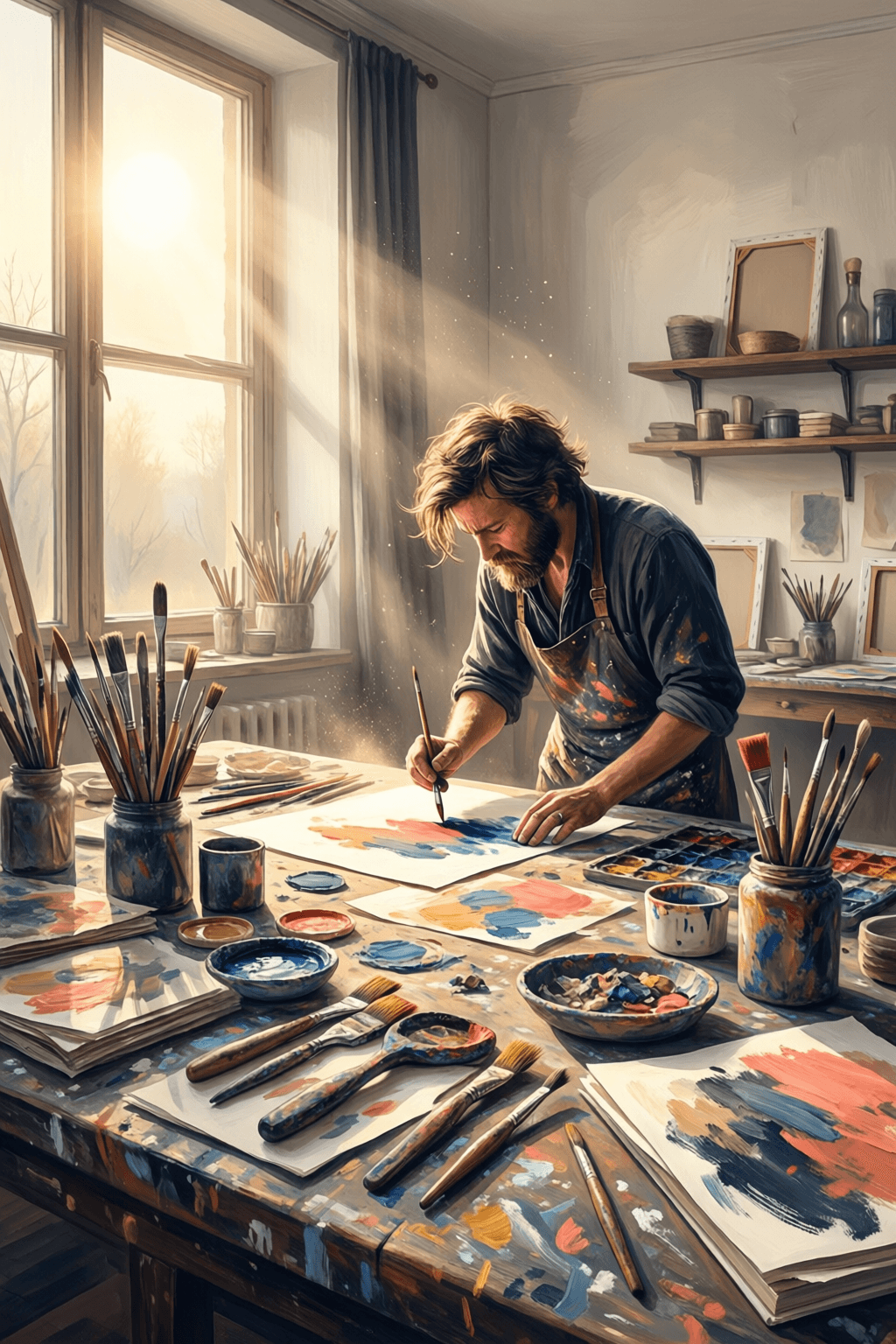
Don't worry about whether it's good or bad. Just make more art while they're busy deciding. — Andy Warhol
—What lingers after this line?
Action Over Approval
At its core, Andy Warhol’s line dismisses the paralysis that comes from waiting to be judged. Rather than obsessing over whether work will be called good or bad, he urges the artist to stay in motion. The real danger, in this view, is not criticism but hesitation. From there, the quote opens into a broader philosophy of creative survival: other people will always classify, rank, and debate, but the maker’s task is different. The artist must produce, experiment, and continue. In that sense, Warhol shifts attention away from verdicts and back to process.
Warhol’s Own Creative Method
This attitude was not merely rhetorical; it defined Warhol’s career. In the 1960s, works like Campbell’s Soup Cans (1962) and Marilyn Diptych (1962) provoked confusion as much as praise, yet Warhol kept making images with mechanical repetition, commercial references, and cool detachment. He did not pause to resolve every argument about whether his work counted as serious art. Consequently, his practice became a living example of the quote. While critics debated originality, celebrity, and consumer culture, Warhol expanded his output into film, printmaking, photography, and publishing. His answer to uncertainty was volume, not retreat.
The Freedom to Ignore Judgment
Because judgment is inevitable, Warhol’s advice offers a kind of freedom. If others are already busy deciding what your work means or whether it succeeds, then their activity no longer needs to govern your own. You can continue making without waiting for permission, consensus, or perfect confidence. In this way, the quote also challenges perfectionism. Many creators delay their work until they can guarantee excellence, but Warhol implies that such guarantees are illusions. Art grows through repetition and risk, and therefore progress often belongs to those willing to create before they feel fully justified.
Art as Continuous Experiment
Seen another way, the statement treats art less as a final masterpiece and more as an ongoing stream of attempts. This idea aligns with modern creative practice, where drafts, studies, discarded versions, and side projects often matter as much as polished results. What looks effortless in public is usually built on a private history of relentless making. For example, Pablo Picasso’s prolific output across painting, ceramics, and drawing shows how experimentation itself can become a method. Similarly, Warhol’s remark suggests that quantity is not the enemy of quality; instead, sustained production is often the path through which originality emerges.
A Rebellion Against Cultural Gatekeeping
At the same time, the quote carries a subtle rebellion against gatekeepers. Critics, curators, audiences, and markets all participate in deciding what counts, but Warhol reduces their authority by refusing to make their judgment the center of artistic life. Their role is to evaluate; the artist’s role is to create. This distinction matters because cultural institutions often move slowly. By the time a consensus forms, the most vital work may already have moved elsewhere. Thus Warhol’s advice becomes strategic as well as inspirational: keep producing while the world is still catching up.
A Practical Lesson for Any Creator
Ultimately, Warhol’s words reach beyond galleries and studios. Writers, musicians, filmmakers, and even entrepreneurs face the same trap of waiting for validation before continuing. His message is simple but demanding: let others debate the worth of what you do, and meanwhile keep building the next thing. That is why the quote endures. It replaces anxiety with momentum and turns criticism into background noise. Instead of asking endlessly whether the work is good or bad, it asks a more useful question—what are you making now?
One-minute reflection
What's one small action this suggests?
Related Quotes
6 selectedThe most important thing about art is to work. Nothing else matters except sitting down every day and trying. — Steven Pressfield
Steven Pressfield
At its core, Steven Pressfield’s quote shifts attention away from glamour and toward routine. He argues that art is not primarily built from rare flashes of inspiration, but from the repeated act of showing up.
Read full interpretation →The painting has a life of its own. I try to let it come through. — Jackson Pollock
Jackson Pollock
At first glance, Jackson Pollock’s remark gives the painting an almost independent existence, as though the canvas carries its own pulse before the artist fully understands it. Rather than describing painting as pure con...
Read full interpretation →The creative process is not a straight line, but a labyrinth. To get lost in it is not a failure; it is the only way to find the hidden things worth saying. — M.C. Richards
M.C. Richards
At its core, M.C. Richards rejects the comforting myth that creative work unfolds through orderly steps.
Read full interpretation →To create something new, one must first learn to be comfortable with the mess of the process. — Yayoi Kusama
Yayoi Kusama
At first glance, Yayoi Kusama’s insight reframes creativity as something far less polished than people often imagine. To create something truly new, she suggests, one must stop fearing confusion, failed attempts, and unf...
Read full interpretation →The creative process is a sanctuary for healing, a space where resilience is transformed into art that speaks to our shared humanity. — Ben Okri
Ben Okri
At its heart, Ben Okri’s statement imagines the creative process as more than production; it becomes a refuge. A sanctuary is a place of shelter, and by choosing that word, Okri suggests that making art offers protection...
Read full interpretation →It is through the process of creating that we discover who we are, not by waiting for a finished masterpiece to tell us. — Twyla Tharp
Twyla Tharp
Twyla Tharp’s insight begins with a reversal of a common assumption: we often imagine that identity arrives fully formed and then expresses itself through art, work, or achievement. Instead, she argues that we come to kn...
Read full interpretation →More From Author
More from Andy Warhol →They always say time changes things, but you actually have to change them yourself. — Andy Warhol
This quote highlights the importance of personal agency in enacting change. It suggests that while time can alter circumstances, individuals must take proactive steps to bring about meaningful change in their lives.
Read full interpretation →You have to be willing to get happy about nothing. — Andy Warhol
This quote suggests that one should embrace the simple pleasures of life. Happiness can be derived from the smallest, seemingly insignificant moments, rather than from grand achievements or possessions.
Read full interpretation →Take action on your ideas, before the world shapes them for you. — Andy Warhol
This quote emphasizes the need to act on one's ideas before external influences reshape or dilute them. Taking initiative ensures that your vision remains original and true to your intentions.
Read full interpretation →