
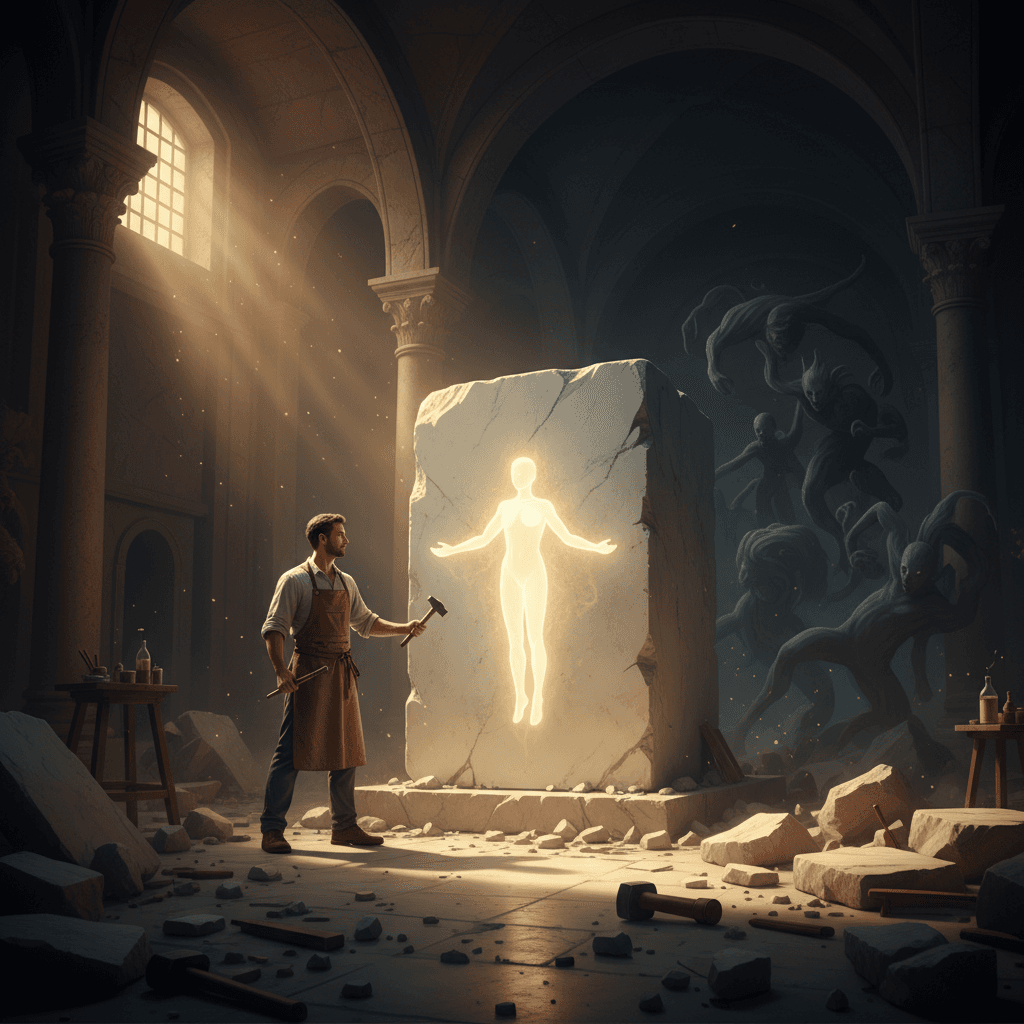
Chisel away at your fears until only the sculpture of your purpose remains. — Michelangelo
—What lingers after this line?
Fear as Excess Stone
Michelangelo’s metaphor invites us to imagine fear not as an enemy to be destroyed, but as surplus marble hiding who we really are. Just as a block of stone contains a statue within it, our lives often contain a clear purpose obscured by doubts, anxieties, and inherited expectations. The sculptor’s task, then, is not to add something new, but to remove what does not belong. In this view, fear becomes the unnecessary weight that conceals our potential, waiting to be carefully chipped away.
Purpose as the Hidden Statue
Flowing from this image, purpose appears as something already present, rather than a distant treasure to be found. Michelangelo is often credited with saying he saw the angel in the marble and carved until he set it free. Likewise, our calling may be less about inventing ourselves and more about uncovering what is already there: our natural inclinations, values, and talents. When we treat purpose as an inner sculpture, we shift our efforts from frantic searching to patient revealing, trusting that meaning exists beneath the surface.
The Slow Craft of Chiseling Fear
However, the metaphor also underscores that this process is neither quick nor painless. A statue emerges through thousands of deliberate strikes, and in the same way, we dismantle fear through repeated, small acts of courage. Each uncomfortable conversation, honest reflection, or risk taken in alignment with our values is a chisel mark. Over time, these consistent actions wear down the thick layers of hesitation. Rather than waiting for fear to vanish, we work alongside it, steadily reshaping the contours of our life.
Accepting Imperfection in the Finished Work
As we continue this inner sculpting, another truth becomes clear: no statue is flawless, and neither is any life. Renaissance works like Michelangelo’s unfinished ‘Prisoners’ figures show bodies emerging from rough stone, never fully freed. Likewise, we rarely reach a perfect, fear-free existence; instead, we achieve clearer outlines of who we are meant to be. Embracing these imperfections keeps us from abandoning the work halfway. The chips and tool marks of our struggles become part of the integrity and authenticity of the final form.
Living as the Sculpture of Purpose
Ultimately, the goal is not simply to remove fear, but to stand in the world as the sculpture that remains. This means arranging our choices, relationships, and daily habits around what feels deeply aligned, even when it still feels risky. By doing so, our lives begin to resemble a cohesive artwork rather than a rough, unshaped block. In this way, Michelangelo’s image calls us to an ongoing artistry of the self, where every decision is a stroke of the chisel, bringing the contours of our true purpose increasingly into view.
One-minute reflection
What's one small action this suggests?
Related Quotes
6 selectedTo be courageous is to act with the heart. — Molière
Molière
Molière’s line suggests that courage is not merely the absence of fear, but the decision to move despite it. By connecting courage with the heart, he frames bravery as an emotional and moral act rather than a simple disp...
Read full interpretation →Whatever you are doing, do it with a sense of purpose, not merely to pass the time. — Seneca
Seneca
Seneca’s counsel begins with a simple but demanding idea: life should not be treated as something to be spent carelessly. For the Stoics, time was not a disposable background to action but the very material of character.
Read full interpretation →The best people possess a feeling for beauty, the courage to take risks, the discipline to tell the truth, the capacity for sacrifice. — Ernest Hemingway
Ernest Hemingway
Hemingway’s line presents goodness not as politeness or success, but as a demanding inner code. The “best people” are those who combine sensitivity, bravery, honesty, and self-denial—qualities that do not always coexist...
Read full interpretation →Our plans miscarry because they have no aim. When a man doesn't know what harbor he's making for, no wind is the right wind. — Seneca
Seneca
Seneca’s remark begins with a simple but severe diagnosis: plans fail not merely from bad luck, but from the absence of a clear aim. In his view, activity alone is not progress.
Read full interpretation →If you are not willing to look stupid, nothing great is ever going to happen to you. — Julia Cameron
Julia Cameron
Julia Cameron’s remark begins with a hard truth: many people do not fail because they lack talent, but because they fear embarrassment. In that sense, ‘looking stupid’ becomes shorthand for being seen trying, stumbling,...
Read full interpretation →You don't have to bully yourself out of feeling fear. You just have to move while it's still there. — Annie Wright
Annie Wright
At its core, Annie Wright’s quote challenges the common belief that courage begins only after fear has disappeared. Instead, it reframes fear as something that can accompany action rather than prevent it.
Read full interpretation →More From Author
More from Michelangelo →If people knew how hard I had to work to gain my mastery, it would not seem so wonderful at all. — Michelangelo
At first glance, Michelangelo’s remark strips genius of its mystique. Rather than presenting mastery as a gift bestowed at birth, he insists that extraordinary achievement is rooted in sustained and often invisible effor...
Read full interpretation →I am still learning. — Michelangelo
Michelangelo’s brief statement, “I am still learning,” carries unusual force because it comes from a master whose achievements might have justified certainty. Instead, he presents knowledge as unfinished and the self as...
Read full interpretation →The true work of art is but a shadow of the divine perfection. — Michelangelo
Michelangelo’s statement immediately frames art as an act of humility rather than conquest. Instead of claiming that human creativity rivals ultimate truth, he suggests that even the finest painting or sculpture merely r...
Read full interpretation →Chisel away the needless to reveal the bold figure of what you are meant to be. — Michelangelo
Michelangelo’s line frames identity as something already present, waiting beneath excess. Instead of “building” a self from scratch, he suggests we uncover a truer form by removing what obscures it—habits, fears, and bor...
Read full interpretation →