
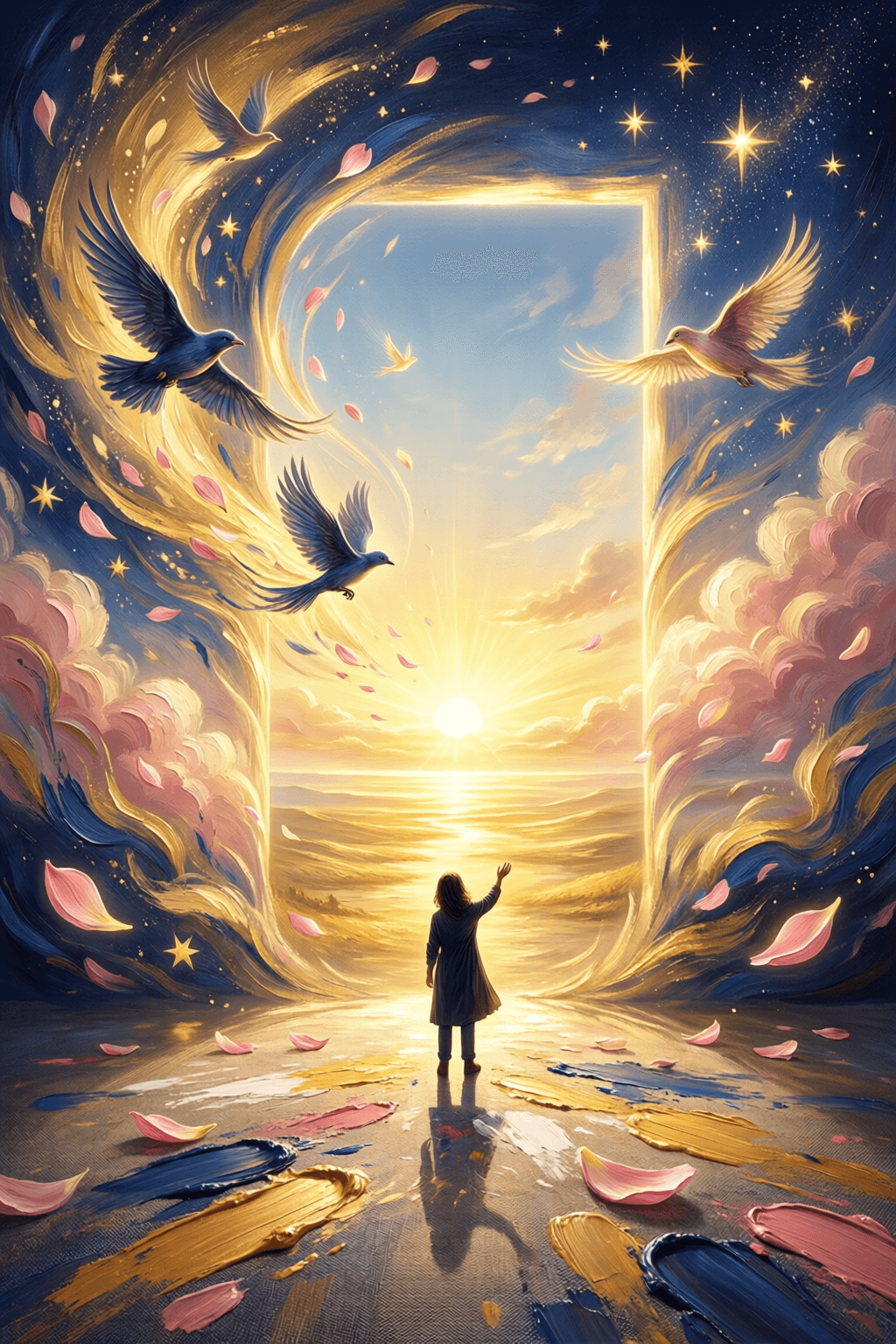
The goal of life is rapture. Art is the way we experience it. — Joseph Campbell
—What lingers after this line?
Life as an Opening to Rapture
Joseph Campbell’s statement begins with a bold claim: life is not merely about survival, achievement, or social approval, but about rapture—a heightened state of wonder, intensity, and felt aliveness. By placing rapture at the center of human purpose, Campbell shifts attention away from external success and toward the inner experience of being fully awake to existence.
Art as the Doorway
From that premise, art becomes more than decoration or entertainment; it becomes a passage into deeper perception. A painting, a song, a poem, or a dance can suspend ordinary time and draw us into an experience larger than the self. Campbell’s idea echoes traditions in which art serves as a bridge between the everyday and the sacred.
Myth and the Sacred Imagination
This view is consistent with Campbell’s lifelong study of myth, especially in works such as The Hero with a Thousand Faces (1949), where stories reveal patterns of transformation. Myths, like art, do not simply explain the world; they intensify it. Through symbolic images and heroic journeys, they help people feel the mystery of life rather than merely think about it.
Rapture Beyond Pleasure
Yet Campbell’s rapture should not be confused with simple pleasure. Pleasure may be brief and personal, while rapture often carries a sense of awe, surrender, and connection. For instance, listening to Beethoven’s Ninth Symphony (1824) or standing before Van Gogh’s Starry Night (1889) can move a person beyond comfort into astonishment, where beauty feels almost overwhelming.
The Artist as Mediator
Following this logic, the artist becomes a kind of mediator between ordinary life and intensified being. Artists shape color, sound, language, and movement so that others may encounter what is usually hidden beneath routine. In this sense, art does not invent rapture from nothing; rather, it reveals the rapture already latent in existence.
Living Artistically
Finally, Campbell’s insight invites us to live more artistically, even if we are not professional artists. To notice light on a wall, to be moved by a story, or to create something with care is to participate in the same search for rapture. Art teaches us that the goal of life may not be to escape the world, but to experience it more deeply.
One-minute reflection
What's one small action this suggests?
Related Quotes
6 selectedAll the arts we practice are apprenticeship. The big art is our life. — M.C. Richards
M.C. Richards
M.C. Richards turns the usual hierarchy upside down by suggesting that painting, music, poetry, and craft are not ultimate achievements but forms of preparation.
Read full interpretation →Craftsmanship is the visible edge of art. — David Bayles
David Bayles
At first glance, David Bayles’s line suggests that craftsmanship is the point where inner vision becomes outward form. Art may begin in imagination, intuition, or feeling, but it only enters the world through skillful ex...
Read full interpretation →Art is not a thing; it is a way. — Elbert Hubbard
Elbert Hubbard
Elbert Hubbard’s line immediately shifts attention away from paintings, sculptures, or books as isolated products. Instead, he suggests that art lives in the manner of seeing, choosing, and shaping experience.
Read full interpretation →It is not the language of painters but the language of nature which one should listen to. — Pablo Picasso
Pablo Picasso
At first glance, Picasso’s remark challenges the authority of artistic convention. By contrasting ‘the language of painters’ with ‘the language of nature,’ he suggests that art should not merely imitate established techn...
Read full interpretation →Art is man's expression of his joy in labor. — Henry Kissinger
Henry Kissinger
At first glance, Henry Kissinger’s remark suggests that art does not arise apart from work but grows directly out of it. In this view, labor is not merely toil or obligation; it becomes meaningful when human beings impri...
Read full interpretation →Great art picks up where nature ends. — Marc Chagall
Marc Chagall
At its core, Marc Chagall’s remark suggests that art does not compete with nature but continues its unfinished conversation. Nature gives us raw forms—color, light, movement, emotion—while art reshapes them into meaning.
Read full interpretation →More From Author
More from Joseph Campbell →The old skin has to be shed before the new one can come. — Joseph Campbell
Joseph Campbell’s image of old skin being shed before new skin can appear turns personal growth into something vivid and bodily. At its core, the quote suggests that renewal is not simply about adding better habits or br...
Read full interpretation →Your life is the fruit of your own doing. You have no one to blame but yourself. — Joseph Campbell
This quote emphasizes the concept of personal responsibility, suggesting that individuals are accountable for their actions and the outcomes in their lives. It encourages self-reflection and ownership of one’s choices.
Read full interpretation →To know what you prefer instead of screaming about your rights is the greatest power. — Joseph Campbell
This quote emphasizes the importance of self-awareness and understanding one's own desires and preferences. Real power comes from knowing what is truly important to you rather than simply demanding your rights.
Read full interpretation →We must let go of the life we planned, so as to accept the one that is waiting for us. — Joseph Campbell
This quote highlights the need to embrace the unexpected turns life takes, rather than clinging to rigid plans. By letting go of our expectations, we open ourselves to the richness and surprises of life’s journey.
Read full interpretation →