
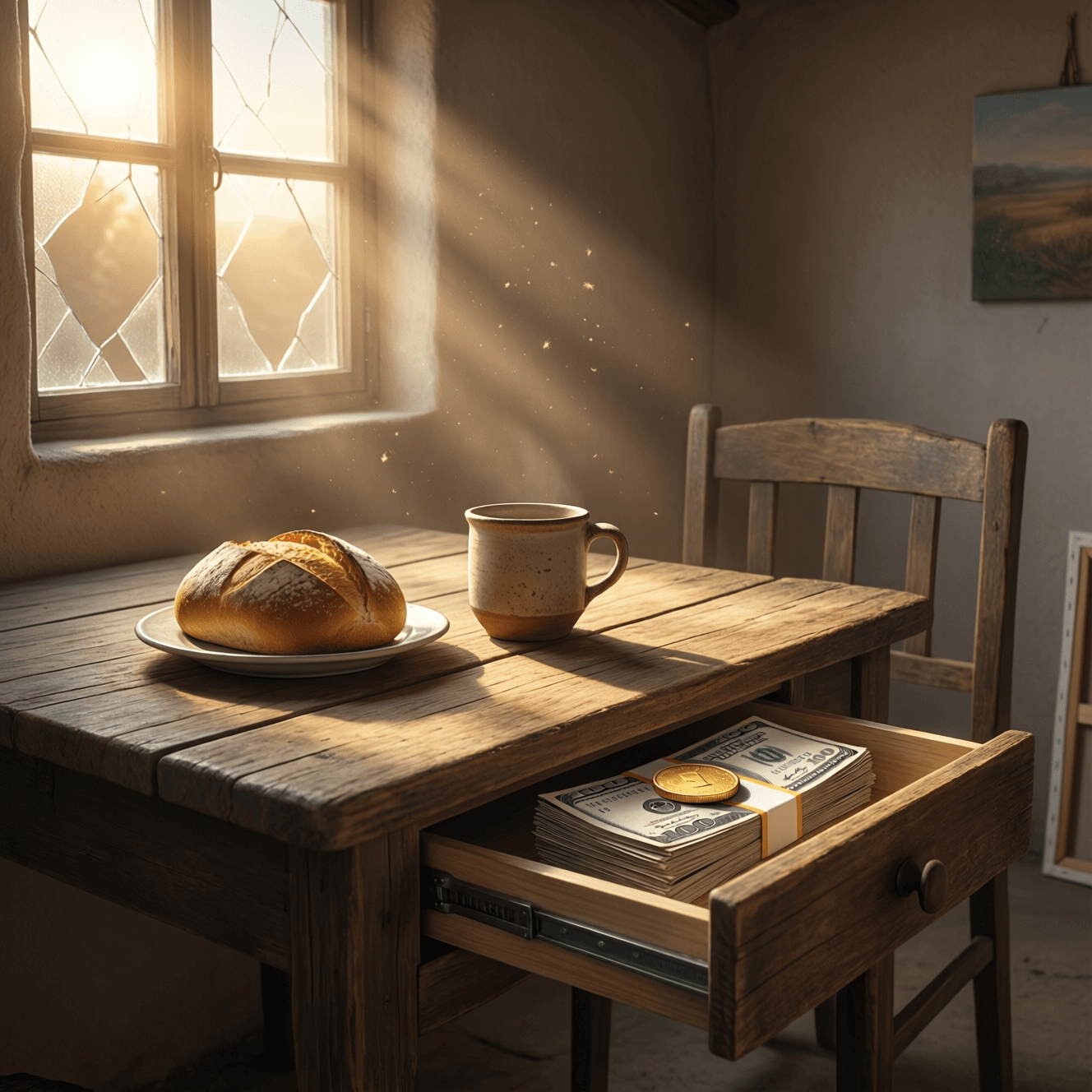
I'd like to live as a poor man with lots of money. — Pablo Picasso
—What lingers after this line?
A Joke That Lands Like a Philosophy
Picasso’s line sounds like a quip, yet it immediately opens a deeper question: what is money for if not to change how we live? By wishing to be “a poor man” while having “lots of money,” he highlights the tension between financial capacity and personal identity. The humor works because it points to something recognizable—many people crave the security of wealth without wanting the social distance, anxiety, or clutter that can come with it. From there, the statement becomes less about contradiction and more about choice: Picasso is sketching a life where money exists as a tool in the background, not a script for how one must behave.
Poverty as a Style of Living
Although “poor” usually denotes deprivation, Picasso seems to use it as a shorthand for simplicity—fewer attachments, fewer obligations, less performance. In that sense, he is not romanticizing hardship but admiring the clarity that can come from living with modest needs. The paradox suggests he wants the freedom associated with having little to lose, while still holding the resources that prevent real suffering. This idea echoes older moral traditions that treat voluntary simplicity as a discipline. Diogenes the Cynic, as reported by Diogenes Laërtius’ Lives of Eminent Philosophers (3rd century), famously embraced austerity to demonstrate independence from convention, a gesture Picasso reframes in modern, moneyed terms.
Money as Insurance, Not Identity
Once we separate “having money” from “living richly,” Picasso’s wish starts to sound practical: keep financial security while refusing to let it dictate habits, tastes, or self-image. In other words, money becomes insurance against misfortune rather than proof of status. The poor man’s mindset—repairing instead of replacing, valuing utility over display—can remain intact even when the bank account grows. This also hints at a fear many quietly share: that wealth can rewrite one’s life into something busier, more managed, and less authentic. Picasso’s phrasing rejects that rewrite, insisting that abundance need not come with a new personality.
The Artist’s Suspicion of Comfort
Transitioning from economics to creativity, the quote also reads like an artist’s caution. Comfort can dull perception, while scarcity—real or chosen—can sharpen it. Picasso built a career on breaking forms and refusing easy repetition; wanting to “live as a poor man” can be interpreted as protecting the appetite, restlessness, and attentiveness that fuel invention. Art history often records this ambivalence toward luxury: creators may enjoy patronage yet distrust its softening effects. Picasso’s line condenses that tension into a single wish—keep the means, preserve the edge.
A Critique of Status and Display
Furthermore, the quote subtly critiques the social theater around wealth. To live like a poor man while possessing money is to refuse the signals—brands, excess, conspicuous consumption—that society uses to sort people. Thorstein Veblen’s The Theory of the Leisure Class (1899) describes “conspicuous consumption” as a way status is performed; Picasso’s wish reads like opting out of that performance while retaining private capability. In this light, his paradox becomes a protest: money should expand freedom, not compel exhibition. The richest outcome would be privacy, discretion, and self-directed living rather than admiration.
The Modern Ideal: Enough, Without Excess
Finally, Picasso’s line points toward a modern aspiration: to have “enough” so that fear recedes, yet not so much excess that life becomes crowded with upkeep and pretense. It’s an argument for lightness—owning fewer things, making fewer compromises, keeping one’s days flexible. Many contemporary movements, from minimalist living to financial independence, echo the same aim in different language. So the paradox resolves into a coherent ethic: build resources, then live as though you don’t need to prove it. In that quiet confidence, Picasso suggests, wealth achieves its highest function—supporting a life that stays free.
One-minute reflection
Where does this idea show up in your life right now?
Related Quotes
6 selectedThe greatest wealth is to live content with little. — Plato
Plato
This quote highlights the importance of finding contentment and happiness in simplicity rather than material possessions. It suggests that true wealth comes from a satisfied mind and spirit.
Read full interpretation →The way to capture the moment is to slow down and look within, to simplify and celebrate the everyday. — Carl Honoré
Carl Honoré
Carl Honoré’s quote begins with a gentle but radical suggestion: if we want to truly capture a moment, we must first stop rushing through it. Rather than treating life as a sequence of tasks to be completed, he asks us t...
Read full interpretation →To live content with small means is a great art. — Lucius Annaeus Seneca
Lucius Annaeus Seneca
The quote promotes finding satisfaction and happiness in a simple, modest lifestyle rather than constant pursuit of material wealth or extravagance.
Read full interpretation →To live content with small means; to seek elegance rather than luxury. — Henry David Thoreau
Henry David Thoreau
Henry David Thoreau’s statement encourages the virtue of contentment through minimalism. Rather than aspiring to endless abundance, he proposes that genuine satisfaction springs from making peace with ‘small means.’ This...
Read full interpretation →Living simply makes loving simple. — bell hooks
bell hooks
bell hooks distills an ethic: when we strip life to essentials, we free attention for care. In All About Love (2000), she describes love as a practiced commitment to nurture growth.
Read full interpretation →It is not the language of painters but the language of nature which one should listen to. — Pablo Picasso
Pablo Picasso
At first glance, Picasso’s remark challenges the authority of artistic convention. By contrasting ‘the language of painters’ with ‘the language of nature,’ he suggests that art should not merely imitate established techn...
Read full interpretation →More From Author
More from Pablo Picasso →It is not the language of painters but the language of nature which one should listen to. — Pablo Picasso
At first glance, Picasso’s remark challenges the authority of artistic convention. By contrasting ‘the language of painters’ with ‘the language of nature,’ he suggests that art should not merely imitate established techn...
Read full interpretation →The chief enemy of creativity is good sense. — Pablo Picasso
At first glance, Picasso’s claim sounds like a provocation against reason itself. Yet his point is subtler: ‘good sense’ often means the habits, rules, and social expectations that keep people from taking imaginative ris...
Read full interpretation →The artist is a receptacle for emotions that come from all over the place: from the sky, from the earth, from a scrap of paper, from a passing shape, from a spider's web. — Pablo Picasso
At the heart of Picasso’s remark is a striking redefinition of creativity: the artist is not merely a maker, but a receiver. Rather than inventing emotion from nothing, the artist absorbs impressions that drift in from t...
Read full interpretation →Computers are useless. They can only give you answers. — Pablo Picasso
Pablo Picasso’s jab—“Computers are useless. They can only give you answers.”—is less a literal dismissal than a provocation about what humans value.
Read full interpretation →