
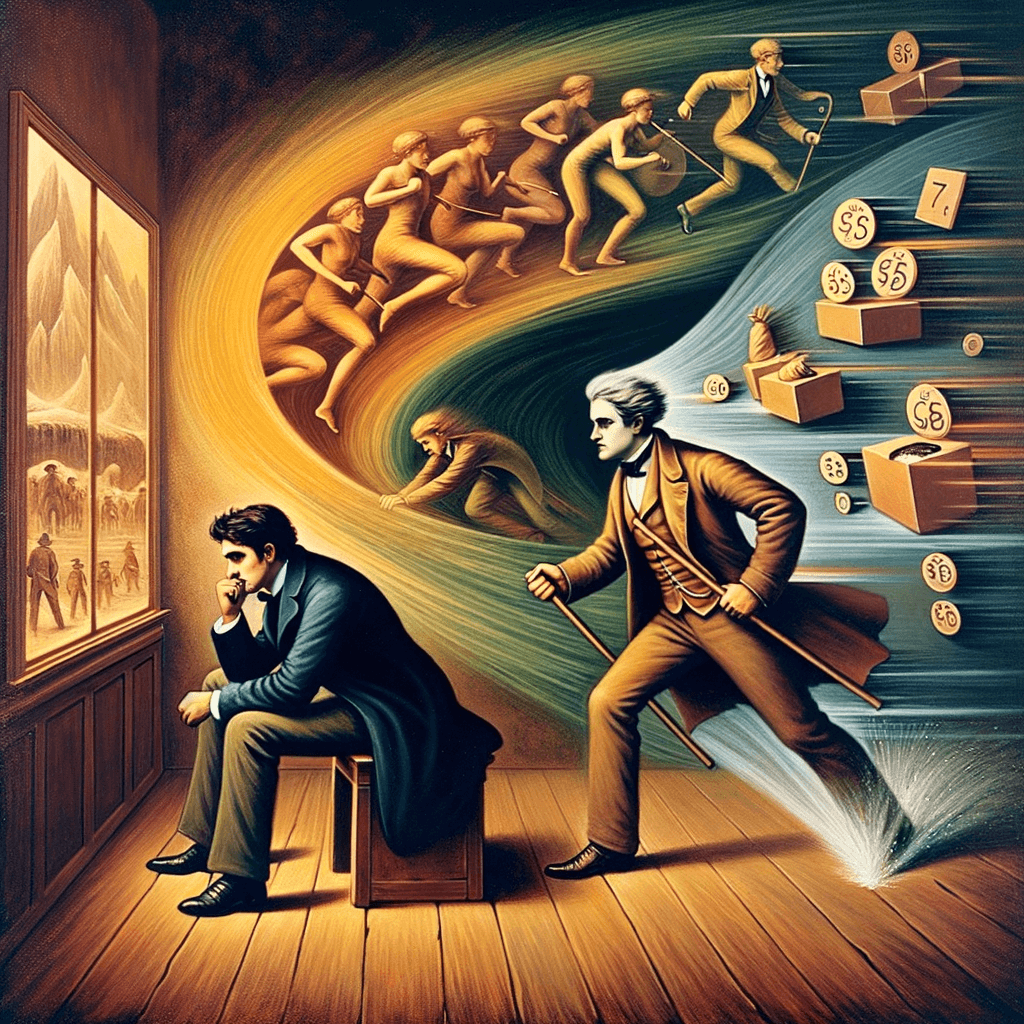
Good things come to those who wait, but only the things left by those who hustle. — Abraham Lincoln
—What lingers after this line?
The Value of Patience
The first part of the quote emphasizes the idea that patience can lead to positive outcomes. It suggests that waiting for the right opportunities is often rewarded.
Importance of Action
The second part of the quote stresses that simply waiting is not enough. It highlights the necessity of hard work and initiative in achieving success, as the best opportunities often go to those who actively pursue them.
Balancing Patience and Effort
This quote encourages a balance between being patient for good things and recognizing that effort is crucial. It points out that while waiting can yield results, one must also be proactive and work towards their goals.
Consequence of Inaction
Lincoln’s statement also hints at the consequences of inaction. Those who wait without taking steps may find that the best opportunities are taken by those who are willing to hustle and work hard.
Historical Perspective
Abraham Lincoln, the 16th President of the United States, was known for his tenacity during challenging times. His life and leadership reflect the principles of determination, hard work, and the power of perseverance in the face of adversity.
One-minute reflection
What feeling does this quote bring up for you?
Related Quotes
6 selectedPatience is not passive waiting. Patience is active acceptance of the process required to attain your goals and dreams. — Ray Davis
Ray Davis
Ray Davis’s words begin by correcting a common misunderstanding: patience is not the same as doing nothing. Passive waiting suggests resignation, as if time alone will deliver success.
Read full interpretation →Slow progress today is often stable progress tomorrow. Fast growth collapses easily. Slow growth holds. — Timeless Type
Timeless Type
At first glance, slow progress can feel discouraging, especially in a culture that praises speed, sudden breakthroughs, and visible success. Yet the quote reminds us that what seems unimpressive today may become the foun...
Read full interpretation →Sometimes you have to slow down to go fast. — Jeff Olson
Jeff Olson
Jeff Olson’s line begins with a practical paradox: speed is not always created by rushing. Sometimes the quickest path forward requires pausing long enough to see the road clearly, correct mistakes early, and choose acti...
Read full interpretation →Dreams can come true, but there is a secret. They are realized through the magic of persistence, determination, commitment, passion, practice, focus, and hard work. — Harsha Bhogle
Harsha Bhogle
Harsha Bhogle’s words begin by dismantling the illusion that dreams come true by luck alone. Although achievement can look magical from the outside, he reminds us that the real enchantment lies in ordinary habits repeate...
Read full interpretation →Everything that is great in life is the product of slow growth; the newer, and greater, and higher, and nobler the work, the slower is its growth. — William George Jordan
William George Jordan
William George Jordan’s reflection begins with a quiet but demanding truth: the most meaningful achievements rarely arrive quickly. He suggests that greatness is not manufactured in sudden bursts but cultivated through t...
Read full interpretation →You cannot force ideas. Successful ideas are the result of slow growth. — Alexander Graham Bell
Alexander Graham Bell
Alexander Graham Bell’s statement begins with a quiet warning against impatience: ideas cannot be commanded into maturity simply because we desire results. Like plants, they require conditions, time, and repeated attenti...
Read full interpretation →More From Author
More from Abraham Lincoln →The best way to predict your future is to create it. — Abraham Lincoln
This quote empowers individuals to take control of their own destinies. It emphasizes that our future is not set in stone, but can be shaped by our actions and decisions.
Read full interpretation →In the end, it's not the years in your life that count. It's the life in your years. — Abraham Lincoln
This quote emphasizes that the quality of your experiences and how you live your life is more important than the number of years you live. A shorter life filled with meaningful moments is more valuable than a longer life...
Read full interpretation →Whatever you are, be a good one. — Abraham Lincoln
This quote encourages individuals to strive for excellence in whatever role or profession they occupy. It suggests that one's current position, no matter how grand or humble, should be performed to the best of one's abil...
Read full interpretation →Those who look for the bad in people will surely find it. — Abraham Lincoln
This quote highlights how a person's mindset can influence their perception of others. If someone approaches relationships or interactions with a negative outlook, they are likely to notice flaws and shortcomings more re...
Read full interpretation →