
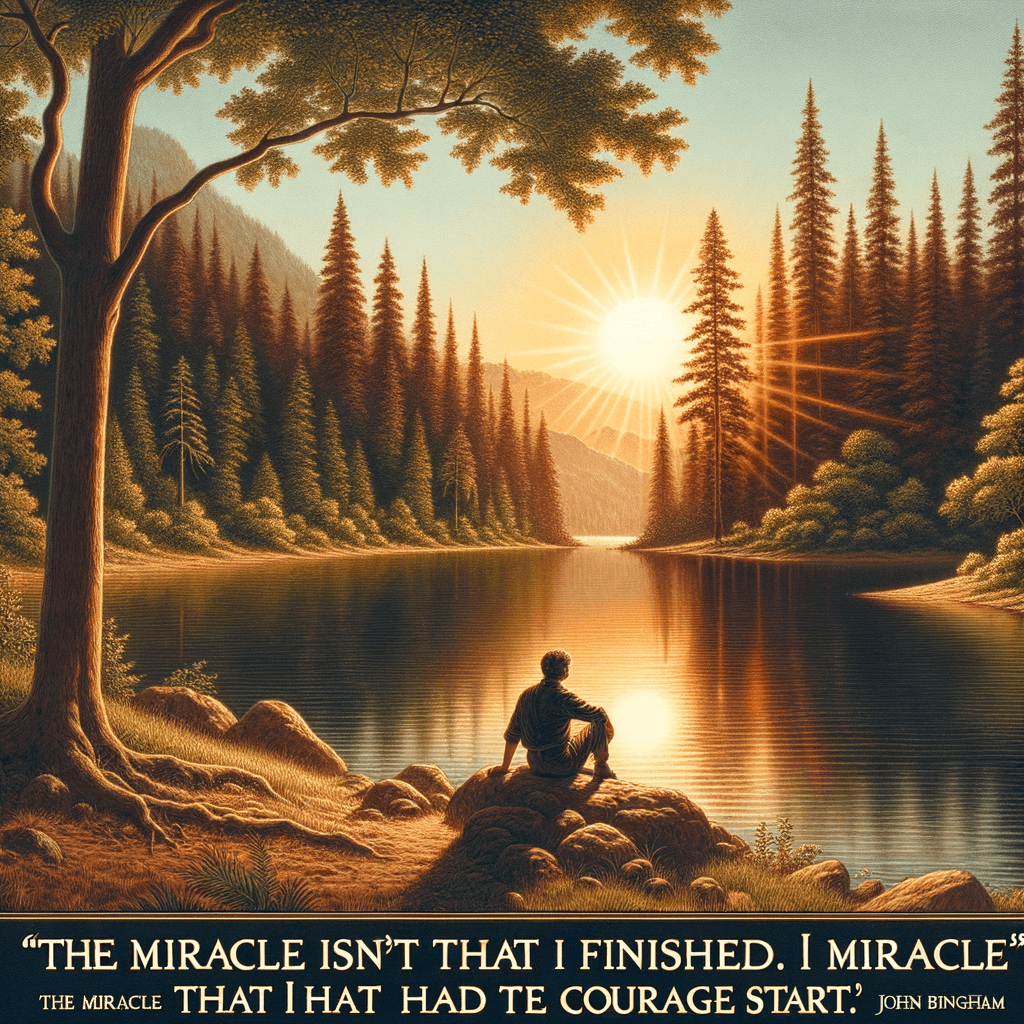
The miracle isn't that I finished. The miracle is that I had the courage to start. — John Bingham
—What lingers after this line?
Courage to Begin
This quote emphasizes that the true achievement lies in having the bravery to take the first step towards a goal, rather than merely completing it. Starting anything new often requires overcoming fear and uncertainty.
Value of the Journey
It suggests that the process of embarking on a journey is significant, and the act of starting can be a monumental step in personal growth and development.
Overcoming Obstacles
Bingham's words reflect the idea that challenges and self-doubt can prevent many from starting their desired path. Therefore, the act of beginning is a miracle in itself as it signifies the decision to confront those obstacles.
Mindset Shift
This quote encourages a mindset that values initiation over completion. It highlights the importance of being proactive and embracing new challenges, as starting is often the hardest part.
Personal Growth and Development
John Bingham is known in the running community not just for his completion of marathons, but as a motivational speaker. His experiences showcase how starting, regardless of the outcome, can lead to growth, inspiration, and self-discovery.
Recommended Reading
As an Amazon Associate, we earn from qualifying purchases.
One-minute reflection
Why might this line matter today, not tomorrow?
Related Quotes
6 selectedIt takes a lot of courage to show your dreams to someone else. — Erma Bombeck
Erma Bombeck
Erma Bombeck’s insight begins with a simple truth: dreams feel precious because they expose what we most deeply want. To share them is not merely to state a goal, but to reveal hope, insecurity, and the possibility of fa...
Read full interpretation →You do not have to be fearless to be brave. You only need to be present enough to take the next deliberate action. — Pema Chödrön
Pema Chödrön
At first glance, Pema Chödrön’s quote gently overturns a common misconception: that bravery belongs only to people untouched by fear. Instead, she presents courage as something far more accessible.
Read full interpretation →The most radical act of courage is to be truly seen, to step out from behind our carefully curated walls and offer our authentic selves to the world. — Glennon Doyle
Glennon Doyle
Glennon Doyle’s quote reframes courage not as conquest or spectacle, but as the quiet, risky decision to be known. At its core, it suggests that the bravest act is not hiding our flaws behind polished identities, but all...
Read full interpretation →If you want the truth, you must be brave enough to hear it. — Margaret Heffernan
Margaret Heffernan
At first glance, Margaret Heffernan’s remark sounds like a simple call for honesty, yet it reaches further than that. She suggests that truth is not merely something we uncover through intelligence or investigation; rath...
Read full interpretation →Movement does not always mean speed; sometimes, the most courageous step you can take is to slow down and breathe. — Sarah Ban Breathnach
Sarah Ban Breathnach
At first glance, movement is often confused with speed, productivity, or constant visible progress. Sarah Ban Breathnach’s quote gently corrects that assumption by suggesting that motion can also take the form of pause,...
Read full interpretation →Trust in your next step more than you fear the fall. — Jim Carroll
Jim Carroll
At its core, Jim Carroll’s line urges us to give more weight to possibility than to anxiety. The ‘next step’ stands for action in moments of uncertainty, while ‘the fall’ represents failure, embarrassment, or loss.
Read full interpretation →More From Author
More from John Bingham →