
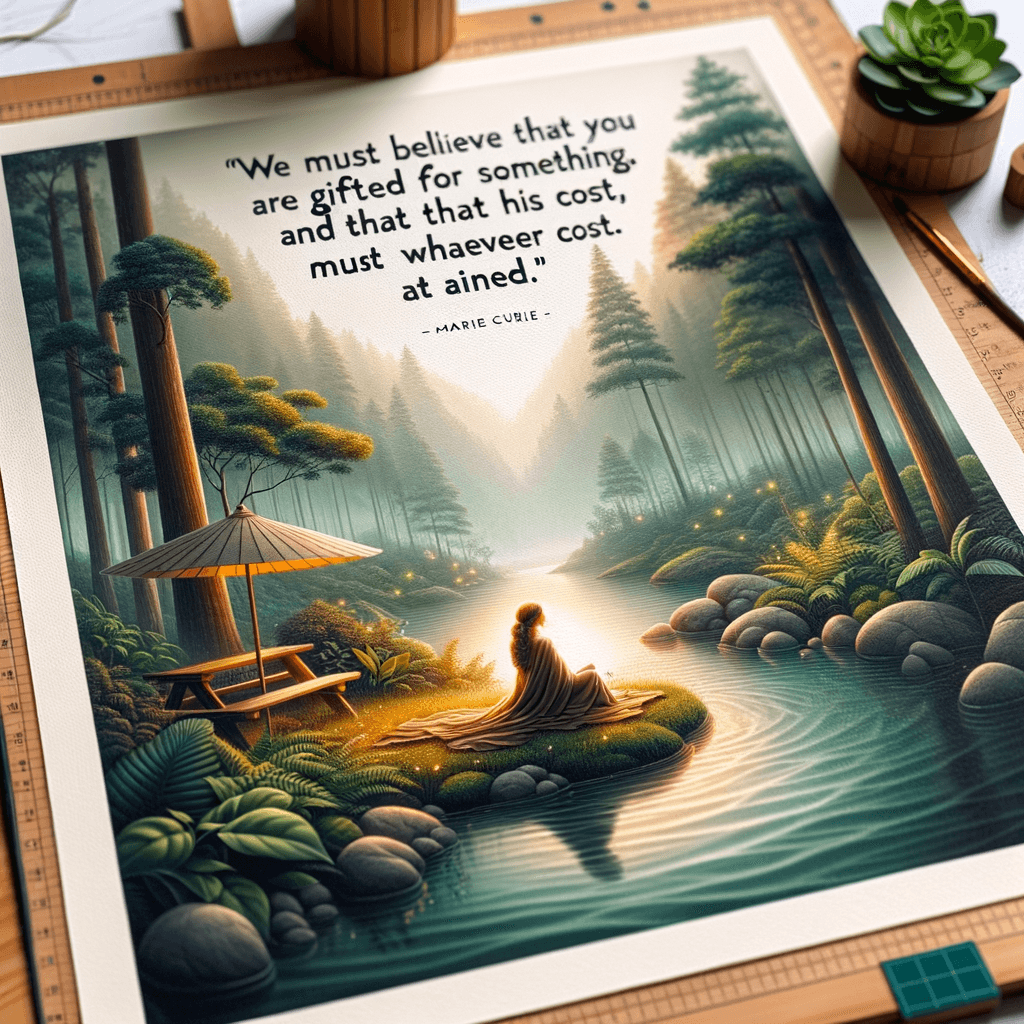
We must believe that we are gifted for something and that this thing, at whatever cost, must be attained. — Marie Curie
—What lingers after this line?
Self-Belief and Purpose
This quote highlights the importance of believing in one's unique talents and gifts. Recognizing our abilities gives us a sense of direction and purpose.
Pursuit of Passion
Curie emphasizes that the realization of one's potential requires a commitment to pursue what we are passionate about, regardless of the challenges that may arise.
Determination and Resilience
The quote suggests that achieving our goals may come at a cost, but demonstrates the value of determination and resilience in the face of adversity.
The Cost of Achievement
Curie acknowledges that significant achievements often require sacrifices, whether they be time, effort, or personal comforts. The pursuit of one's gifts may necessitate hard work and dedication.
Inspirational Figure
Marie Curie, renowned for her groundbreaking work in radioactivity and two-time Nobel Laureate, serves as a powerful example of how believing in one's gifts can lead to revolutionary discoveries and contributions to science.
One-minute reflection
What feeling does this quote bring up for you?
Related Quotes
6 selectedPursue truth with tireless hands; discovery rewards the patient and the brave. — Marie Curie
Marie Curie
Curie’s injunction to pursue truth with “tireless hands” foregrounds science as a craft before it is a revelation. Truth emerges not from one grand epiphany but from many careful gestures—calibrating instruments, logging...
Read full interpretation →If we are facing in the right direction, all we have to do is keep walking. — Thích Nhất Hạnh
Thich Nhat Hanh
Thích Nhất Hạnh’s words begin with a simple but profound premise: progress depends first on direction, not speed. If a person is turned toward compassion, clarity, healing, or truth, then each modest step becomes meaning...
Read full interpretation →Do the best one can. Do it over again. Then still improve, even if ever so slightly, those retouches. — Marguerite Yourcenar
Marguerite Yourcenar
Yourcenar’s words begin with a simple demand: do the best one can. Yet she immediately refuses to let effort become an excuse for stopping.
Read full interpretation →A good-enough novel violently written now is better than a perfect novel meticulously written never. — Elizabeth Gilbert
Elizabeth Gilbert
Elizabeth Gilbert’s line immediately shifts the argument from artistic purity to artistic existence. A “good-enough” novel, even one “violently written,” has entered the world and can move, provoke, or comfort someone; b...
Read full interpretation →There is no road too long to the man who advances deliberately and without undue haste; there are no honors too distant to the man who prepares himself for them with patience. — Jean de La Bruyère
Jean de La Bruyère
At its core, La Bruyère’s line praises steady movement over restless speed. A long road feels intimidating only when seen all at once; once it is broken into deliberate steps, distance loses much of its power.
Read full interpretation →There are no soft grounds in life. Just places to water and plough. — Athésia
Athésia
At first glance, Athésia’s line dismisses the hope that life might eventually deliver a permanently gentle terrain. There are, in this view, no naturally soft grounds waiting for us—no stage where effort disappears and g...
Read full interpretation →More From Author
More from Marie Curie →Plant ideas like seeds and tend them with action until forests of change grow — Marie Curie
Marie Curie’s metaphor treats ideas not as static thoughts but as living seeds—small, vulnerable, and full of latent potential. A seed contains an entire future, yet it remains invisible until it meets the right conditio...
Read full interpretation →Measure progress by the bridges you build, not by the walls you avoid. — Marie Curie
The quote asks for a different yardstick: instead of treating success as the absence of conflict, it frames progress as the presence of connection. Avoiding “walls” can look like prudence—staying silent, steering clear o...
Read full interpretation →Measure your worth by the compassion you practice, not by the trophies you collect. — Marie Curie
Marie Curie’s line asks us to swap a familiar scoreboard for a quieter one. Instead of counting trophies—awards, titles, status symbols—she points to compassion as the real unit of measure, because it reflects how our li...
Read full interpretation →Risk a sincere attempt; the world rewards the brave. — Marie Curie
Marie Curie’s exhortation to “risk a sincere attempt” begins with a challenge to our habitual caution. Rather than waiting for perfect conditions or guaranteed success, she urges us to act with genuine intent, even when...
Read full interpretation →