
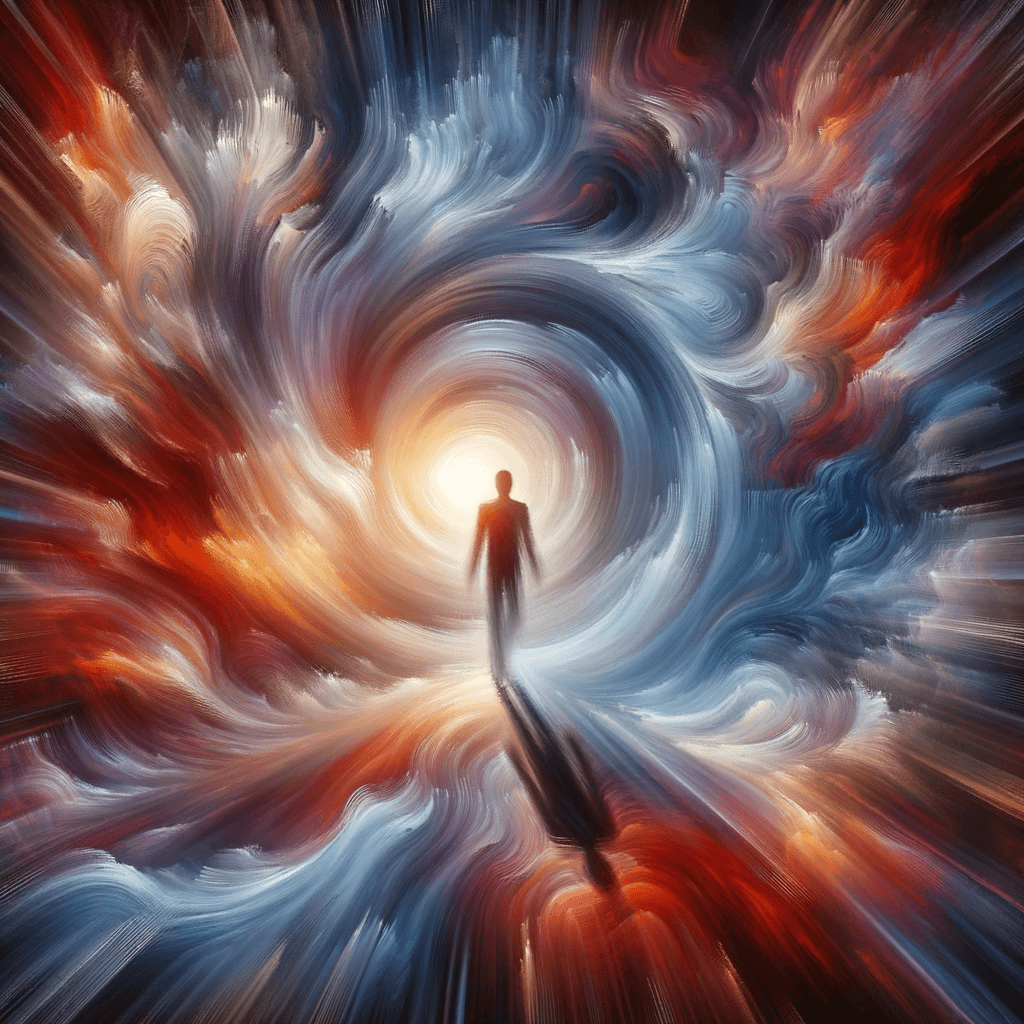
In the midst of movement and chaos, when there is no time to think, there is no time to think, only time to feel. — A. R. Ammons
—What lingers after this line?
Instinctive Reactions
This quote suggests that during moments of fast-paced change or chaos, there is no space for deep reflection or intellectualization. Instead, instinct and emotions take over, guiding actions and decisions.
Emotional Response in Chaos
It emphasizes the role of feelings in stressful or chaotic situations. When the mind is overwhelmed and there is no time for conscious thought, pure emotion surfaces as the driving force.
The Power of the Present Moment
Ammons is highlighting the idea that in moments of intensity or unpredictability, we exist fully in the present. We are forced to engage with our immediate emotions, rather than relying on logic to process events as they happen.
Intuition Versus Thought
This quote contrasts intuition and feeling with deliberate thought. It suggests that there are situations where reasoning must take a backseat, allowing intuitive and emotional responses to prevail when time is scarce.
Poet’s Reflection on Human Experience
A.R. Ammons, an American poet known for his existential and nature-inspired themes, often explored human experiences in his works. This quote reflects his understanding of how individuals react to life's uncertainties and the chaos of the natural world.
One-minute reflection
What feeling does this quote bring up for you?
Related Quotes
6 selectedIf you enter a noisy street and add noise to it, you are doing an ordinary thing! If you want to do something extraordinary, add calm to the chaos! — Mehmet Murat İldan
Mehmet Murat ildan
At first glance, Mehmet Murat İldan’s remark turns a simple observation into a moral challenge. Anyone can amplify disorder in a loud, frantic world; that requires little imagination or discipline.
Read full interpretation →Chaos is merely order waiting to be deciphered. — José Saramago
José Saramago
At first glance, Saramago’s line overturns an everyday assumption: what looks chaotic may not be meaningless at all, but simply unreadable to us for the moment. In that sense, chaos is less a property of the world than a...
Read full interpretation →It is not enough to know your craft – you have to have feeling. — Edouard Manet
Edouard Manet
At first glance, Manet’s remark seems simple: skill matters, but skill by itself is incomplete. To know one’s craft is to understand the mechanics—composition, color, timing, form, structure.
Read full interpretation →Those who are in the middle of the storm cannot see the shining sun. — A.R. Ammons
A.R. Ammons
This quote suggests that when people are going through difficult or tumultuous times, they may not be able to see or feel hope or positivity, much like being unable to see the sun during a storm.
Read full interpretation →The creative process is a journey of 95 percent intuitive, seat-of-the-pants, at-the-moment decisions that you can't even explain. — George Saunders
George Saunders
George Saunders presents creativity not as a tidy formula but as a lived, improvisational act. At the heart of his claim is the idea that most artistic choices arise in motion, before the mind can neatly justify them.
Read full interpretation →The goal is to get to the point where you're not thinking anymore. You're just reacting to the magic. — Rick Rubin
Rick Rubin
Rick Rubin’s line points to a subtle creative destination: the moment thinking stops being the driver and becomes, at most, a quiet passenger. Instead of deliberating over each choice, the artist responds in real time—li...
Read full interpretation →More From Author
More from A.R. Ammons →