
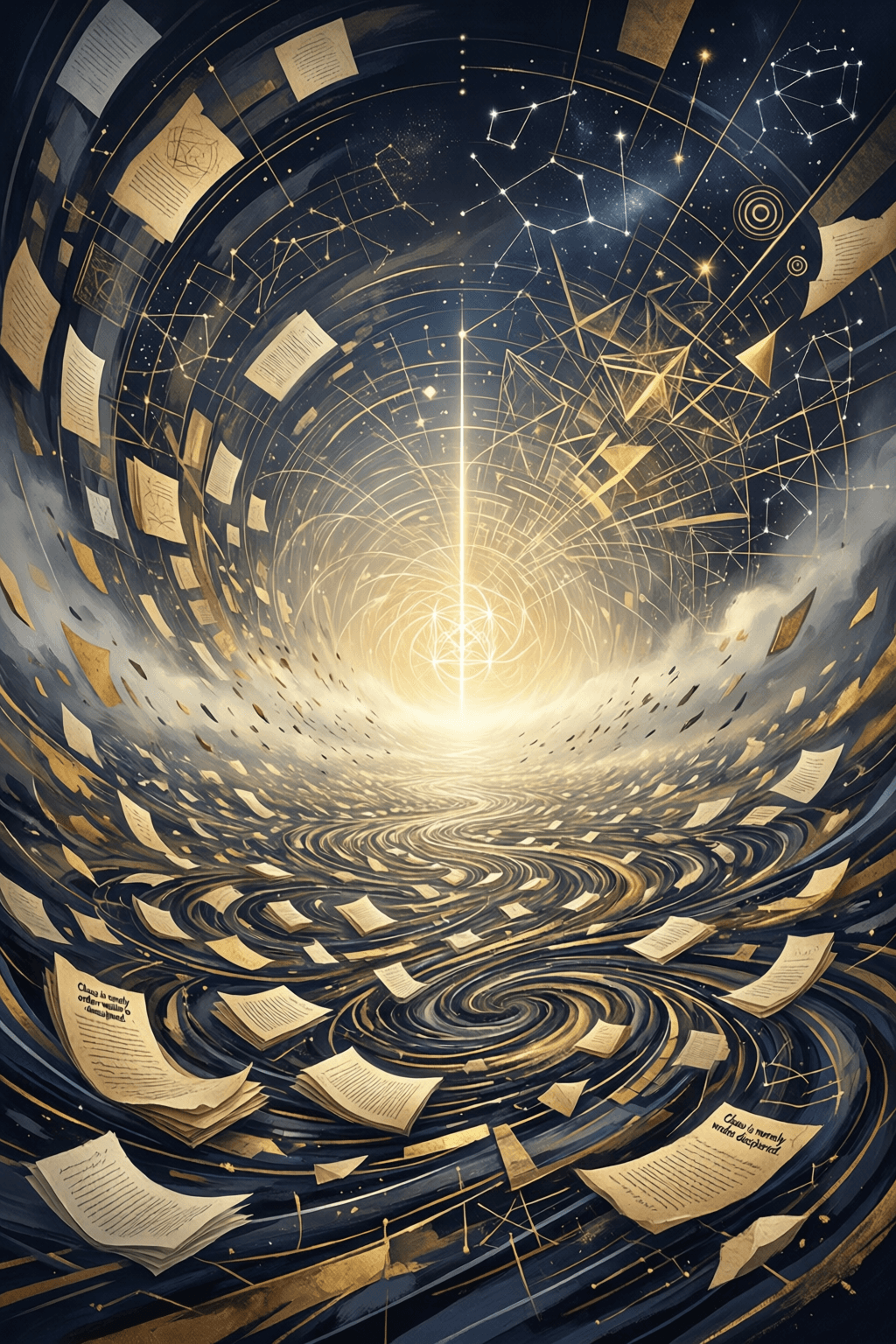
Chaos is merely order waiting to be deciphered. — José Saramago
—What lingers after this line?
A Reversal of Appearances
At first glance, Saramago’s line overturns an everyday assumption: what looks chaotic may not be meaningless at all, but simply unreadable to us for the moment. In that sense, chaos is less a property of the world than a limit of perception. We call something disorderly when we have not yet found the pattern that organizes it. This reversal matters because it shifts attention from panic to inquiry. Rather than treating confusion as a dead end, Saramago invites us to see it as the beginning of interpretation. What seems scattered, then, may be an unfinished puzzle, waiting for patience, language, and insight to reveal its design.
The Human Hunger for Pattern
From there, the quote speaks to a deep human instinct: we are pattern-seeking creatures. Historians, detectives, and scientists all begin with fragments that appear disconnected, then slowly assemble them into coherence. Charles Darwin’s notebooks before On the Origin of Species (1859), for instance, show years of observations that only gradually formed a unifying theory. Consequently, deciphering is not a passive act but an intellectual craft. We compare, sort, test, and revise until order emerges. Saramago’s phrasing honors that process, suggesting that understanding does not always arrive in a flash; often it is built through disciplined attention to what first looked hopelessly confused.
Literature and the Shape of Confusion
Moreover, literature often demonstrates how apparent disorder can conceal a deeper structure. In Saramago’s own Blindness (1995), social collapse seems at first like pure chaos, yet the novel gradually exposes recurring patterns of fear, power, dependence, and moral choice. The surface may be turbulent, but the underlying human behaviors are legible. Likewise, modernist works such as T. S. Eliot’s The Waste Land (1922) can feel fragmented on first reading. Yet as references, symbols, and echoes begin to connect, the poem reveals an architecture beneath the brokenness. In this way, art trains readers to tolerate confusion long enough for hidden order to come into view.
A Scientific Echo
In a scientific register, Saramago’s idea resembles the insight that complex systems may look random while still obeying rules. Weather patterns, traffic flow, and ecosystems often appear unruly because they involve so many interacting variables. Yet fields such as chaos theory, developed through figures like Edward Lorenz in the 1960s, show that irregular behavior can arise from underlying deterministic structures. Importantly, this does not mean everything is simple once decoded. Rather, it means that complexity is not the same as meaninglessness. The deciphering may be difficult, partial, or always evolving, but Saramago’s claim remains persuasive: beneath turbulence, there may be form.
An Ethical Lesson in Patience
As the quote widens beyond art and science, it also offers an ethical lesson. When faced with personal crisis, political upheaval, or emotional confusion, people often rush to condemn what they do not yet understand. Saramago proposes a steadier response: patience. If chaos may be unread order, then bewilderment calls not only for control, but for humility. This attitude can change how we meet both events and people. A troubled life, a tense community, or a contradictory decision may contain causes and structures invisible at first glance. Therefore, deciphering becomes a moral practice as well as an intellectual one, grounded in careful attention instead of premature judgment.
Hope Within Uncertainty
Finally, the enduring appeal of the quotation lies in its quiet hope. It does not deny confusion, suffering, or disorder; instead, it suggests that opacity is temporary. What we cannot yet read today may become intelligible tomorrow, once experience, perspective, or knowledge catches up with reality. For that reason, Saramago’s sentence feels both realistic and consoling. It acknowledges that life often arrives in fragments, yet it resists despair by implying that fragments can be interpreted. Chaos, then, is not the end of meaning, but the threshold of understanding—the moment before order is finally named.
Recommended Reading
As an Amazon Associate, we earn from qualifying purchases.
One-minute reflection
Why might this line matter today, not tomorrow?
Related Quotes
6 selectedChaos is the law of nature; order is the dream of man. — Henry Adams
Henry Adams
This quote suggests that the natural world is governed by unpredictability and disorder, where events such as storms, earthquakes, and other phenomena defy human control and understanding.
Read full interpretation →Creativity is the ability to introduce order into the randomness of nature. — Edgard Varèse
Edgard Varèse
At its core, Edgard Varèse’s remark defines creativity as an act of transformation rather than mere invention. The world presents itself as overwhelming, irregular, and full of scattered possibilities; the creative mind,...
Read full interpretation →In the midst of movement and chaos, when there is no time to think, there is no time to think, only time to feel. — A. R. Ammons
A.R. Ammons
This quote suggests that during moments of fast-paced change or chaos, there is no space for deep reflection or intellectualization. Instead, instinct and emotions take over, guiding actions and decisions.
Read full interpretation →Act with a purpose or you will be overwhelmed by the chaos. — A. V. Williams
A. V. Williams
This quote underscores the need for deliberate action. Without a clear purpose, one risks being swept away by the randomness and noise of life.
Read full interpretation →The art of progress is to preserve order amid change. — Alfred North Whitehead
Alfred North Whitehead
This quote highlights the importance of maintaining stability while embracing change. Progress does not mean total disruption; instead, it requires a careful balance between new advancements and existing structures.
Read full interpretation →Only from chaos comes creativity. — Brian Eno
Brian Eno
Brian Eno’s statement that creativity emerges only from chaos challenges our conventional ideas about order and innovation. Rather than viewing disorder as an impediment, Eno positions it as an essential precondition—a s...
Read full interpretation →More From Author
More from José Saramago →