
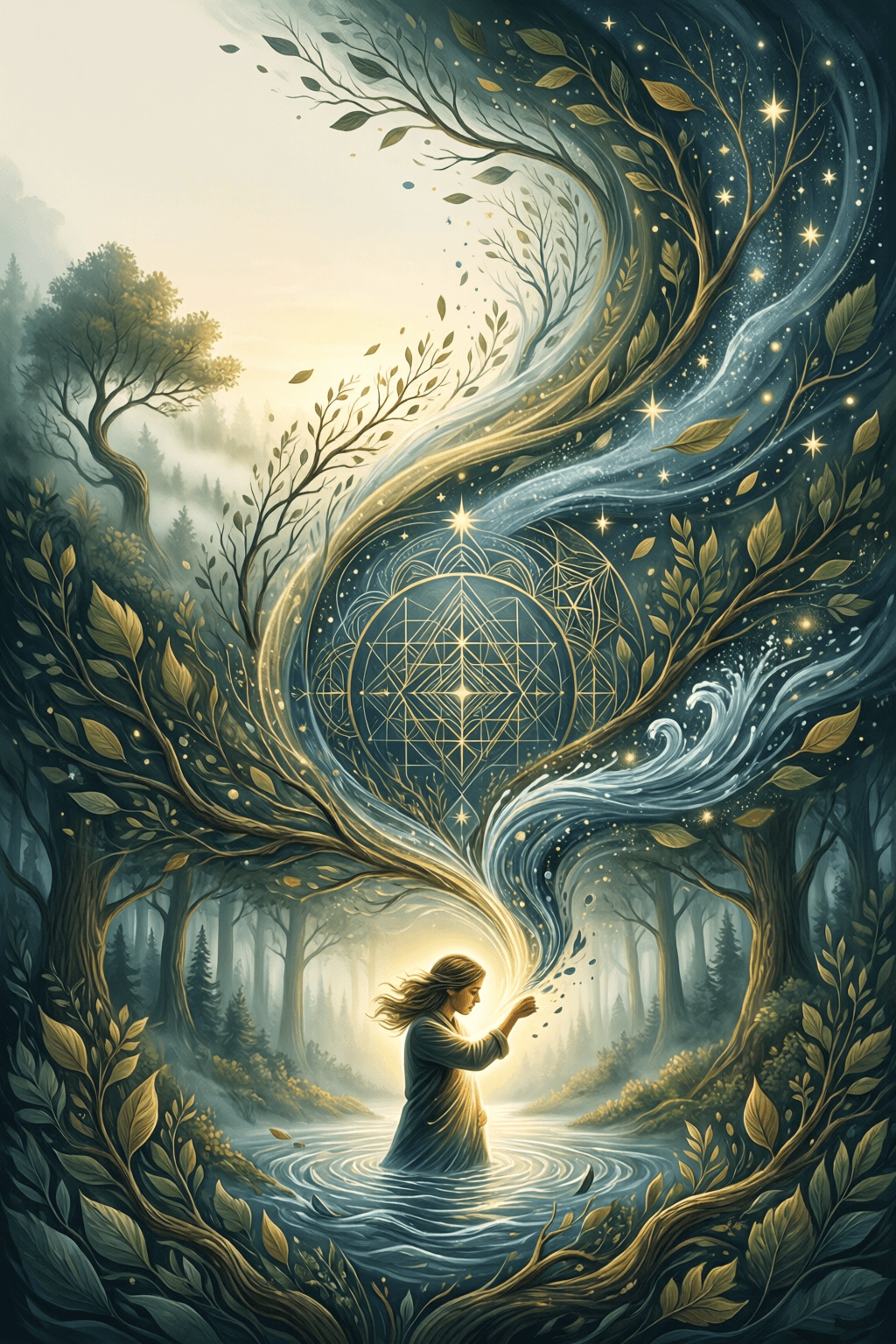
Creativity is the ability to introduce order into the randomness of nature. — Edgard Varèse
—What lingers after this line?
A Definition Built on Tension
At its core, Edgard Varèse’s remark defines creativity as an act of transformation rather than mere invention. The world presents itself as overwhelming, irregular, and full of scattered possibilities; the creative mind, in turn, does not erase that disorder but shapes it into something intelligible. In this sense, creativity becomes a disciplined response to chaos, a way of discovering form within what first appears formless. This tension between randomness and order is what gives the quote its force. Rather than imagining artists or thinkers as magicians producing ideas from nothing, Varèse presents them as organizers of reality. The creative act begins, therefore, with attention: one must first notice the wild abundance of nature before one can arrange it into pattern, meaning, or beauty.
Varèse and the Music of Modernity
Seen in light of Varèse’s own work, the statement becomes even richer. In compositions such as Ionisation (1931), he used percussion, unconventional timbres, and sonic mass to create music that often sounded untamed at first hearing. Yet beneath that apparent turbulence lay careful structure, proving that modern art could harness noise itself and turn it into expressive order. Consequently, Varèse was not simply speaking in metaphor; he was describing his artistic practice. He treated sound as raw material, much as a sculptor treats stone or metal. By arranging bursts, silences, and textures into deliberate relationships, he showed that creativity does not deny nature’s wildness but collaborates with it.
Nature as Raw Material
More broadly, the quote suggests that nature is not only a source of inspiration but also a field of endless unpredictability. A landscape, a storm, birdsong, or even human emotion arrives without tidy design, and the creator’s role is to perceive underlying connections where others see only fragments. In that way, creativity resembles pattern recognition elevated into art. This idea appears across disciplines. Leonardo da Vinci’s notebooks, for instance, transformed observations of water, anatomy, and flight into studies that linked natural irregularity with human design. Likewise, Japanese haiku often distills fleeting seasonal moments into a few measured lines, proving that art can give brief and unruly experience a lasting shape.
The Mind’s Search for Pattern
From there, the quote opens onto psychology. Human beings are natural pattern-seekers, and creativity may be one of the highest expressions of that impulse. Cognitive research often describes insight as the ability to connect seemingly unrelated elements; what looks like randomness to one person becomes, to another, the beginning of a melody, theory, or image. However, Varèse’s wording also implies that creativity requires selection, not just imagination. To introduce order is to choose what matters, what repeats, and what can be left aside. The artist or inventor is therefore not only receptive but decisive, shaping attention until a coherent form emerges from countless possible arrangements.
Art, Science, and Shared Creation
Importantly, Varèse’s idea does not belong to art alone. Scientists also confront the apparent randomness of the natural world and attempt to extract laws, models, and systems from it. Isaac Newton’s Principia Mathematica (1687), for example, organized the motion of falling apples and orbiting planets into a unified framework, showing that creative order can be mathematical as well as aesthetic. Thus, the quote bridges the arts and sciences through a common act: both seek meaningful structure in what first appears chaotic. Whether one composes a symphony, designs a building, or formulates an equation, the process begins in uncertainty and ends in form. Creativity, then, is a universal way of making the world legible.
A Humble but Powerful Vision
Finally, Varèse offers a view of creativity that is both ambitious and humble. It is ambitious because it grants human beings the power to shape experience into order; yet it is humble because that order is not imposed from nowhere. Instead, it arises through engagement with the materials of the world as they already exist, in all their disorderly richness. For that reason, the quote remains deeply relevant. It reminds us that creativity is less about escaping reality than about working carefully within it. In music, writing, science, or daily problem-solving, the creative person is the one who can stand before confusion and gradually reveal the pattern hidden inside.
Recommended Reading
As an Amazon Associate, we earn from qualifying purchases.
One-minute reflection
What does this quote ask you to notice today?
Related Quotes
6 selectedCreativity takes courage. — Henri Matisse
Henri Matisse
This quote highlights that being creative often involves exposing one's inner thoughts and feelings, which requires a significant amount of courage as it makes one vulnerable to criticism and judgment.
Read full interpretation →Only from chaos comes creativity. — Brian Eno
Brian Eno
Brian Eno’s statement that creativity emerges only from chaos challenges our conventional ideas about order and innovation. Rather than viewing disorder as an impediment, Eno positions it as an essential precondition—a s...
Read full interpretation →Don't think. Thinking is the enemy of creativity. It's self-conscious, and anything self-conscious is lousy. — Ray Bradbury
Ray Bradbury
At first glance, Ray Bradbury’s line sounds almost rebellious: “Don’t think. Thinking is the enemy of creativity.” Yet his target is not intelligence itself, but the paralyzing kind of self-awareness that makes an artist...
Read full interpretation →You can be cautious or you can be creative, but there's no such thing as a cautious creative. — George Lois
George Lois
George Lois draws a sharp line between two mindsets: caution protects what already exists, while creativity risks making something new. At first glance, the statement sounds absolute, yet that severity is exactly its poi...
Read full interpretation →Almost always, the creative dedicated minority has made the world better. — Martin Luther King, Jr.
Martin Luther King Jr.
Martin Luther King, Jr. distills a sweeping historical truth into a single sentence: progress is often driven not by the passive majority but by a small, committed group willing to imagine a better order.
Read full interpretation →What keeps life fascinating is the constant creativity of the soul. — Deepak Chopra
Deepak Chopra
At its core, Deepak Chopra’s line suggests that life stays interesting not because the world is fixed and exciting on its own, but because the inner self continually reinterprets it. The phrase “creativity of the soul” p...
Read full interpretation →More From Author
More from Edgard Varèse →