
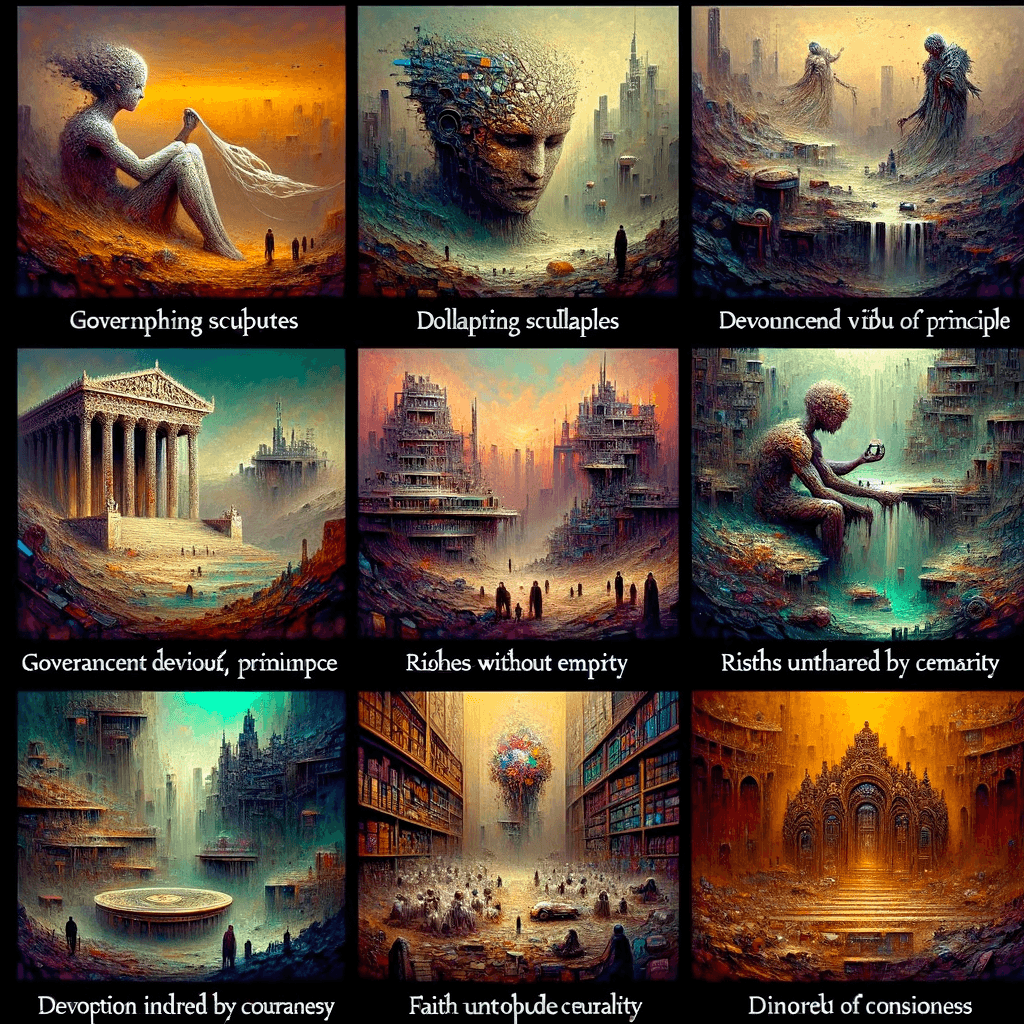
These things will destroy the human race: politics without principle, progress without compassion, wealth without work, learning without silence, religion without fearlessness and worship without awareness. — Adlai Stevenson II
—What lingers after this line?
Politics Without Principle
This refers to governance driven by self-interest, corruption, or dishonesty rather than ethical values or the common good. It warns that a lack of moral integrity in politics can lead to societal decay.
Progress Without Compassion
Stevenson highlights the dangers of advancing technology, industry, or societal structures without empathy or consideration for the well-being of others. Progress devoid of compassion can exacerbate inequality and harm vulnerable populations.
Wealth Without Work
This emphasizes the injustice of acquiring wealth without effort or contribution, such as through exploitation or unearned privilege. It points to the erosion of the value of hard work and fairness in society.
Learning Without Silence
Silence symbolizes reflection and contemplation. Learning without taking the time to deeply process and reflect on knowledge can lead to superficial understanding and a lack of wisdom.
Religion Without Fearlessness
This suggests that a meaningful spiritual life requires courage to question, challenge norms, and stand up for what is right, rather than blind obedience or fear of dissent.
Worship Without Awareness
Awareness in worship signifies mindfulness and sincere devotion. Worship without awareness reduces spiritual practices to empty rituals, losing their true purpose of connection and understanding.
Overall Message and Context
Adlai Stevenson II, an American politician and diplomat, stresses the importance of balancing values like morality, empathy, and mindfulness with human endeavors. His warning reflects a desire for integrity and conscientiousness in building a sustainable and ethical society.
One-minute reflection
What does this quote ask you to notice today?
Related Quotes
6 selectedYou must love in such a way that the person you love feels free. — Thich Nhat Hanh
Thich Nhat Hanh
At its core, Thich Nhat Hanh’s statement redefines love as an act of care that does not confine. To love someone so that they feel free means offering affection without turning it into control, guilt, or dependence.
Read full interpretation →The sort of fearless openness required to turn toward our suffering is only possible within the spacious receptivity of love. — Frank Ostaseski
Frank Ostaseski
Frank Ostaseski’s statement begins with a striking claim: real courage is not simply toughness or willpower. Instead, the bravery required to face suffering honestly arises from love’s presence.
Read full interpretation →Healing is an art. It takes time, it takes practice, it takes love. — Maza Dohta
Maza Dohta
Maza Dohta’s quote begins by reframing healing as an art rather than a mechanical repair. That distinction matters, because art is rarely instant: it involves sensitivity, patience, revision, and care.
Read full interpretation →The only way to exist in a world that feels increasingly cold is to be the warmth you wish to receive from others. — Maya Angelou
Maya Angelou
At its core, Maya Angelou’s line reframes loneliness as a call to action rather than a verdict on the world. If life feels impersonal, distant, or harsh, she suggests that waiting passively for kindness may only deepen t...
Read full interpretation →We are called to be strong companions and clear mirrors to one another, to seek those who reflect with compassion how we are doing. — Wayne Muller
Wayne Muller
Wayne Muller’s quote begins with a call to companionship that is more than simple friendship. To be a strong companion is to stand beside another person with steadiness, honesty, and care, especially when life becomes co...
Read full interpretation →You can't save people from themselves. You can only love them while they save themselves. — Al-Anon Philosophy
Anon Philosophy
At its core, this Al-Anon saying confronts a painful truth: no amount of devotion can force another person to change. It rejects the fantasy of rescue, reminding us that healing, sobriety, and emotional growth must ultim...
Read full interpretation →More From Author
More from Adlai Stevenson II →