
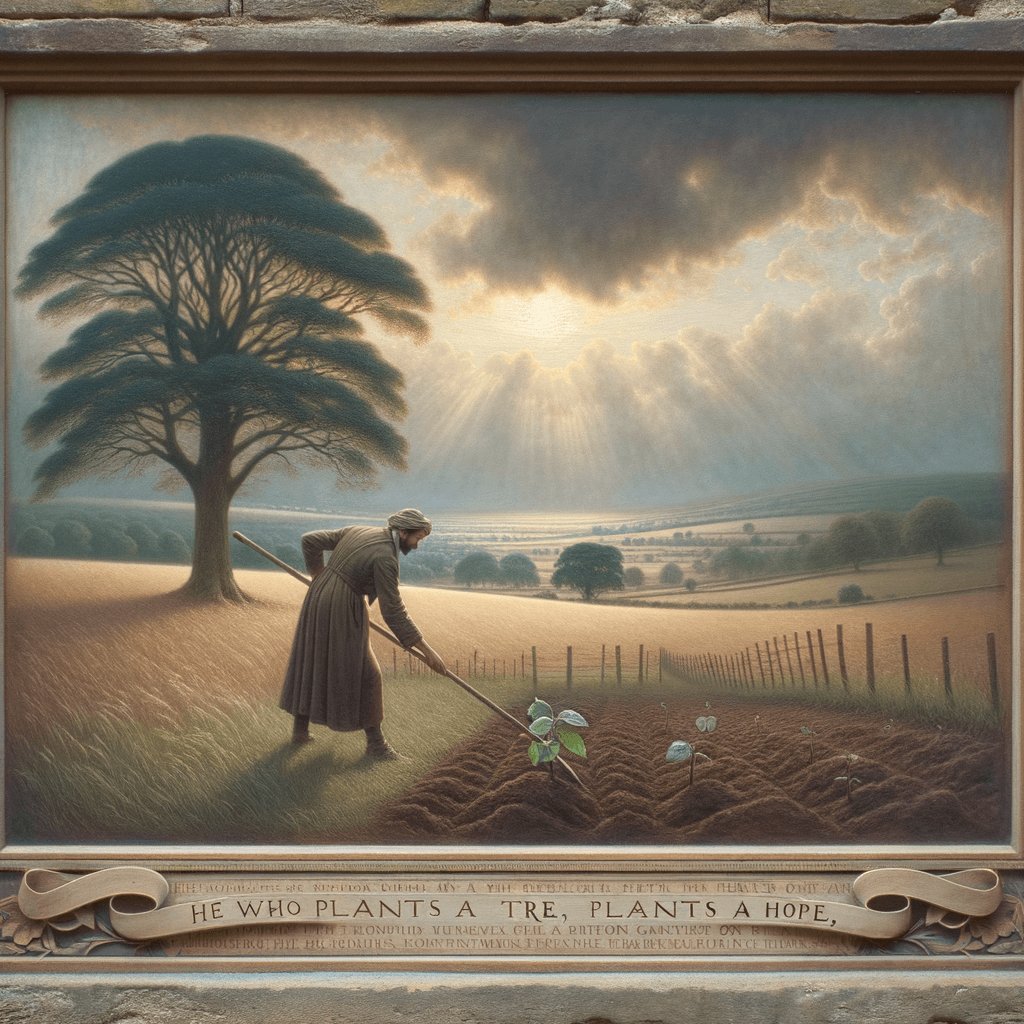
He who plants a tree, plants a hope. - Lucy Larcom
—What lingers after this line?
Symbolism of Trees
Trees symbolize life, growth, and the future. Planting a tree represents the planting of hope for future generations and the well-being of the planet.
Environmental Stewardship
This quote underscores the importance of taking care of the environment. By planting a tree, one contributes to ecological balance, promoting clean air and preserving natural habitats.
Long-Term Vision
Planting a tree signifies thinking beyond the present moment. It is an investment in the future and an act of faith that the tree will grow and thrive for years to come.
Connection to Nature
The act of planting a tree fosters a deep connection with nature, encouraging individuals to take an active role in nurturing and protecting the environment.
Legacy and Giving Back
Planting a tree can be seen as leaving a positive legacy. It represents giving back to the earth and leaving something of lasting value for future generations.
Historical and Literary Context
Lucy Larcom was a 19th-century American poet and teacher. Her writings often reflected themes of nature and human connection to the environment, inspired by the natural world and its enduring beauty.
One-minute reflection
What's one small action this suggests?
Related Quotes
6 selectedPlant hope like trees of fruit: their shade and harvest arrive long after the first seed. — Kahlil Gibran
Kahlil Gibran
Gibran frames hope as something planted rather than simply felt, shifting it from a mood into a practice. A seed is small, even unimpressive, yet it carries a future that can’t be rushed into view.
Read full interpretation →Hope is the thing with feathers that perches in the soul - and sings the tunes without the words - and never stops - at all. - Emily Dickinson
Emily Dickinson
Emily Dickinson uses the metaphor of a bird to represent hope. The 'thing with feathers' suggests that hope is light, delicate, but also persistent.
Read full interpretation →Hope is the thing with feathers that perches in the soul, and sings the tune without the words, and never stops at all. - Emily Dickinson
Emily Dickinson
Dickinson uses the metaphor of a bird with feathers to symbolize hope. Like a bird, hope can lift us and help us soar above challenges and difficulties.
Read full interpretation →In the heart of every dream, there are seeds of hope waiting to bloom.
Unknown
This quote suggests that within every dream lies the potential for hope. Dreams are seen as beacons that harbor the possibility of positive outcomes and new beginnings.
Read full interpretation →Hope is the thing with feathers that perches in the soul, and sings the tune without the words, and never stops at all. - Emily Dickinson
Emily Dickinson
Emily Dickinson personifies hope as a bird with feathers that resides within the soul. This metaphor captures the delicate yet persistent nature of hope.
Read full interpretation →In the glow of every dawn, seeds of hope are nurtured.
Unknown
Dawn represents a new beginning, a fresh start. The glow of dawn symbolizes the light that drives away darkness, much like hope that dispels despair.
Read full interpretation →More From Author
More from Lucy Larcom →