
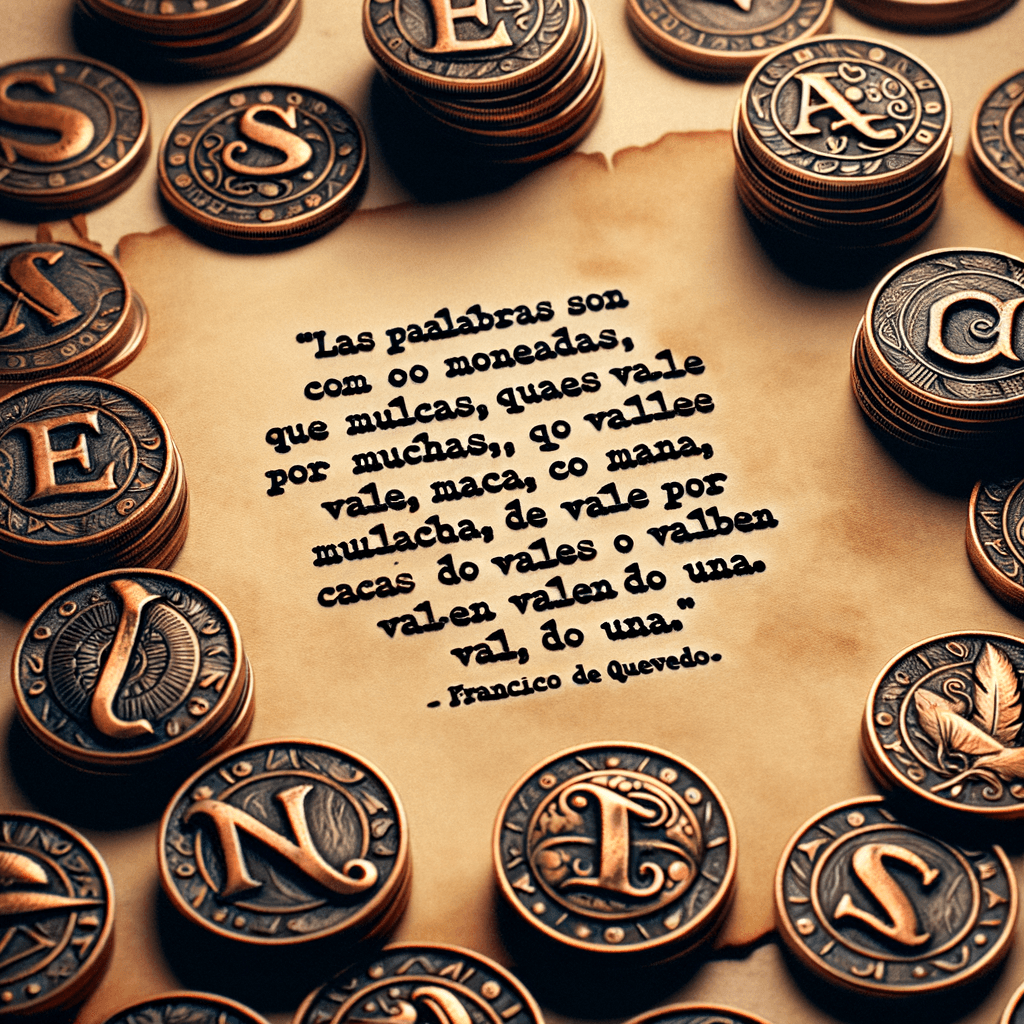
Words are like coins; one can be worth many, but many may not be worth one. - Francisco de Quevedo
—What lingers after this line?
Value of Words
This quote emphasizes the importance of quality over quantity in communication. A single, well-chosen word can have a significant impact, whereas many words may fail to convey anything meaningful.
Power of Precision
It highlights the power of precise language. Just as some coins are worth more due to their value, a well-thought-out word can hold more weight and meaning than a multitude of less impactful words.
Economy of Speech
The analogy suggests that being concise and choosing words carefully is valuable. Overloading speech with too many words can dilute the message and reduce its effectiveness.
Communication Effectiveness
Effective communication often requires clarity and brevity. This quote underscores the idea that sometimes, saying less can actually convey more and be more impactful.
Historical Context
Francisco de Quevedo was a Spanish nobleman, poet, and writer during the late 16th and early 17th centuries. Known for his sharp wit and satirical style, Quevedo often explored themes of social and moral issues in his works, reflecting the cultural dynamics of the Spanish Baroque period.
Recommended Reading
As an Amazon Associate, we earn from qualifying purchases.
One-minute reflection
What feeling does this quote bring up for you?
Related Quotes
6 selectedThe art of being wise is the art of knowing what to overlook. — William James
William James
William James reframes wisdom as subtraction rather than accumulation: to be wise is not merely to notice more, but to decide what deserves notice at all. At first, that can sound like avoidance, yet his point is sharper...
Read full interpretation →The art of being wise is the art of knowing what to overlook. — William James
William James
William James reframes wisdom not as the accumulation of more facts, but as the disciplined narrowing of focus. In everyday life, we are flooded with stimuli—opinions, irritations, news alerts, minor slights—and the mind...
Read full interpretation →Clarity about what matters provides clarity about what does not. — Cal Newport
Cal Newport
Cal Newport’s line hinges on a simple but potent mechanism: once you know what truly matters, everything else becomes easier to label as peripheral. Clarity, in this sense, isn’t just self-knowledge—it’s an operating sys...
Read full interpretation →The art of being wise is the art of knowing what to overlook. — William James
William James
William James reframes wisdom less as accumulating facts and more as directing attention. In his view, a wise person is not the one who notices everything, but the one who understands that noticing everything is impossib...
Read full interpretation →The art of being wise is the art of knowing what to overlook. — William James
William James
William James reframes wisdom as a discipline of attention rather than a mere accumulation of facts. Instead of trying to register everything, the wise person decides what deserves focus and what can be safely left unexa...
Read full interpretation →Close some doors. Not because of pride, arrogance, or vanity, but because they no longer lead somewhere. — Paulo Coelho
Paulo Coelho
This quote advises making pragmatic decisions to close off paths that no longer serve a useful or productive purpose, focusing on practicality rather than emotions.
Read full interpretation →More From Author
More from Francisco de Quevedo →