
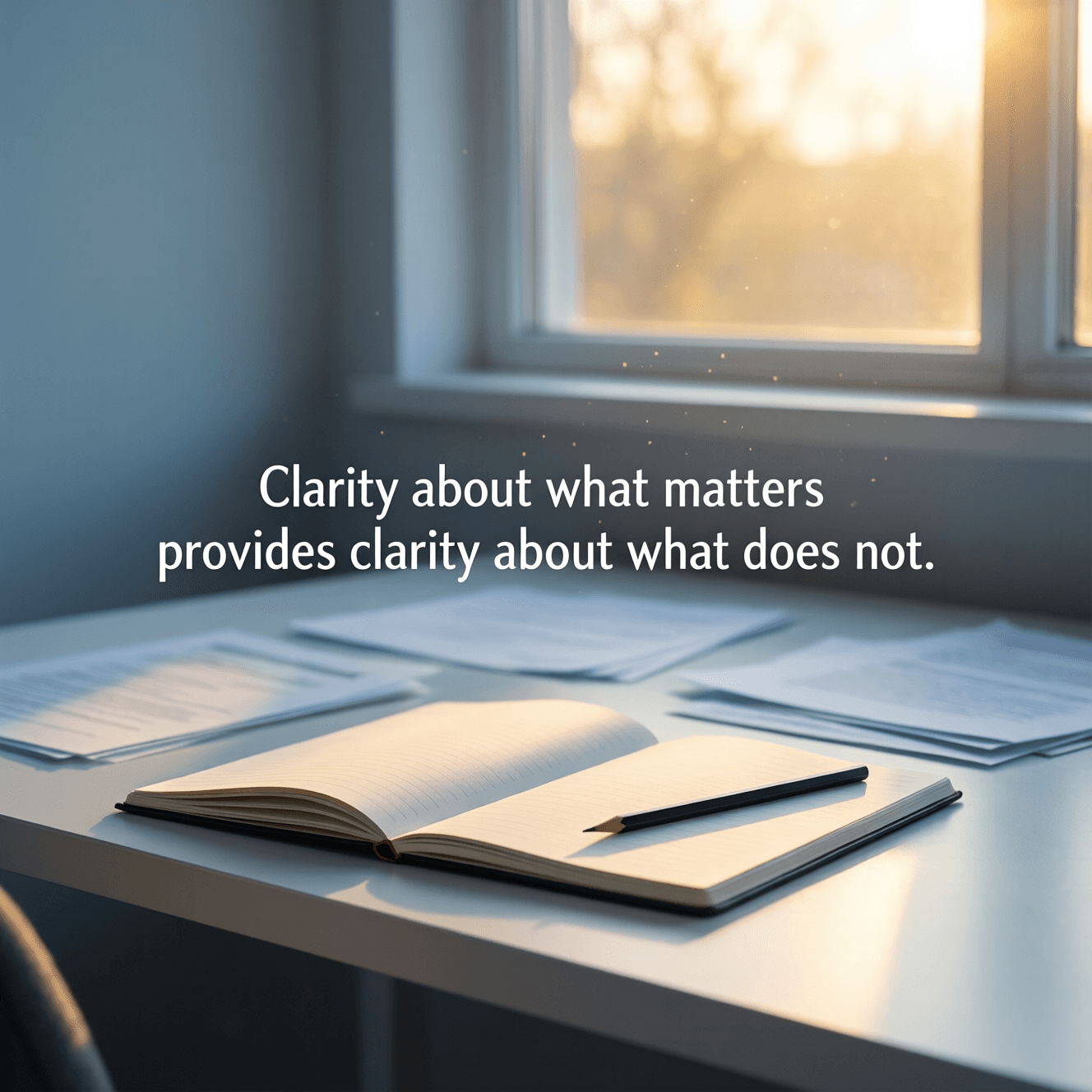
Clarity about what matters provides clarity about what does not. — Cal Newport
—What lingers after this line?
A Compass for Attention
Cal Newport’s line hinges on a simple but potent mechanism: once you know what truly matters, everything else becomes easier to label as peripheral. Clarity, in this sense, isn’t just self-knowledge—it’s an operating system for attention. Instead of negotiating every request, temptation, or opportunity on the spot, you filter them through a stable set of priorities. This is why the quote feels almost mathematical: define the variables that count, and the rest of the equation simplifies. With that simplification, decision-making shifts from reactive to deliberate, and daily life gains a sense of direction rather than constant recalculation.
Why “No” Becomes Less Painful
Once priorities are explicit, saying “no” stops being a social performance and becomes a logical consequence. The discomfort of refusal often comes from ambiguity—if you’re not sure what you’re protecting, any “no” can feel arbitrary or selfish. Newport implies the opposite: a clear “yes” to what matters naturally produces clear “no’s” to what doesn’t. As a result, boundaries feel less like walls and more like guardrails. Rather than rejecting people or possibilities wholesale, you’re selecting a path, and the clarity of that path reduces guilt because the trade-offs are acknowledged instead of hidden.
The Hidden Cost of the Unimportant
Clarity also exposes how small, low-value commitments quietly tax your life. A meeting that “only” takes thirty minutes can fragment a morning; an app that “only” steals a few minutes can break concentration repeatedly. Newport’s broader work, such as *Deep Work* (2016), argues that attention is a finite resource, and shallow demands can drain it faster than we notice. Seen this way, recognizing what does not matter is not minimalism for its own sake—it’s conservation. When the unimportant is correctly identified, you stop paying for it with time, energy, and cognitive freshness that could have supported the things you claim to value.
Values Turn Into Criteria
However, “what matters” can remain fuzzy unless it’s translated into criteria you can apply in real situations. It’s one thing to say “family matters” and another to decide whether that means no work emails after dinner or a hard stop at 5 p.m. Similarly, “craft matters” might imply fewer projects, longer timelines, or protected focus blocks. This translation is where the quote becomes practical: clarity isn’t merely inspirational, it’s definitional. When you can articulate what matters in observable terms—hours, outputs, habits, commitments—then what does not matter becomes easier to spot because it fails the test.
Anecdote: The Calendar Tells the Truth
Consider a common moment: someone scans their week and realizes the calendar is full, yet nothing significant is moving forward. That discomfort often triggers Newport’s insight in real time. Once the person decides, for instance, that finishing a thesis chapter or rebuilding health is the priority, the schedule suddenly looks different: recurring obligations that once felt “necessary” reveal themselves as optional. From there, the process becomes self-reinforcing. Each removed or renegotiated commitment creates space, and that space makes the chosen priority more visible—further clarifying what belongs and what doesn’t.
From Clarity to a Sustainable Life
Finally, the quote suggests a path to sustainability: life becomes manageable not by doing more, but by seeing more clearly. When what matters is well defined, you spend less time in internal debate, less time managing regret, and less time repairing the damage of distraction. The resulting calm is not accidental—it’s the byproduct of alignment. In that sense, Newport isn’t advocating a rigid or joyless life. He is describing how meaningful flexibility emerges: by committing to the essential, you stop being commandeered by the nonessential, and your time begins to reflect your actual intentions.
One-minute reflection
What feeling does this quote bring up for you?
Related Quotes
6 selectedDoing less is not a sign of laziness but a necessary condition for doing things well. — Cal Newport
Cal Newport
Cal Newport’s line challenges a common cultural reflex: equating busyness with virtue. By arguing that doing less is a “necessary condition,” he treats restraint not as a personality trait but as a prerequisite for excel...
Read full interpretation →You can do anything but you can't do everything. Prioritize what truly matters, and allow yourself some breathing room. It's okay to pace yourself. — Blurt It Out
Blurt It Out
At its core, this quote begins with a simple but liberating truth: capability is not the same as endless capacity. A person may be talented, willing, and hardworking, yet still unable to carry every task, obligation, and...
Read full interpretation →We don't drift into good directions. We discipline and prioritize ourselves there. — Andy Stanley
Andy Stanley
Andy Stanley’s quote challenges a comforting illusion: that a meaningful life will naturally sort itself out if we simply keep moving. Instead, he argues that good directions are rarely accidental.
Read full interpretation →Sometimes what you don't do is just as important as what you do. — Leo Babauta
Leo Babauta
At first glance, Leo Babauta’s observation seems simple, yet it points to a deeper truth: our lives are shaped not only by action but also by omission. Every time we decline a distraction, postpone a reactive comment, or...
Read full interpretation →An intentional life embraces only the things that will add to the mission of significance. — John C. Maxwell
John C. Maxwell
John C. Maxwell’s line reframes life as a deliberate design rather than a default drift.
Read full interpretation →Eat a live frog first thing in the morning and nothing worse will happen to you the rest of the day. — Mark Twain
Mark Twain
Mark Twain’s line is meant to jolt: the grotesque image of eating a live frog isn’t culinary advice but a metaphor for confronting the most unpleasant task first. By exaggerating the discomfort, Twain makes the underlyin...
Read full interpretation →More From Author
More from Cal Newport →The greatest luxury in a modern world is not things, but the ability to disconnect and reclaim your own attention. — Cal Newport
At first glance, Newport’s statement overturns the traditional idea of luxury as something material. Instead of wealth being measured by rare objects, he suggests it is now measured by the freedom to step away from noise...
Read full interpretation →Technology should empower us, not overwhelm us. Digital wellness is about reclaiming control over our attention and time. — Cal Newport
At its core, Cal Newport’s statement draws a clear boundary between empowerment and domination. Technology, he suggests, fulfills its promise only when it serves human aims rather than dictating them.
Read full interpretation →We are not defined by the speed of our output, but by the depth of our attention. — Cal Newport
At first glance, Cal Newport’s line challenges one of modern life’s favorite assumptions: that worth is proven through visible speed. In many workplaces and social spaces, quick replies, rapid delivery, and constant acti...
Read full interpretation →The task of a craftsman is not to generate meaning, but rather to cultivate in himself the skill of discerning the meanings that are already there. — Cal Newport
At its core, Cal Newport’s quote overturns a popular modern assumption: that fulfillment is something we simply fabricate through self-expression alone. Instead, he argues that meaning already exists in the structure of...
Read full interpretation →