
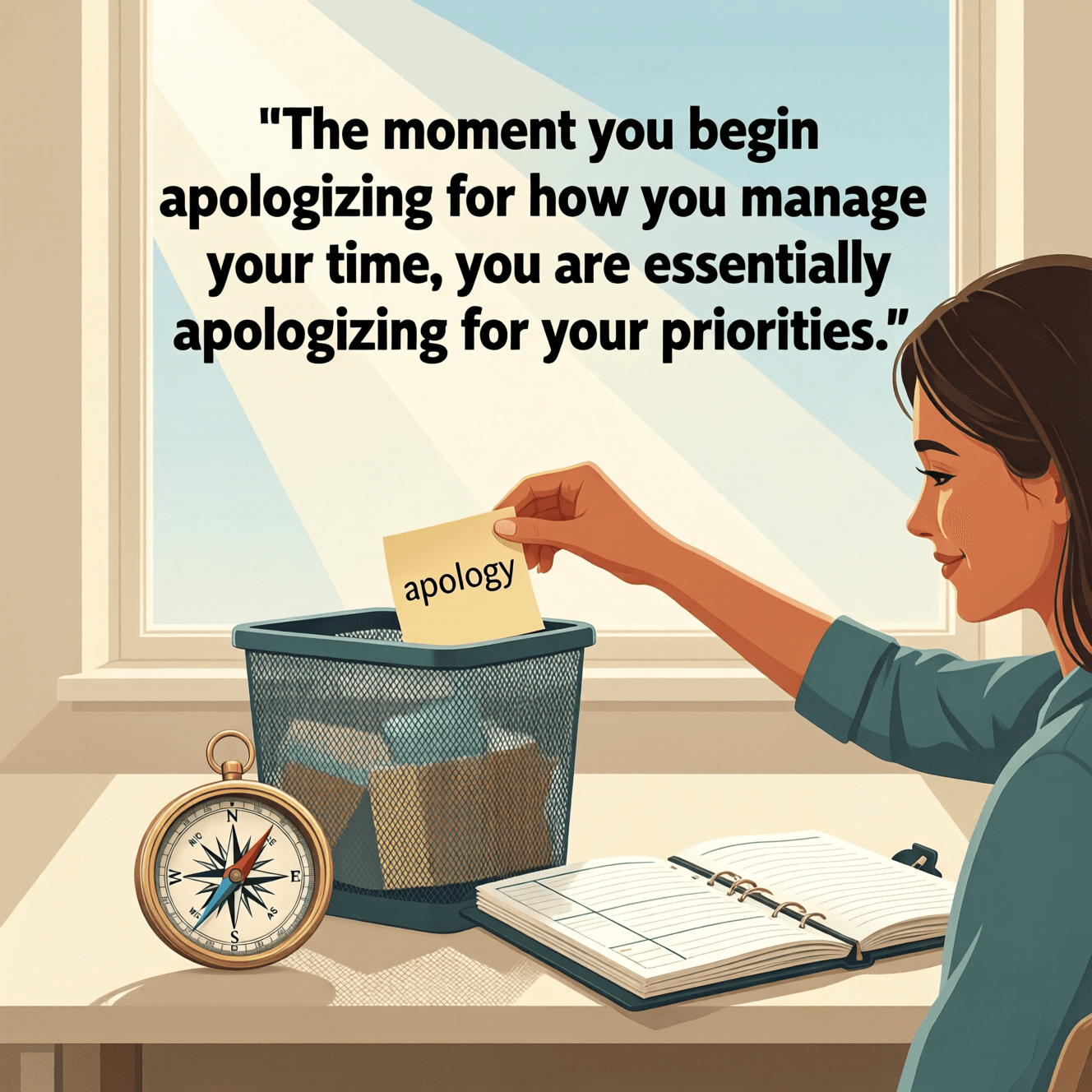
The moment you begin apologizing for how you manage your time, you are essentially apologizing for your priorities. — Cal Newport
—What lingers after this line?
Time Apologies as Hidden Value Judgments
Cal Newport’s line reframes a common social reflex: saying “sorry I’m so busy” or “sorry I didn’t reply sooner” often isn’t about time at all—it’s about what we chose to do with it. Because time is the medium through which we express values, an apology about scheduling can quietly become an apology for what mattered more in that moment. From there, the quote nudges us to notice the moral undertone in everyday coordination. We treat time allocation as neutral logistics, yet we instinctively sense it reveals preference, commitment, and respect—so we apologize to soften the implied message: “something else came first.”
The Social Pressure to Be Universally Available
Building on that idea, Newport points to a modern expectation that responsiveness is a kind of baseline courtesy. Always-on messaging makes it feel abnormal to be unreachable, so any delay can seem like a breach requiring explanation. In this climate, people apologize not because they did something wrong, but because they violated an implicit norm of perpetual accessibility. Consequently, “time guilt” becomes a social lubricant: it reassures others that you still care, even if you didn’t comply with the speed of the channel. The quote challenges that norm by suggesting we should judge ourselves less by immediacy and more by whether our priorities are deliberate and defensible.
Priorities Made Visible Through Behavior
Next, the quote highlights a blunt truth: priorities are easier to claim than to prove, and time is the proof. Anyone can say family matters most, deep work matters most, health matters most—yet calendars, inboxes, and habits reveal what actually wins. This is why time management feels personal; it’s a public record of private values. Seen this way, apologizing for time can become a subtle form of self-erasure, as if your chosen obligations were less legitimate than someone else’s expectations. Newport’s provocation is not to become inconsiderate, but to align your actions with your stated commitments—and accept the trade-offs openly.
When Apologies Are Appropriate—and When They Aren’t
That said, the quote doesn’t abolish apology; it clarifies what deserves one. If you made a promise and broke it, misled someone, or caused avoidable harm, an apology is appropriate because trust was damaged. But if you simply chose a different legitimate commitment—sleep, focused work, caregiving, recovery—constant apologizing can imply those commitments were inherently questionable. As a transition from guilt to responsibility, a more honest approach is to acknowledge constraints without self-condemnation. “I can’t make that deadline” communicates reality; “I’m sorry I’m like this” turns a boundary into a character flaw.
Replacing Time-Guilt With Clear Boundaries
From here, Newport’s idea naturally leads to boundary-setting as a practical alternative to apology. Instead of apologizing for delays, you can pre-communicate expectations: when you check email, what response times you aim for, what hours are protected, and which channels are urgent. Clarity reduces the need for frequent repair. In everyday life, this can be as simple as a short note: “I’m offline in the mornings to work; I’ll respond after lunch,” or “I can do a 15-minute call next week.” These statements respect others while also treating your priorities as legitimate, not as inconveniences requiring repeated contrition.
Owning Trade-Offs to Build a Coherent Life
Finally, the quote invites a broader kind of integrity: if your life is shaped by trade-offs, then peace comes from choosing them consciously rather than apologizing your way through them. Newport’s larger body of work, including *Deep Work* (2016), argues that attention is finite and valuable, so protecting it is not selfish but necessary for meaningful output and a calmer mind. When you stop reflexively apologizing for your schedule, you’re forced to ask a sharper question: are these priorities truly mine, and do I stand behind them? If the answer is yes, you can communicate them with steadiness; if the answer is no, the discomfort becomes a useful signal to redesign your commitments.
One-minute reflection
What does this quote ask you to notice today?
Related Quotes
6 selectedThe key to a high-volume output is a low-volume schedule. — Cal Newport
Cal Newport
Cal Newport’s line flips a familiar assumption: that more hours and more commitments naturally produce more results. Instead, he argues that volume of output depends on the opposite—keeping the calendar lean enough to pr...
Read full interpretation →The most productive thing you can do is learn to manage your energy, not just your time. — Arianna Huffington
Arianna Huffington
Arianna Huffington’s quote reframes productivity at its foundation. Instead of treating time as the only scarce resource, she points to energy as the real force that determines whether hours become meaningful work or mer...
Read full interpretation →Instead of saying 'I don't have time,' try saying 'it's not a priority,' and see how that feels. — Laura Vanderkam
Laura Vanderkam
Laura Vanderkam’s quote works by replacing a familiar excuse with a more revealing truth. “I don’t have time” sounds objective, as if the day itself has failed us; however, “it’s not a priority” returns the matter to cho...
Read full interpretation →Don't count the years. Make every year count. — Medium Collective
Medium Collective
At its core, “Don’t count the years. Make every year count” challenges the habit of measuring life by duration alone.
Read full interpretation →Self-discipline is the ability to do what you should do, when you should do it. — Brian Tracy
Brian Tracy
Brian Tracy’s definition strips self-discipline down to its practical essence: not merely knowing the right thing, but doing it at the right moment. In other words, discipline is less about inspiration than about obedien...
Read full interpretation →Lack of direction, not lack of time, is the problem. — Zig Ziglar
Zig Ziglar
Zig Ziglar’s line flips a common complaint on its head: most people don’t actually lack time; they lack a clear aim for the time they already have. When direction is missing, hours get spent reacting—scrolling, answering...
Read full interpretation →More From Author
More from Cal Newport →The greatest luxury in a modern world is not things, but the ability to disconnect and reclaim your own attention. — Cal Newport
At first glance, Newport’s statement overturns the traditional idea of luxury as something material. Instead of wealth being measured by rare objects, he suggests it is now measured by the freedom to step away from noise...
Read full interpretation →Technology should empower us, not overwhelm us. Digital wellness is about reclaiming control over our attention and time. — Cal Newport
At its core, Cal Newport’s statement draws a clear boundary between empowerment and domination. Technology, he suggests, fulfills its promise only when it serves human aims rather than dictating them.
Read full interpretation →We are not defined by the speed of our output, but by the depth of our attention. — Cal Newport
At first glance, Cal Newport’s line challenges one of modern life’s favorite assumptions: that worth is proven through visible speed. In many workplaces and social spaces, quick replies, rapid delivery, and constant acti...
Read full interpretation →The task of a craftsman is not to generate meaning, but rather to cultivate in himself the skill of discerning the meanings that are already there. — Cal Newport
At its core, Cal Newport’s quote overturns a popular modern assumption: that fulfillment is something we simply fabricate through self-expression alone. Instead, he argues that meaning already exists in the structure of...
Read full interpretation →