
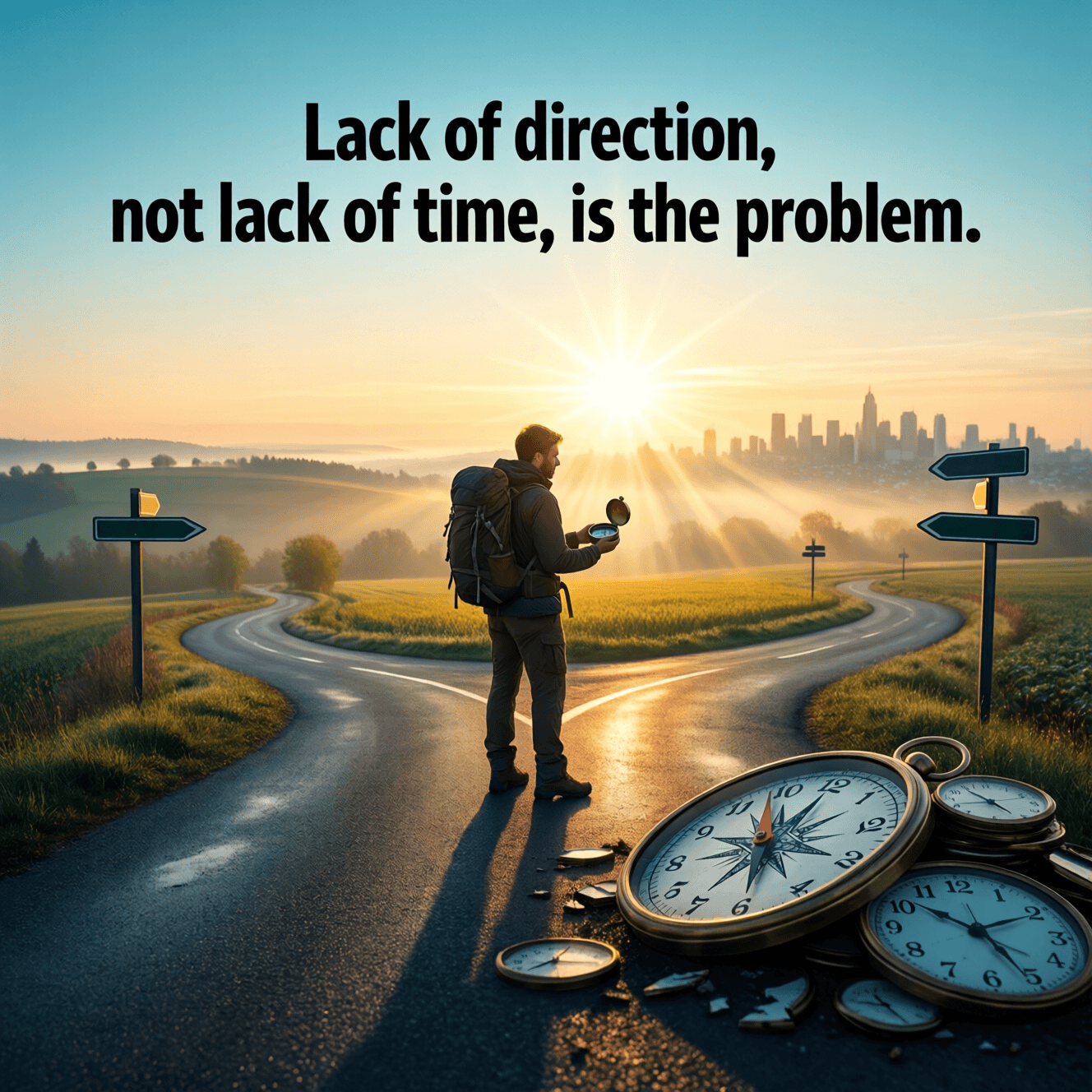
Lack of direction, not lack of time, is the problem. — Zig Ziglar
—What lingers after this line?
Reframing the Real Shortage
Zig Ziglar’s line flips a common complaint on its head: most people don’t actually lack time; they lack a clear aim for the time they already have. When direction is missing, hours get spent reacting—scrolling, answering, drifting—rather than moving deliberately. In that sense, the calendar becomes an easy scapegoat for a deeper uncertainty about what matters. Once we accept this reframing, the problem becomes solvable. Time can’t be expanded for anyone, but direction can be chosen, clarified, and strengthened, turning the same 24 hours into a vastly different life.
Why Busyness Can Still Be Stagnation
It’s possible to be packed with activity and still go nowhere, because motion isn’t the same as progress. Without a target, tasks multiply: you respond to every request, chase every new idea, and end the day exhausted yet strangely unchanged. The feeling of “I had no time” often means “I didn’t decide what deserved priority.” This is why direction matters first: it filters noise. When you know your destination, you can decline distractions without guilt, because you’re no longer optimizing for being busy—you’re optimizing for arriving.
Goals as a Compass, Not a Cage
Direction doesn’t have to mean a rigid five-year plan; it can be a simple, workable compass. A goal like “earn a certification by June” or “write 500 words a day” provides enough structure to guide daily choices. In contrast, vague intentions—“get healthier,” “do more”—leave too much room for procrastination disguised as preparation. Importantly, a compass still allows course corrections. As Seneca notes in *Letters to Lucilius* (c. 65 AD), “If one does not know to which port one is sailing, no wind is favorable”—a reminder that even small clarity makes effort more effective.
Turning Direction into Daily Decisions
Once direction exists, it must be translated into behavior, or it remains motivational wallpaper. People often benefit from picking a “next visible step” and attaching it to a routine: a morning study block, a weekly outreach session, a protected creative hour. These actions are modest, but they convert intention into momentum. A simple anecdote illustrates the point: two colleagues both “want to network,” yet only one schedules one coffee chat every Friday. After three months, the scheduler has relationships and leads, while the other has the same wish—proving that direction lives in repeated, specific choices.
The Emotional Cost of Aimlessness
Lack of direction isn’t merely inefficient; it can quietly erode confidence. When days feel unshaped, people conclude they are undisciplined or incapable, even if the real issue is that they never chose a clear objective. This misdiagnosis creates a loop: discouragement leads to avoidance, which deepens the sense of wasted time. By contrast, direction generates evidence of competence. Even small wins—two workouts a week, one page read nightly—restore agency, making motivation less of a prerequisite and more of a byproduct.
Choosing Direction as a Practical Skill
Ziglar’s point ultimately treats direction as something you practice, not something you magically discover. Clarifying values, defining a near-term goal, and setting boundaries are all learnable. The aim is not to control every minute, but to ensure your minutes serve a purpose you endorse. As this becomes habitual, the “no time” complaint loses power. You still face limits, but now you’re deciding what to trade for what—turning time from an adversary into a resource aligned with intention.
One-minute reflection
Why might this line matter today, not tomorrow?
Related Quotes
6 selectedYour attitude determines your direction. — Unknown
Unknown
This quote emphasizes the significant role one's mindset plays in shaping their path in life. A positive attitude can lead to positive outcomes, while a negative attitude can hinder progress.
Read full interpretation →If we are facing in the right direction, all we have to do is keep walking. — Thích Nhất Hạnh
Thich Nhat Hanh
Thích Nhất Hạnh’s words begin with a simple but profound premise: progress depends first on direction, not speed. If a person is turned toward compassion, clarity, healing, or truth, then each modest step becomes meaning...
Read full interpretation →Our plans miscarry because they have no aim. When a man doesn't know what harbor he's making for, no wind is the right wind. — Seneca
Seneca
Seneca’s remark begins with a simple but severe diagnosis: plans fail not merely from bad luck, but from the absence of a clear aim. In his view, activity alone is not progress.
Read full interpretation →The most productive thing you can do is learn to manage your energy, not just your time. — Arianna Huffington
Arianna Huffington
Arianna Huffington’s quote reframes productivity at its foundation. Instead of treating time as the only scarce resource, she points to energy as the real force that determines whether hours become meaningful work or mer...
Read full interpretation →Sometimes we can only find our true direction when we let the wind of change carry us. — Mimi Novic
Mimi Novic
At first glance, Mimi Novic’s line seems to praise passivity, yet it points to something more subtle: the wisdom of surrender. Rather than forcing life into a rigid plan, we sometimes discover our path only by loosening...
Read full interpretation →Instead of saying 'I don't have time,' try saying 'it's not a priority,' and see how that feels. — Laura Vanderkam
Laura Vanderkam
Laura Vanderkam’s quote works by replacing a familiar excuse with a more revealing truth. “I don’t have time” sounds objective, as if the day itself has failed us; however, “it’s not a priority” returns the matter to cho...
Read full interpretation →More From Author
More from Zig Ziglar →When you are tough on yourself, life is going to be infinitely easier on you. — Zig Ziglar
At its heart, Zig Ziglar’s line argues that voluntary discipline is easier than enforced consequences. When a person chooses high standards, honest self-correction, and consistent effort, they reduce the need for life to...
Read full interpretation →Your value does not decrease based on someone's inability to see your worth. — Zig Ziglar
At its heart, Zig Ziglar’s statement insists that human worth is not a fluctuating market price set by other people’s opinions. Someone may overlook, underestimate, or dismiss you, yet their failure of perception does no...
Read full interpretation →If you are not willing to learn, no one can help you. If you are determined to learn, no one can stop you. — Zig Ziglar
Zig Ziglar’s quote begins with a blunt truth: learning cannot be forced from the outside. Teachers, mentors, and books may offer guidance, yet none of them can move a closed mind.
Read full interpretation →You cannot consistently perform in a manner which is inconsistent with the way you see yourself. — Zig Ziglar
At its core, Zig Ziglar’s quote argues that performance is not driven by effort alone but by identity. People may push themselves for a while, yet if their actions clash with their self-image, those efforts usually fade.
Read full interpretation →