
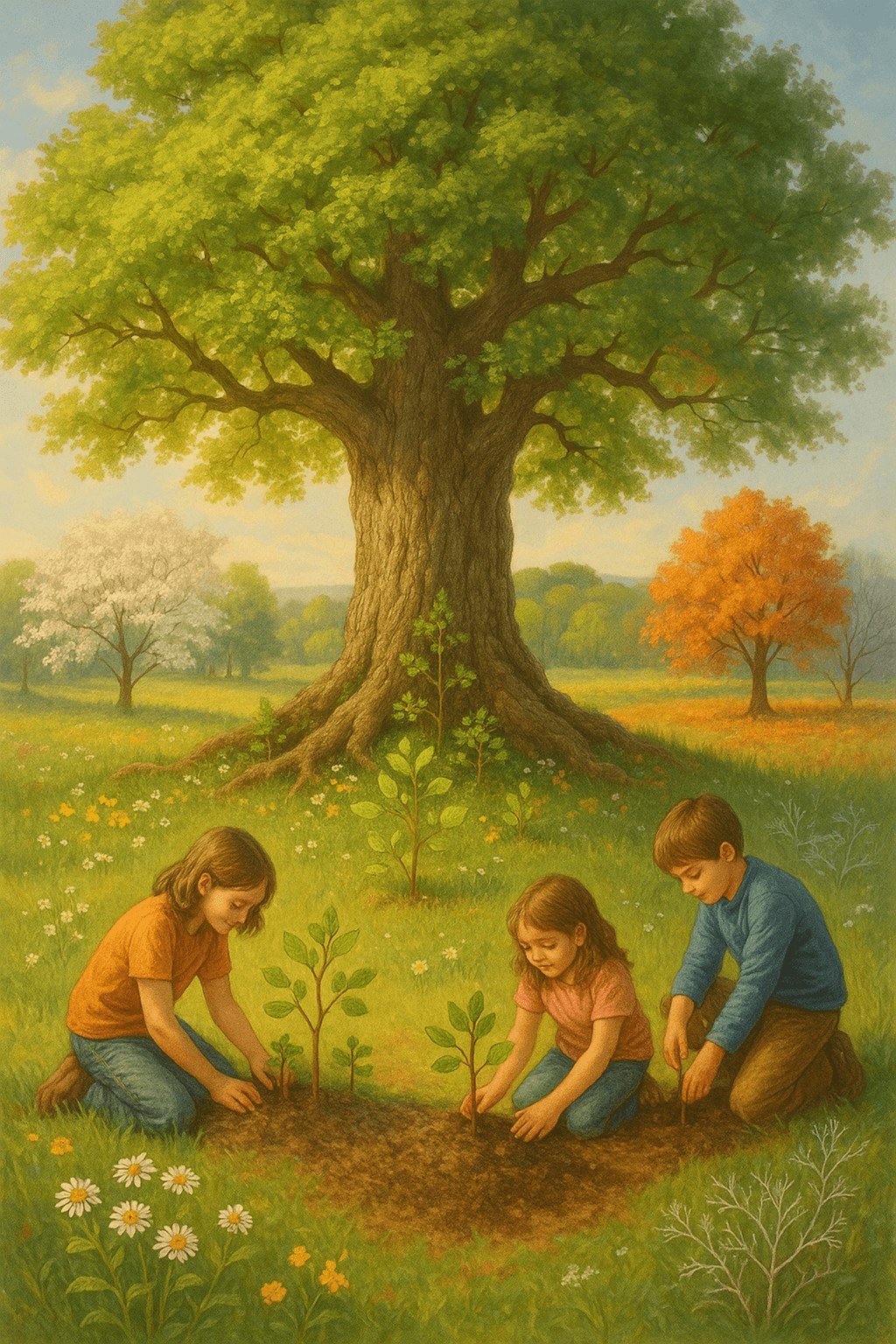
We do not plant a tree for ourselves, but for posterity. — Alexander Smith
—What lingers after this line?
The Spirit of Generational Giving
Alexander Smith’s statement invites us to consider the selfless nature of planting a tree. By its very essence, this act transcends personal benefit; the planter rarely enjoys the full shade, fruit, or beauty of a young sapling. Instead, the action becomes a legacy, passing down benefits to those yet to come. In doing so, it mirrors many ancient traditions, such as the Greek proverb, 'A society grows great when old men plant trees whose shade they know they shall never sit in.'
Environmental Stewardship Over Time
Extending this notion, tree planting symbolizes environmental responsibility. Forests planted today mitigate the effects of climate change, provide habitats, and enrich soil for decades, if not centuries, ahead. The U.S. Forest Service, in reforestation efforts after wildfires, often references the long timelines required for woods to recover fully. Such commitment illustrates that ecological well-being depends on forward-thinking actions.
Cultivating a Culture of Progress
Furthermore, investing in the future embodies faith in human continuity and progress. By planting for posterity, communities demonstrate trust that the world will endure and improve. Notably, public parks and city green spaces—like New York’s Central Park, completed in the 19th century—were designed for citizens unseen by their creators, turning urban planning into generational service.
A Metaphor for Education and Innovation
Likewise, Smith’s metaphor extends beyond forestry to encompass teaching, mentorship, and invention. When educators nurture young minds or innovators develop technology, they, too, 'plant trees.' Their work’s full impact may only bloom in the hands of future generations—a theme explored by Isaac Newton in his modest claim: 'If I have seen further, it is by standing on the shoulders of giants.'
Inspiring Civic Responsibility
Ultimately, this philosophy urges each person to contribute meaningfully to a collective future. Civic projects, conservation efforts, and acts of kindness become seeds for a thriving community. Smith’s wisdom, therefore, guides us to act with vision and hope, ensuring that our world remains vibrant not just for ourselves, but for those who follow in our footsteps.
One-minute reflection
What's one small action this suggests?
Related Quotes
6 selectedA farmer is helpless to grow grain; all he can do is provide the right conditions for the growing of grain. — Richard J. Foster
Richard J. Foster
At first glance, Foster’s farming metaphor shifts attention away from control and toward humility. A farmer cannot command a seed to sprout, just as a person cannot force true growth—whether spiritual, personal, or relat...
Read full interpretation →Stop begging God to increase your territory when you can't even maintain the territory you already have. — Iyanla Vanzant
Iyanla Vanzant
At its core, Iyanla Vanzant’s statement confronts a common contradiction: people often ask for more influence, wealth, opportunity, or responsibility before proving they can care for what is already in their hands. In th...
Read full interpretation →One must care about a world one will never see. — Bertrand Russell
Bertrand Russell
At its core, Bertrand Russell’s line asks us to stretch our concern beyond immediate experience. To care about a world one will never see is to recognize that moral responsibility does not end with personal benefit or ev...
Read full interpretation →It is not our part here to take thought only for a season, or for a few lives of men, or for a passing age of the world. — J.R.R. Tolkien
J.R.R. Tolkien
At its core, Tolkien’s line rejects narrow, short-term thinking. He urges us to look beyond a single season, a generation, or even an era, and to measure our actions against a far larger horizon.
Read full interpretation →In every conceivable manner, the family is link to our past, bridge to our future. — Alex Haley
Alex Haley
At its core, Alex Haley’s statement presents family as more than a private circle of relatives; it is a living structure that connects what came before with what is yet to come. By calling family a link to the past and a...
Read full interpretation →Ours is not the task of fixing the entire world all at once, but of stretching out to mend the part of the world within our reach. — Clarissa Pinkola Estés
Clarissa Pinkola Estés
Clarissa Pinkola Estés begins by stripping away the fantasy of total repair. The quote quietly challenges the heroic impulse to “fix everything,” suggesting that such ambition can become a form of avoidance—grand, exhaus...
Read full interpretation →More From Author
More from Alexander Smith →