
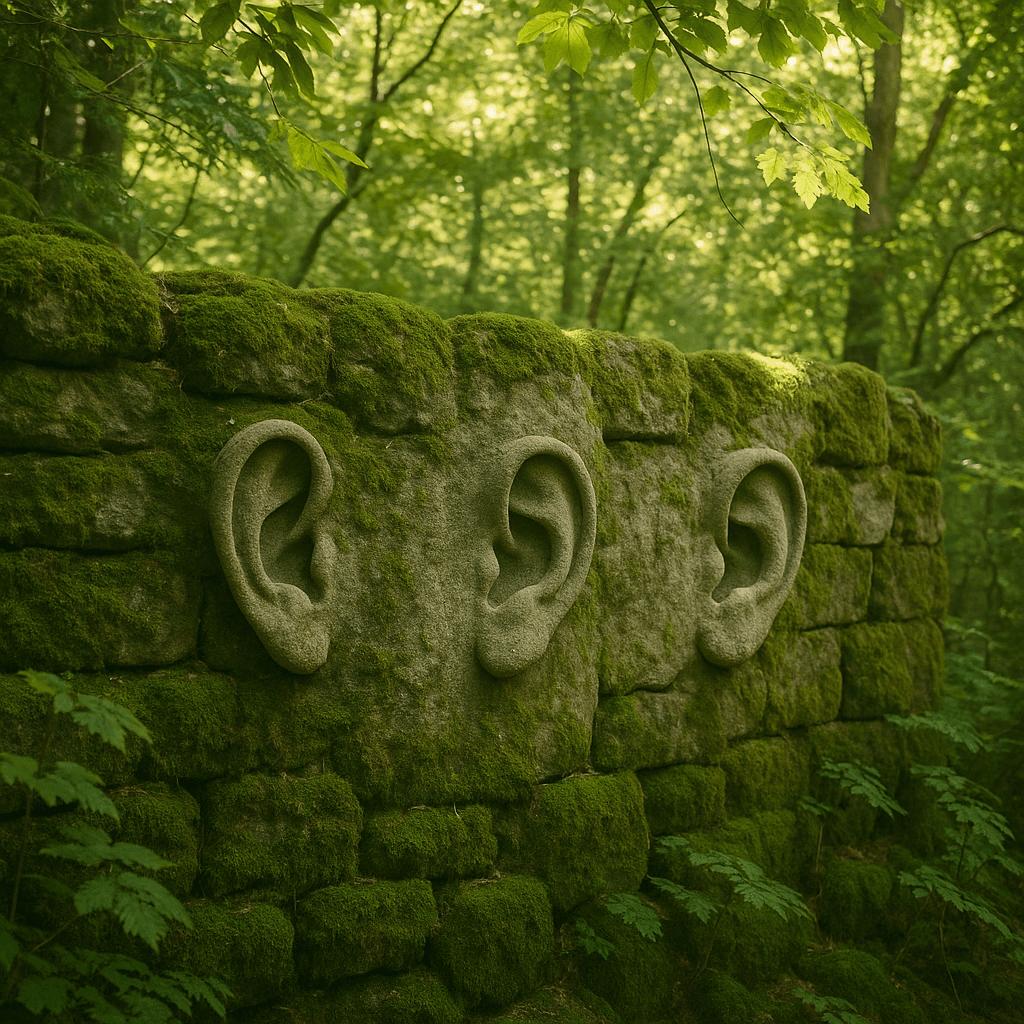
Even a wall has ears. Speak to yourself with honesty. — Yoruba Proverb
—What lingers after this line?
The Wisdom Behind the Proverb
The Yoruba proverb, 'Even a wall has ears. Speak to yourself with honesty,' fuses the recognition of ever-present listeners with a call for self-truthfulness. At its core, this saying reminds us that privacy is often illusory—even when we believe we're alone. Amidst this uncertainty, the one steadfast refuge is our honest self-reflection, a value treasured across cultures and ages.
Navigating Secrets in a Watchful Society
Building on this, the proverb echoes a universal tension: the desire to keep secrets versus the reality that information often spreads unseen. Much like Benjamin Franklin’s observation, ‘Three may keep a secret, if two of them are dead,’ the saying warns that walls—symbolizing our surroundings—can’t always be trusted. Thus, in environments charged with suspicion or surveillance, the proverb counsels vigilance and careful speech.
The Imperative of Self-Honesty
Despite external risks, the Yoruba wisdom insists that our internal dialogue should remain forthright. This aligns with the philosophical beliefs of Socrates, who famously claimed that ‘an unexamined life is not worth living.’ Here, the emphasis shifts from external threats to the moral necessity of confronting our own truths, regardless of the perceived audience.
Trust, Authenticity, and Mental Peace
Transitioning from warning to personal benefit, embracing self-honesty becomes a pathway to inner peace and authenticity. Studies in psychology, such as Carl Rogers’ work on congruence, highlight that individuals who are honest with themselves experience less inner conflict and greater well-being. The proverb thus serves not only as caution but as encouragement to cultivate trust within ourselves, even when outward trust seems precarious.
Harmonizing Caution with Integrity
Ultimately, the proverb’s dual message brings wisdom for modern life: exercise discretion in a world where privacy can be compromised, but never at the expense of your own integrity. By harmonizing vigilance with personal honesty, we can navigate external uncertainties while fostering a strong, truthful inner core—a legacy that continues to resonate from ancient Yoruba philosophy to the present day.
Recommended Reading
As an Amazon Associate, we earn from qualifying purchases.
One-minute reflection
Why might this line matter today, not tomorrow?
Related Quotes
6 selectedThe most rigorous form of tough love is the kind we look at in the mirror. — Ryan Holiday
Ryan Holiday
Ryan Holiday’s line reframes tough love from something imposed by others into something demanded of ourselves. At its core, the mirror symbolizes honest self-confrontation: the moment when excuses fall away and we face o...
Read full interpretation →Being alone at home is like having a sanctuary for your soul, where you can recharge, reflect, and rediscover the beauty of your own company. — Melody Beattie
Melody Beattie
At its core, Melody Beattie’s quote transforms the ordinary idea of being alone at home into something sacred. Rather than framing solitude as emptiness, she presents it as a sanctuary—a place where the self is protected...
Read full interpretation →The whole value of solitude depends upon oneself: it may be a sanctuary or a prison, a haven of repose or a place of punishment. — Philip Hamerton
Philip Hamerton
At first glance, Philip Hamerton’s remark presents solitude as neither inherently good nor bad, but profoundly shaped by the person who enters it. To one mind, being alone becomes a sanctuary—a space for restoration, ref...
Read full interpretation →Nothing is a better proof of a well-ordered mind than a man's ability to stop just where he is and pass some time in his own company. — Seneca
Seneca
Seneca proposes a deceptively simple test for inner stability: can a person pause, without needing an excuse, and remain peacefully with himself? Rather than pointing to productivity, status, or constant motion as signs...
Read full interpretation →Only in still water can we see our own reflection — Chuang Tzu
Chuang Tzu
Chuang Tzu’s line begins with a simple physical observation: when water is stirred, the surface breaks into fragments and our image scatters. Yet when the water becomes still, a clear reflection returns.
Read full interpretation →Polish your mind daily; a clear mirror shows the next right move — Confucius
Confucius
Confucius frames the mind as a mirror: when it is clean, it reflects reality without distortion, making the “next right move” easier to recognize. In this view, wisdom is less about sudden inspiration and more about remo...
Read full interpretation →More From Author
More from Yoruba Proverb →Dream like a king; act like a servant. — Yoruba Proverb
This proverb encourages people to aspire towards great achievements (thinking like a king) while remaining humble and dedicated in their actions (working like a servant).
Read full interpretation →A brave man acknowledges the strength of others. — Yoruba Proverb
The proverb highlights that true courage includes the ability to recognize and respect others' abilities, not just one's own.
Read full interpretation →