
Share the Flame: How Hope Multiplies
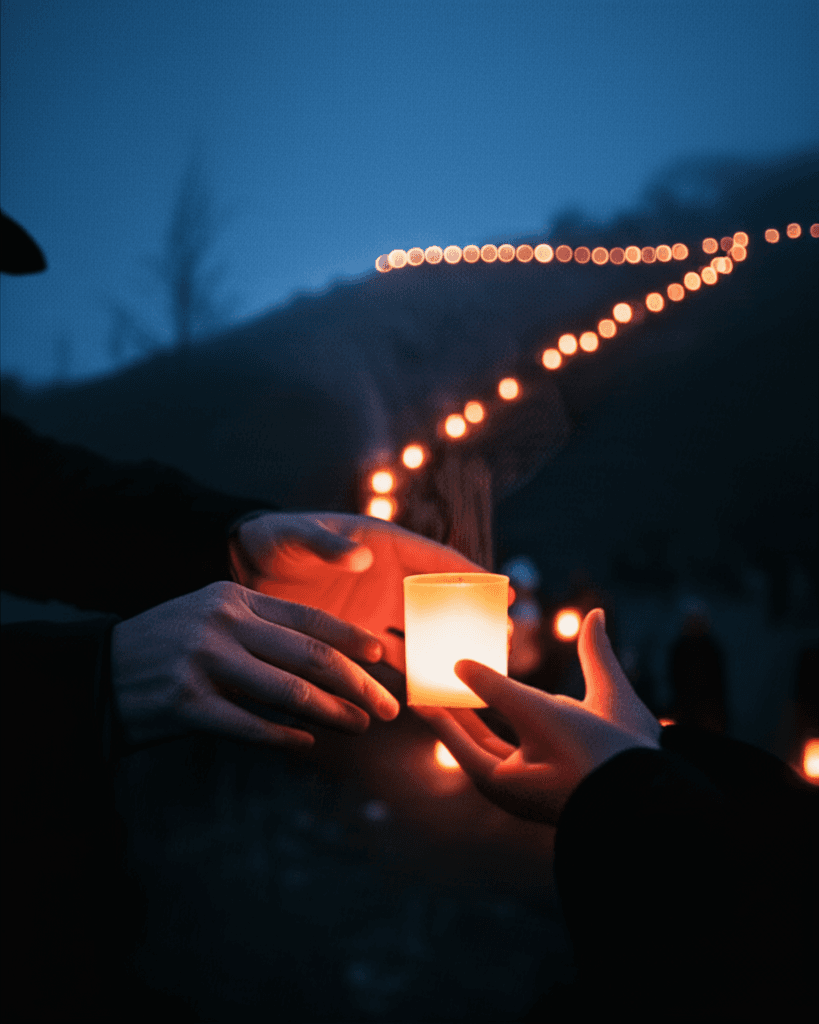
Keep your hope burning and pass the flame; warmth multiplies when shared. — Langston Hughes
—What lingers after this line?
From Spark to Hearth: The Core Metaphor
To begin, the image of keeping hope burning and passing the flame turns a private feeling into a social resource. A single candle illuminates a corner; a row of candles warms an entire room. The proverb that a candle loses nothing by lighting another clarifies the dynamic: generosity does not diminish us; it amplifies what we already carry. Thus, warmth becomes a collective asset, moving from isolated glow to communal hearth. By invoking multiplication rather than mere addition, the line suggests that shared hope does more than replicate itself—it intensifies, creating conditions where courage, clarity, and care become easier for everyone. In this way, the metaphor invites us not only to persevere personally but to make our endurance usable by others.
Hughes’s Poetry and the Hand-to-Hand Relay
Next, the sentiment resonates with Langston Hughes’s lifelong emphasis on communal resilience. In 'Mother to Son' (1922), a mother passes grit to her child, a staircase climbed one step at a time—hope handed forward. 'I, Too' (1926) looks toward a shared table, where dignity is not a solitary achievement but a collective future. Even across the broader arc of Let America Be America Again (1935), Hughes invites a chorus of dreamers to speak together, not as isolated voices but as a community insisting on possibility. Read through this lens, the line becomes a relay: each person guards a spark and then extends it, palm to palm. Hope, in Hughes’s world, is less a mood and more a civic practice sustained through companionship, narration, and song.
Evidence That Warmth Spreads in Networks
Moreover, social science supports the claim that shared hope multiplies. Christakis and Fowler’s analysis of the Framingham Heart Study (BMJ, 2008) found that well-being can spread through social networks up to three degrees of separation. Likewise, Dunn, Aknin, and Norton (Science, 2008) showed that prosocial giving increases happiness for givers and observers, suggesting a positive feedback loop. Beyond mood, Albert Bandura’s work on collective efficacy (Self-Efficacy, 1997) shows that groups confident in their shared power are more likely to achieve difficult goals. Together, these findings indicate that hopeful action is contagious: one person’s gesture alters expectations, which in turn reshapes behavior. Thus, passing the flame is not merely symbolic; it is a practical way to change the emotional climate of a group and, with it, the outcomes they can imagine.
When Communities Sing the Light Forward
History offers vivid scenes of warmth multiplying in public. During the Civil Rights Movement, mass meetings often ended with congregants singing 'This Little Light of Mine.' Fannie Lou Hamer led it in Mississippi Freedom Summer (1964), and the simple refrain steadied nerves while inviting others to offer their own light. The song turned individual bravery into shared courage—many small flames becoming a visible blaze. Similarly, Rebecca Solnit’s A Paradise Built in Hell (2009) documents how disaster survivors routinely form communities of care, improvising kitchens, clinics, and mutual aid. These acts generate hope not by ignoring hardship but by facing it together. In both cases, the practice of gathering—voices joined, resources pooled—demonstrates that hope’s warmth is most reliable when it belongs to everyone.
Simple Ways to Pass Your Flame Today
In practical terms, passing the flame can be small and immediate. Tell a specific, credible story of a recent win; as Karl Weick’s 'small wins' framework (1984) suggests, tangible progress invites participation. Offer micro-mentorship—a focused hour to review a resume, rehearse a pitch, or write a reference—so that confidence transfers alongside knowledge. Start or join mutual-aid practices, from neighborhood tool libraries to emergency funds, where warmth takes the form of trust. Even rituals matter: opening a meeting by acknowledging someone’s quiet labor, or closing with a brief reflection, can become kindling for the next person. Online, amplify constructive efforts rather than outrage alone; attention is oxygen. In each case, the key is repeatable generosity—actions light enough to do often, bright enough to be noticed, and contagious enough to spread.
Tending the Fire Without Burning Out
Finally, a shared blaze needs steady fuel and fresh air. Hope thrives when paced; otherwise, the wick gutters. Research on burnout (Maslach and Leiter, 1997) shows that sustainable effort requires manageable load, fairness, and community. Audre Lorde’s reminder in A Burst of Light (1988) that self-care is self-preservation reframes rest as a communal duty: a banked fire keeps tomorrow’s warmth possible. Set boundaries that protect attention, rotate roles to distribute heat, and celebrate milestones to replenish morale. As the flame circulates, no single person must be its sole keeper. In that balance—burning bright, passing often, resting wisely—the promise of the line is fulfilled: shared warmth not only grows; it endures.
Recommended Reading
As an Amazon Associate, we earn from qualifying purchases.
One-minute reflection
Why might this line matter today, not tomorrow?
Related Quotes
6 selectedSing ordinary days with hopeful fire and they become extraordinary. — Langston Hughes
Langston Hughes
Langston Hughes suggests that the raw material of a meaningful life is not rarity but repetition: the ordinary day. What changes everything is the way we meet it—whether we merely pass through hours or “sing” them, notic...
Read full interpretation →Lift a little light where shadows gather and watch them scatter. — Langston Hughes
Langston Hughes
Langston Hughes’s line, “Lift a little light where shadows gather and watch them scatter,” begins with the image of a modest, almost fragile light held up against encroaching darkness. Rather than invoking a blazing sun...
Read full interpretation →Light a small candle for hope; its glow invites others to kindle warmth. — Desmond Tutu
Desmond Tutu
Desmond Tutu’s image of lighting a small candle captures how even fragile gestures can confront overwhelming darkness. A candle is ordinary, easily extinguished, and yet it remains one of humanity’s oldest symbols of res...
Read full interpretation →Hope is the thing with feathers that perches in the soul - and sings the tunes without the words - and never stops - at all. - Emily Dickinson
Emily Dickinson
Emily Dickinson uses the metaphor of a bird to represent hope. The 'thing with feathers' suggests that hope is light, delicate, but also persistent.
Read full interpretation →In the darkness, there is always a ray of light; that is hope.
Unknown
This quote highlights the idea that no matter how challenging or dire a situation may seem, there is always a glimmer of hope. Hope acts as a guiding light during dark times.
Read full interpretation →Hope is the thing with feathers that perches in the soul, and sings the tune without the words, and never stops at all. - Emily Dickinson
Emily Dickinson
Dickinson uses the metaphor of a bird with feathers to symbolize hope. Like a bird, hope can lift us and help us soar above challenges and difficulties.
Read full interpretation →More From Author
More from Langston Hughes →Use your words to clear space for others to stand taller beside you. — Langston Hughes
Langston Hughes frames language as something more than self-expression: it is a tool that can rearrange a room. To “clear space” suggests removing clutter—assumptions, interruptions, ego, or the urge to dominate—so other...
Read full interpretation →Work with courage, laugh with defiance, and leave the world kinder than you found it. — Langston Hughes
Langston Hughes compresses an entire moral philosophy into three linked imperatives: work bravely, laugh defiantly, and improve the world. The structure matters, because it moves from inner posture (courage) to public st...
Read full interpretation →Write your courage into the ordinary hours; the page will remember and reward you. — Langston Hughes
Hughes frames courage not as a single grand gesture but as something we “write” into the most unremarkable parts of life—the ordinary hours that tend to blur together. In that phrasing, bravery becomes a habit of attenti...
Read full interpretation →Plant the seeds of your intentions today and tend them with steady hands — Langston Hughes
Langston Hughes frames intention not as a passing wish but as something alive—small at first, yet capable of becoming substantial. A seed holds potential, but it also requires placement in the right ground; likewise, an...
Read full interpretation →