
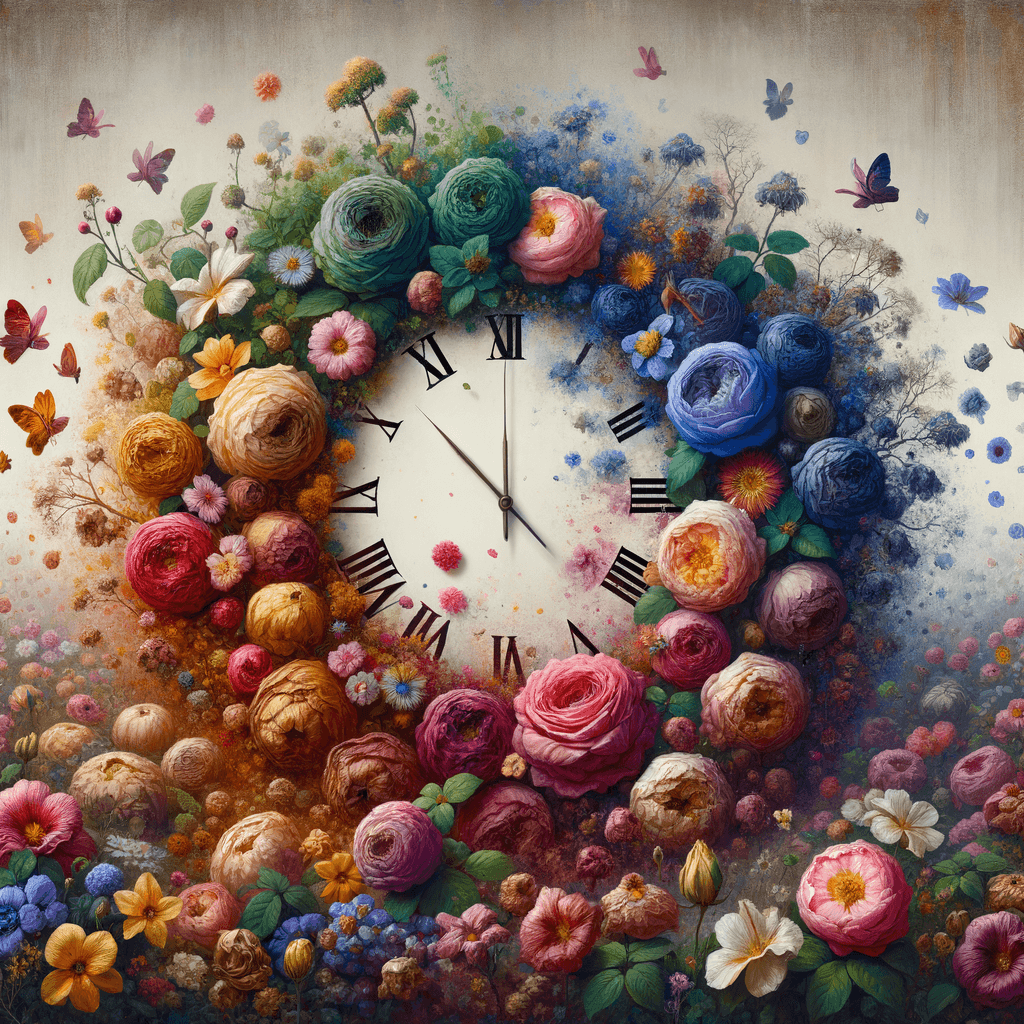
The withering of each flower is a gentle sigh from time.
—What lingers after this line?
Ephemerality of Life
This quote highlights the transient nature of life. Just as flowers wither and fade away, so too does time pass, reminding us of the fleeting moments of existence.
Nature’s Cycle
The withering of flowers is a natural part of their life cycle. This represents the ongoing cycles in nature, where endings are as essential as beginnings.
Time's Passage
The phrase 'a gentle sigh from time' evokes a sense of inevitability and serenity, indicating that the passage of time is continuous and unrelenting, yet often goes unnoticed in its subtlety.
Symbol of Beauty and Decay
Flowers are often symbols of beauty and life. Their withering signifies the impermanent nature of beauty and serves as a reminder that all things are subject to decay over time.
Philosophical Reflection
This quote can prompt deeper philosophical reflections on the nature of existence, urging individuals to appreciate the present moments and the ephemeral beauty in life.
One-minute reflection
What does this quote ask you to notice today?
Related Quotes
6 selectedTime flies like an arrow; the days and months pass swiftly like a shuttle.
Unknown
This quote emphasizes the rapid passage of time, drawing a comparison to an arrow in flight and a shuttle moving back and forth quickly. Both similes highlight the fleeting nature of time.
Read full interpretation →Every day is a little life.
Unknown
This quote highlights the idea that each day is a miniature version of life itself, valuable and to be cherished. By appreciating every single day, we can make the most out of our entire life.
Read full interpretation →If you can find someone who you can hold and close your eyes to the world with, then you're lucky. Even if it only lasts for a minute or a day. — Ernest Hemingway
Ernest Hemingway
At its heart, Hemingway’s line defines luck not as wealth or permanence, but as the discovery of a person who briefly makes the world fall away. To hold someone and close your eyes suggests more than romance; it evokes t...
Read full interpretation →We are such stuff as dreams are made on. — William Shakespeare
William Shakespeare
Shakespeare’s “We are such stuff as dreams are made on” comes from The Tempest (c. 1611), where Prospero reflects on how quickly spectacles—and lives—vanish.
Read full interpretation →Life is a dream, and dreams are merely dreams. - Calderón de la Barca
Calderón de la Barca
This quote prompts a philosophical reflection on the nature of reality and existence. It suggests that life, much like dreams, is ephemeral and perhaps illusory.
Read full interpretation →Prosperous times disperse like fragrant dust, while the flowing water is indifferent and the grass naturally returns in spring. - Du Mu
Du Mu
This quote highlights the fleeting nature of prosperous or successful periods in life. Just like fragrant dust, these times are enjoyable but ephemeral, and they will eventually disperse.
Read full interpretation →More From Author
More from Unknown →The language is the substrate. The architecture is the contract.
The line sets up a deliberate pairing: language lies beneath everything, while architecture governs everything above it. In other words, what you can express determines what you can build, and what you commit to structur...
Read full interpretation →A scroll is not a break; it is a trap disguised as rest. — Unknown
The quote begins by challenging a familiar story we tell ourselves: that a brief scroll is a harmless pause between tasks. On the surface, it looks like recovery—no effort, no decision, no commitment.
Read full interpretation →Don't let your ice cream melt while you're counting someone else's sprinkles. — Unknown
The quote uses ice cream as a simple stand-in for life’s fleeting pleasures: what you have is delicious, but it won’t last forever if you ignore it. Meanwhile, “counting someone else’s sprinkles” captures the habit of mo...
Read full interpretation →If your absence doesn't affect them, your presence never mattered. — Unknown
The quote frames absence as a revealing experiment: remove yourself, and the reaction—concern, curiosity, indifference—becomes a kind of data. If nothing changes when you’re gone, it suggests your role was never integrat...
Read full interpretation →